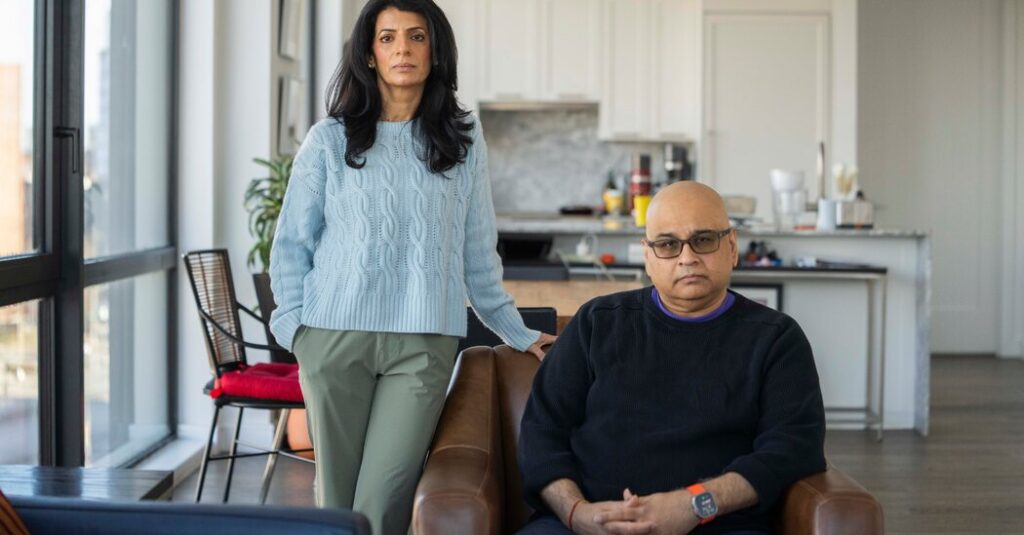
Shalini Babbar received an unexpected phone call on a Sunday morning in August 2024 from an employee at a residential home in upstate New York, where her 19-year-old autistic son was living.
The employee at the home, the Anderson Center for Autism, told Ms. Babbar that her son was being abused. The abuse had been going on for some time, she said she was told, and the employee had a video. Ms. Babbar panicked and begged the man for the footage.
The video, taken in June 2024, showed another employee gripping her son’s genitals and dragging him down a hallway from one room to another, in plain view of other staff members and residents. Her son could be heard screaming and calling for his mother, according to a lawsuit filed on Wednesday in the Southern District of New York.
According to the suit, after leaving Anderson, her son, who is identified in court documents as A.B., was diagnosed with post-traumatic stress disorder and hospitalized multiple times. His parents have said they have “paid considerable sums of money out of pocket” to care for A.B. since his time at the center and have accused Anderson of assault and battery, negligent supervision and discrimination on the basis of disability.
“His dignity was stolen,” Ms. Babbar said in an interview this week. “He was being physically and sexually abused and my whole world changed in an instant.”
Ms. Babbar said that she had immediately sent the video to her former husband, Anil Babbar, and that the two, who live in Queens, drove to pick up their son at the Anderson Center in Dutchess County. They also reported the abuse to the police.
The employee in the video, Garnet Collins, pleaded guilty in 2025 to endangering the welfare of an incompetent or physically disabled person for abusing A.B. and another resident and was sentenced to one to three years in prison.
A.B.’s parents filed the lawsuit against the Anderson Center, Mr. Collins and a manager at the home. They say in the suit that Anderson’s leadership was aware that Mr. Collins and other staff members “regularly used physical abuse to control A.B. and other Anderson residents because of the nature and severity of their disabilities.” In 2023, officials at the center were notified that another employee had struck A.B. in the eye with a broom handle, the suit said.
“The incident depicted in the video stands in direct opposition to our mission and values,” said John Eddy, an Anderson spokesman, “and we have zero tolerance for any behavior that compromises the safety or dignity of the people we serve.”
Reports of abuse at Anderson date back to at least 2003. That year, Jonathan Carey, a 9-year-old autistic boy, was sent to the home by his parents because they were worried they could no longer care for him. Jonathan began losing weight at Anderson and his parents eventually learned that staff members were punishing him by withholding food and secluding him in his room for extended periods of time. (The boy’s parents settled a lawsuit with Anderson in 2010.)
Jonathan’s parents later enrolled him in the since-shuttered Oswald D. Heck Developmental Center, a state-run institution, where he died of asphyxiation after being restrained by an employee in the back seat of a van. His killing led to the passing of a law in 2007 that required the state to disclose episodes of abuse to guardians, including parents or spouses, within 10 working days.
But a report from the state comptroller in 2019 found that processes to ensure facilities were complying with the law had not been effectively implemented. A follow-up in 2021 found that New York had made “limited progress.” (Anderson was not part of either review.)
Anderson celebrated its 100th anniversary in 2024. In June, the state gave the center, based on a 100-acre campus in the town of Staatsburg, $3 million to address a work force shortage and improve residents’ quality of life.
But shortly after A.B. arrived at the home in May, his parents said, they began noticing that he had lost weight. They also saw bruises on A.B.’s body during visits and he seemed to have poor hygiene.
However, his parents said, they were never told about the abuse he was enduring.
The family’s lawyer, Ilann Maazel, said A.B.’s experience was “some of the most appalling abuse I’ve seen in over 25 years of practice.” Mr. Maazel also represented Jonathan’s family.
The employee who sent the video to A.B.’s parents, Emmerson Phiri, filed a separate federal lawsuit in July, saying he told supervisors about the abuse he saw at the center. The supervisors retaliated, he said, “subjecting him to baseless disciplinary action, confiscating his apartment keys, threatening his immigration status and ultimately terminating him.” Mr. Phiri is from Malawi.
“Our case raises grave concerns about the treatment of profoundly vulnerable individuals and the retaliation faced by Emmerson,” said Thomas Henry Andrykovitz, Mr. Phiri’s lawyer.
Before he sent the video, Mr. Phiri said he was told that he had been placed on administrative leave. He claimed he met with the police, despite warnings not to, on Aug. 19, 2024. He was fired from Anderson the next day and was told to immediately leave the United States before the end of the month, according to the suit.
The abuse of developmentally disabled people extends beyond the Anderson Center, Mr. Babbar said in an interview this week. He and Ms. Babbar have spoken to families with similar concerns, he said, but who often lack evidence. He called the care network for autistic people a “criminal ecosystem against the vulnerable population.”
“But for the whistle-blower’s video of my son, my son may be dead today,” Mr. Babbar said.
Kitty Bennett contributed research.
Hurubie Meko is a Times reporter covering criminal justice in New York, with a focus on the Manhattan district attorney’s office and state courts.
The post Parents of Autistic Teen Sue Residential Home Over Abuse by Employee appeared first on New York Times.