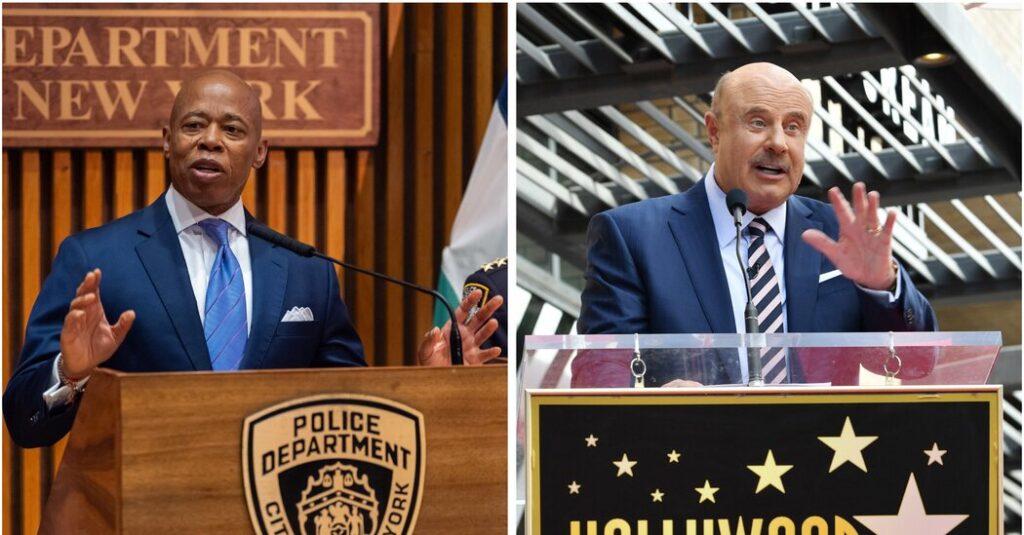
In the last year of Eric Adams’s tenure as mayor, New York City police officials would occasionally arrive at crime scenes and, to their great surprise, would find a camera crew shooting footage behind the yellow caution tape.
The crew was filming a reality show, “Behind the Badge,” which was greenlit by the mayor and was hosted by the celebrity psychologist Dr. Phil.
“Behind the Badge” was produced by Dr. Phil’s son, Jordan McGraw, and featured top administration officials, including the deputy mayor for public safety, Kaz Daughtry, a close associate of Mr. Adams. It was meant to highlight the New York Police Department’s work through as many as 17 episodes a year.
But on Wednesday, the city’s Law Department, now overseen by Mr. Adams’s successor, Zohran Mamdani, moved to pull the plug on the show. The city sued Mr. McGraw and his production company, McGraw Media, accusing them of shopping around “extremely problematic” unauthorized episodes of the show that could endanger crime victims, witnesses and undercover officers by revealing their identities and by making public the discussion of “sensitive police operations.”
The lawsuit accuses Mr. McGraw of breach of contract and says the city sought to veto the footage to which it objected, but that the company ignored the feedback and was still looking to sell the show.
The suit also accuses McGraw Media and Mr. McGraw of trademark infringement and dilution by tarnishment, which effectively means diminishing the Police Department’s brand. It asks a judge to bar McGraw Media from selling or distributing the footage and for damages to be determined at trial. It says that McGraw Media “indicated to the city that it is looking for a buyer” that would run the episodes this year.
Were it to run, “Behind the Badge” might stand as one of the more unusual artifacts of the freewheeling Adams years.
The show was created in April 2025 at the height of the administration’s tumult. The formal contract for the show was signed the day after a judge dismissed a federal corruption indictment against Mr. Adams, whose chances at re-election were dwindling.
That month, Mr. Daughtry was interviewed at length by Dr. Phil, who is no longer a licensed psychologist and whose full name is Phillip C. McGraw, during an operation in which police officers and federal agents coordinated the arrest of 27 accused gang members.
Federal officials said then they were displeased by the presence of the celebrity psychologist and a cameraman during the operation, but they were welcomed by Mr. Daughtry.
Along with Mr. Daughtry, the show featured a top police official, Chief of Department John Chell. Both retired from the department toward the end of the Adams administration.
They were among the show’s 10 to 12 primary subjects, according to a Dr. Phil spokesman, Jerry Sharell, who answered questions about the show in June 2025. “Behind the Badge” was in production, Mr. Sharell said then, and “any and all of the force can be featured depending on what happens.”
“Participation is of course voluntary,” he added.
Two people familiar with the contract said that the unorthodox arrangement between the city and McGraw Media was made at the direction of Mr. Adams. The mayor had requested that sole creative control sit with City Hall, one of the people said, and by going forward with the project, acted against the wishes of the police commissioner, Jessica S. Tisch.
One person familiar with the contract said that Mr. Daughtry was involved in identifying service members to participate in the filming, as well as times and locations. Despite having no direct authority over individual service members, he purported to direct police personnel and resources while the cameras were rolling.
Mr. Daughtry declined to comment, and a spokesman for Mr. McGraw and Dr. Phil had no immediate comment.
Though Mr. McGraw signed the contract, early footage that appears to be part of the show featured his father, Dr. Phil, and was published on a YouTube channel associated with Dr. Phil’s production company, MeritTV. That company filed for bankruptcy in July.
The contract between the city and McGraw Media gave the city the power to veto any content in the episodes that it disapproved of, the lawsuit says. But when the city warned that four episodes it screened were “extremely problematic,” McGraw Media ignored the concerns and indicated that it “intended to publish the material that the City flagged for removal.”
That material, the lawsuit says, was sensitive. It included “footage capturing an N.Y.P.D. officer inputting the security code to the back door entrance to a precinct station.”
“Encrypted police communications are discussed,” the suit continues. “Sensitive and confidential policing techniques are discussed at length.”
According to the contract between City Hall and McGraw Media, the parties had to decide on Dec. 31 whether to move forward with the series, or terminate the deal. After conferring with the incoming Mamdani administration, the city sought to withdraw from the contract. A person with knowledge of the deal said that McGraw Media never responded.
It is unclear how McGraw Media reacted, but according to the lawsuit, the company has “failed to provide the city with rough cuts of most episodes” and has instead indicated that “they intend to transfer the assets to a third party for their own enrichment.”
Whatever comes of the litigation, Mr. McGraw was able to monetize his access to City Hall in other ways.
In August and September of last year, Mr. Adams’s campaign paid another company associated with Mr. McGraw $500,000 for what the former mayor’s team described as campaign and digital consulting. The payment was first reported by WNBC.
Sally Goldenberg is a Times reporter covering New York City politics and government.
The post N.Y.C. Sues to Block Adams-Approved Police Reality Show With Dr. Phil appeared first on New York Times.