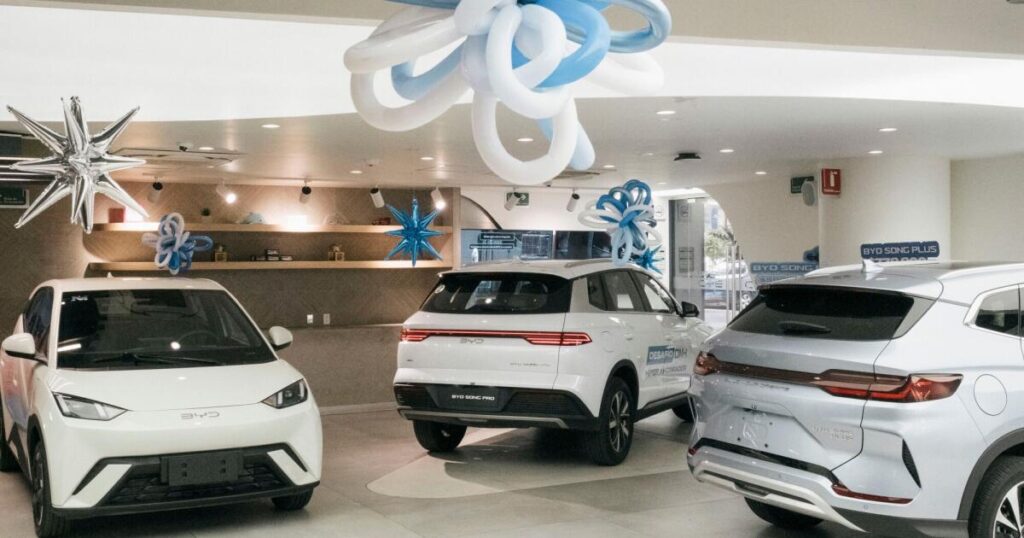
Chinese car brands’ inroads in Mexico have unnerved Washington, rattled established automakers and alarmed the Mexican government, which is throwing up trade barriers.
But even in the face of new tariffs, China-made cars face little competition in the country’s growing market for electric vehicles. Cheap prices, government subsidies and a growing charging network all point to continued sales growth for China’s automakers in the country.
Mexico City is abuzz with cheap, battery-powered compacts made by the likes of China’s BYD Co. The world’s largest EV maker nearly doubled its Mexican sales volume last year and now accounts for about seven of every 10 electric and plug-in hybrid vehicles sold there, according to estimates from BloombergNEF.
EVs or plug-ins account for 9% of new-car sales, making it a growing segment in Mexico that many other global brands have bypassed. It’s a sign of how Chinese automakers see opportunity in developing economies with infrastructure challenges, fragmented distribution and lower income levels.
Middle-class city-dwellers are lured by these EVs’ affordability. Mexico City-resident Mónica Reyes Rosas, a 49-year-old voiceover agent, is one of them. She drove a gas-powered Ford Ranger each day for the better part of six years, until she made the switch last month to a BYD King plug-in hybrid sedan that cost her 463,000 pesos ($26,307). “You save a lot on gasoline and the price is extremely competitive,” Reyes said.
BYD’s Dolphin Mini EV, its most popular model, sells for about $2,000 less than its nearest competitor, the battery-powered Chevrolet Spark EUV, which was introduced to the market just over six months ago.
The swift incursion of Chinese cars has taken Mexico by surprise, leading to concerns by legacy carmakers with manufacturing operations in Mexico and pressure from the U.S. government. As part of a wider effort to address growing dependence on China, in September President Claudia Sheinbaum proposed tariffs as high as 50% on some products from countries that don’t have free trade deals with Mexico, which included Chinese auto imports.
The tariffs were approved by lawmakers in December and went into effect Jan. 1. But it’s unclear how much impact they’ll have.
David González, a BYD sales attendant in Mexico City, told Bloomberg that BYD offered year-end discounts to sell more units ahead of the enactment of the new tariffs. Even so, he didn’t expect a major dent to sales because he reckoned BYD wouldn’t raise prices by more than 15,000 pesos each, instead absorbing any additional cost. BYD’s local representatives didn’t reply to a request for comment.
Roberto Rocha, the co-founder and chief executive officer of Vemo, an EV taxi and charging company that’s partnered with Uber Technologies Inc. in Mexico, reckoned Chinese carmakers like BYD and Anhui Jianghuai Automobile Group Corp., or JAC Group, that comprise the majority of Vemo’s taxi fleet, can remain competitive at 50% tariffs. “We believe the big players are going to continue betting on the market and they’re going to have to absorb some of those increases,’’ he said.
Some analysts say tariffs are unlikely to change the fundamental demand and supply dynamics in Mexico.
“Non-Chinese manufacturers have invested very little in bringing these technologies to Mexico,” said Eugenio Grandio, president of the country’s electromobility association, EMA, and a former Tesla Inc. executive. “They say there’s no demand, and then they complain that the Chinese are selling them. So is there demand, or isn’t there?”
Sales of Chinese-made gas-powered cars have also surged, allowing China to take a 20% share of the total new-car market in 2025, according to data from the Mexico auto dealers’ association, AMDA, up dramatically from five years ago.
China is able to keep costs low due to mass production volumes, which has led to overcapacity in its home market. Its carmakers also benefit from Chinese government subsidies and Beijing’s push for export expansion, said Matías Gómez Leautaud, Eurasia Group lead analyst for Mexico.
As a result, BYD, for example, offers “significantly more accessible prices than its American, European, or Japanese competitors, which has been well-received in a price-sensitive market like Mexico,’’ he said. “The main obstacle to the expansion of Chinese automakers in Mexico is not strictly cost-related, but political.’’
Mach E Premium
General Motors Co. manufactures a trio of EVs in Mexico — not including its Chinese-made Spark EUV model — but sold a total of only 1,540 last year, data from the national statistics bureau Inegi shows. Ford Motor Co., which produces the all-electric Mustang Mach E in the country, sells that model locally — but only at a $10,000 premium over the US sticker. Nissan Motor Co. gave up on marketing its Leaf compact EV three years ago.
Even Tesla sold less than 4,000 cars in Mexico in 2024, according to BloombergNEF’s most recent estimate, which was about one-quarter of BYD’s estimated volume for fully electric vehicles that year.
BYD models can be seen zipping around affluent neighborhoods in Mexico City such as Condesa and Polanco, with new dealerships sprouting up in business districts and posterboards advertising China’s top EV brand displayed prominently in Mexico City’s international airport.
For major American and Japanese carmakers, the Mexican EV market is too small and immature to justify making a major push at a time when global demand is softening. They’re mostly content to offer gasoline or hybrid gas-electric models that make up the bulk of Mexico’s sales.
That’s opened up a lane for Chinese brands like BYD, Chery Automobile Co., and Great Wall Motor Co. that specialize in battery-electrics. In 2021, fewer than 500 Chinese EVs and plug-in hybrids were imported into Mexico. But by 2025, the number had already surged to nearly 100,000, according to Bloomberg analysis of customs data compiled by Big Trade Data. BYD is leading the charge, accounting for more than 80% of the total.
Teresa Amador, a tourism guide, traveled to a BYD showroom in Mexico City from her home in the central state of Hidalgo the weekend before Christmas to check out the inventory on behalf of her 69-year-old mother. The family’s home is located on a rural ranch, but she said her mother was impressed by BYD vehicles’ reputation for both technology and speed. “My mom is no fool, she did her research,” said Amador.
Loans and Incentives
Low-interest rate financing deals may help blunt the impact of tariffs. In the first 10 months of 2025, almost 63% of Chinese cars sold in Mexico — both electric and gasoline-powered — were bought with loans, up from 56% the same period the previous year, according to a December report from Mexico’s auto association AMDA, market researcher JATO Dynamics and Urban Science. That compares with 61% of all new car purchases.
BYD offers car loans through banks with interest rates as low as 7.9%, according to a BYD statement in August, whereas the market average for new car loans is between 13% and 14%. BYD sales attendant González told Bloomberg that BYD offers loans from BBVA and Banorte between about 8.5% and 12.9%.
Chinese brands can also benefit from Mexican government incentives earmarked for EVs.
Battery electrics and plug-in hybrids are exempt from a federal tax at the time of purchase, and they receive a deduction in the income tax known as ISR. Some states in Mexico have waived annual fees on EVs and hybrids, and they are spared expensive emissions tests.
When air quality is poor in Mexico City and certain other metropolitan zones, EVs and plug-in hybrids are allowed on the road at all times, whereas other vehicles can only be driven on certain days. And under a program known as “Plan Mexico,’’ electric and plug-in hybrid cars bought between 2025 and 2030 will receive an immediate tax deduction of as much as 86% of their value.
In addition, Mexico’s government is helping to spur EV adoption with incentives to promote charging infrastructure investment. These include a tax credit for public charging station installations equivalent to 30% of the amount invested. And the state utility, CFE, offers a program that allows the installation of a dedicated meter for vehicle charging, granting access to a commercial rate.
BYD plans to bring its charging technology to Mexico starting from April, Stella Li, the president of BYD Americas, said late last year. Its so-called flash charging is competitive with gas refueling, offering about 250 miles of range for a five-minute charge.
“If you go to any city in Mexico, you can see that BYD is the darling,” Li said at a news conference in Zhengzhou, China, with Mexican journalists in November, comparing the popularity of her company’s dealerships with Apple stores. “Every time we have a weekend event, it’s full of people. They dream about their own BYD car.”
Stillman writes for Bloomberg.
The post Cheap Chinese EVs are suddenly everywhere in Mexico appeared first on Los Angeles Times.


