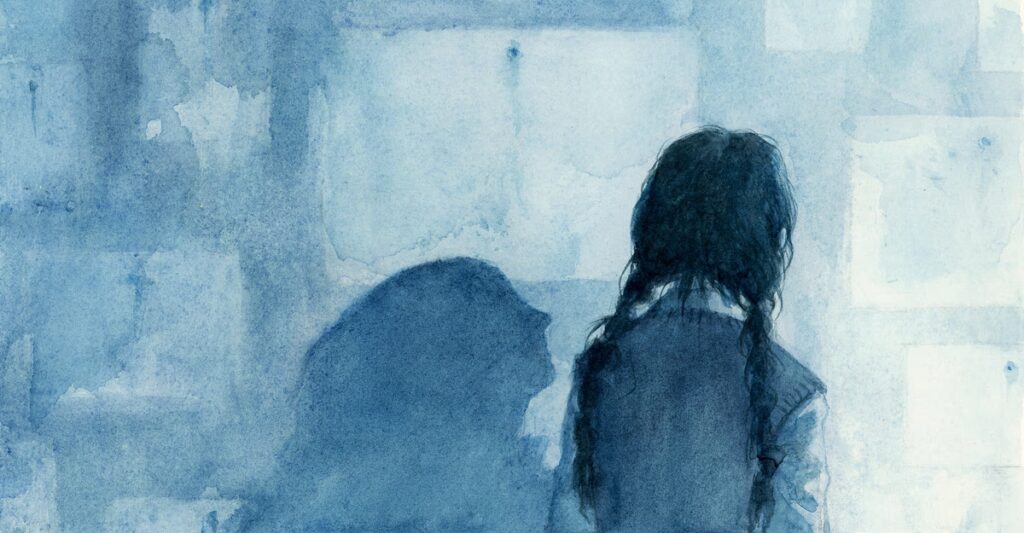
A Russian proverb I heard growing up translates to something like “Those who recall the past will lose an eye.” Dwelling on bygone events, it suggests, is dangerous. My family of post-Soviet refugees seemed to believe it, and mostly passed down their history in loose, cinematic anecdotes. I’d piece together what their lives were like before we immigrated to Los Angeles from images of barbed-wire obstacle courses, ransacked apartments, and sudden deaths. Lore was rarely presented in a matter-of-fact way—so when I was 11, and my grandmother told me plainly that her father had died of a heart attack, I grew suspicious. When I confronted my mother about the story, she admitted what she knew of the truth: My great-grandfather had actually been declared an enemy of the state and abducted by the KGB, never to be seen again.
My grandmother, to whom I was very close, had lied to me, forcing me to strong-arm my way into our family’s history. Many of my immigrant friends remember similar fabrications about their relatives’ lives, ostensibly made up to protect them. None feel that they were better for it. This kind of concealment is common among refugee families: There’s no foolproof roadmap for determining when and how to disclose traumatic events, especially to children, and for many who leave their home country, keeping the past in the past can feel like a way of safeguarding the future. But the secrecy of a parent or grandparent can inflict its own potent wounds.
Such is the case in Quiara Alegría Hudes’s wrenching and mordant debut novel, The White Hot, in which 26-year-old April Soto hits her breaking point and walks out on her 10-year-old daughter, Noelle. The novel mostly takes the form of a letter that April sends Noelle years later, to be read on her 18th birthday. This fiery and self-mythologizing document serves as an explanation—but not an apology—for leaving, and it describes a painful journey toward understanding herself. April, whose grandmother kept her in the dark about her family’s history, is trying to fill it in for her daughter. Secrecy, April explains, is “an insidious form of care—applying a bandage to hide rather than heal.”
[Dear Therapist: I inherited unwanted family secrets]
Excavating bygone times is not a tender process, though. April’s letter is honest about what, and who, pushed her to abandon her child, and she does not spare Noelle, who she believes is now capable of handling the truth. The inciting moment, April explains, was Noelle’s fourth-grade school art show. April narrates the scene: Her daughter has, in her artwork, depicted the family’s Philadelphia row home, where four generations of Soto women live practically on top of one another. She draws April as a faceless figure who wears noise-canceling headphones and frequently locks herself in the bathroom. After the school viewing, Noelle avoids eye contact with her mother, which April interprets as a provocation. Humiliated and hurt by the implication that she’s a negligent mother, April projects all her shame onto the child’s small gesture. “I knew I’d received your artwork as intended,” she writes to her now-grown child.
Later that day, the school principal calls April to report that Noelle has attacked an older student with her graphing calculator. It seems that Noelle has inherited her mother’s bouts of blinding rage—the titular “white hot,” which April describes as “not just a wrecking ball but my dance partner and confidante, the only companion I had.” The principal gives her an ultimatum: Either mother and daughter attend free anger-management classes, or Noelle will be expelled.
The choice seems simple, but April, who fears that neutralizing her fury will leave her unable to “taste life,” can’t abide it. The gentleness with which the principal recommends it makes April doubly suspicious (“his fucking kindness, all over me like a bad sweat”). She is allergic to anything that could suggest she resembles a victim. This is one of many places where Hudes, who is also a playwright and wrote the book for the musical In the Heights, showcases her skill at psychological excavation. Far from a remorseless monster, April is a charismatic and deeply lonely woman. She’s haunted by constant reminders that she knows next to nothing of her family’s experiences before she was born; interrogations of her saint-like grandmother, Abuela Omara, go nowhere. April concludes that something terrible must have driven Abuela from Puerto Rico, but in their most candid conversation, Abuela says only, “I am a person without memories,” and “it’s best to be a tomorrow soul. To move on.” April disagrees, lamenting, “I have no history because of this.” That April’s own disappearance will end up cutting Noelle off from her history barely crosses her radar.
The limited history April does have centers on a single memory: When she was young, she witnessed her father beating her mother unconscious with a loose floorboard. Her grandmother immediately repaired the floor and never again acknowledged that her daughter was nearly beaten to death in their home. April, we learn, grew up in close quarters with emotionally distant people. Now, she tells Noelle, she believes that—nonsensical as it sounds—leaving can be a form of love.
[Read: The questions we don’t ask our families but should]
So, after the art show, when it was all too much, April yanked off her headphones and walked out the door. Readers observe as she boards a Greyhound bus to Pittsburgh; camps with no gear in rural, rugged Ohiopyle State Park; and briefly takes up with a young widower, Kamal. He introduces April to the music of Jimi Hendrix (“Had I not left home, Noelle, I might’ve never heard it”) and helps her see that her body can be a source of not just pain but also pleasure. At 26, April experiences the adolescence she never had, a girlhood she prays Noelle will experience, despite knowing that her abandonment will likely extinguish that possibility. Believing that attaining one’s freedom is “a brutal assignment with many punishments,” April sees the agony of her choices as a necessity. But even at 34, after almost a decade of chasing her authentic self, her letter makes clear that she is so fractured by her family’s secrecy that she still struggles to see herself clearly.
April’s reaction to the mysteries of her family’s past might look extreme, but in Hudes’s rendering, it makes sense. Stories about our elders’ experiences can be crucial to how we form our identities. Ironically, the novel suggests, being raised in an atmosphere of intractable silence has likely inflicted greater damage on April than anything her family could have revealed. The White Hot makes clear that love without honesty is corrosive. For those who have fled their home for harrowing reasons they may struggle to share with their children—and for many others who have been separated from their families and their children in the process—this is a timely revelation. Hudes knows that there is more than one way to leave a child: Emotional abandonment may be less visible than physical separation, but she suggests that it can also have lifelong ramifications.
That April loves Noelle isn’t in question; that she leaves her anyway is gutting. She believes that Noelle will be better off without her, though she can plainly tell that her daughter is heartbroken and terrified. So is April, in her way. She movingly considers the minor details of how her child will fare without her. Imagining whether Noelle will one day have a quinceañera, she wonders, “Would your cheeks shine with glitter? Who would braid your hair?”
[Read: The movie that understands the secret shame of motherhood]
We never learn what happens to several characters I’d grown to care about after April leaves, but it makes sense that a novel about a woman brutally excising herself from her family does not provide neat closure. Even if Noelle—and the reader—got all the answers, the vivid scar of April’s abandonment would remain.
“Do not absolve me, do not forgive me, only hear me, consider my story,” April asks Noelle near the letter’s conclusion. Her vanishing and its long-delayed explanation are attempts to disband the “army of broomed ancestors” that “stood at their backs, sweeping tears under rugs.” Brief, stirring sections from Noelle’s point of view bookend the novel, inviting us to decide whether April’s plan succeeded. These glimpses into the woman Noelle has become are refreshing and poignant. When she asserts, “A mother is a life sentence, after all,” I heard April’s voice—as well as her love of over-the-top metaphors—and was touched by the similarity in how mother and daughter think, after all these years apart.
The post When Family Secrets Create New Wounds appeared first on The Atlantic.