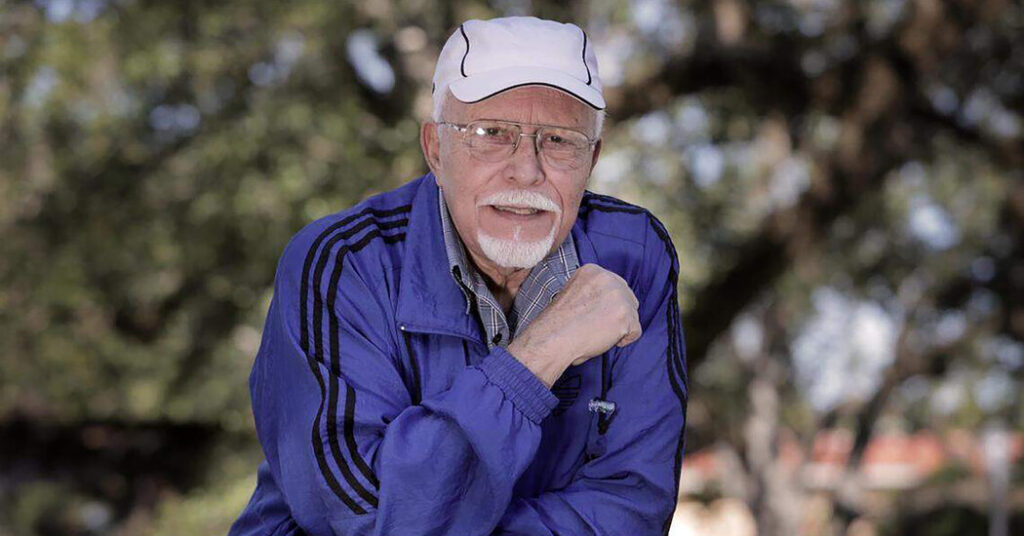
Manolo Villaverde, a Cuban émigré who had a central role on “¿Qué Pasa, U.S.A.?” — believed to be the first bilingual sitcom in the United States — about a Cuban American family in Miami’s Little Havana neighborhood, died on Jan. 10 in Daytona Beach, Fla. He was 89.
Mr. Villaverde collapsed in the driveway of his home and could not be revived by paramedics, Jose Bahamonde, executive producer of the series, said in confirming the death.
“¿Qué Pasa U.S.A.?” debuted in 1976 and ran until 1980, initially on WPBT, a public television station in Miami, and later on many other public stations around the country.
Mr. Villaverde played Pepe Peña, a construction worker from Cuba who lives with his wife, a factory worker; his in-laws, who don’t speak English; and his two thoroughly assimilated children.
“He was the father figure that we were used to,” Mr. Bahamonde said in an interview. “Firm, but soft at the same time; the breadwinner; a traditional guy who was open to a new way of life he had to conquer.”
Alexander Keneas, a critic for Newsday, praised Mr. Villaverde as “especially good, an operatic, hot-tempered, macho caricature of a Latin male.” In The New York Times, John J. O’Connor wrote that the “acting can be outrageously broad in the style of Latin novelas or soap operas. But the result can be enormously engaging.”
After Mr. Villaverde’s death, the journalist Carlos Frias wrote on his website that “there is a little bit of Pepe Peña in all of us.”
“¿Qué Pasa U.S.A.?” was funded by grants from the Department of Health, Education and Welfare (now Health and Human Services) as part of a program that aimed to create ethnic television shows for children and adults.
“The first and second year, we were 60 percent Spanish and 40 percent English,” Mr. Bahamonde said. “But when we went national, we flipped it so we could have a wider audience.”
The show won six local Emmy Awards in the Miami market in 1978, including three for acting: for Mr. Villaverde; Luis Oquendo, who played his father; and Ana Margarita Martínez Casado, who played his wife.
Manuel Villaverde was born on Aug. 11, 1936, in Havana, the son of Manuel and Gloria Villaverde. His father was a tailor.
The younger Mr. Villaverde left Cuba for New York City in the 1950s and served in the U.S. merchant marine before returning to his homeland in 1958 to work as an actor in Cuban television, including playing the romantic lead in a weekly TV series.
He opposed Fidel Castro but remained in the country after Castro’s takeover and was arrested and jailed at one point — most likely, according to his friend and executor, Carlos Poce, for his participation in Operation Pedro Pan, a clandestine program that flew more than 14,000 unaccompanied Cuban children to the United States from 1960 to 1962. Mr. Villaverde delivered approved documents to the children’s parents, said Mr. Poce, who was one of the children sent abroad.
Mr. Villaverde fled Cuba in 1964, traveling first to Mexico and then to the United States.
In Florida, he worked as an interior designer and tour guide while acting occasionally in theaters in Miami, in works like “40 Quilates” (a Spanish translation of the Broadway hit “Forty Carats”), “No, No, Por Favor,” “La Magia de la Felicidad” and Neil Simon’s comedy “Chapter Two,” in translation rendered as “Capitulo Dos.” Mr. Bahamonde cast him in “¿Qué Pasa, U.S.A.?” after seeing him in a Spanish-language version of Tennessee Williams’s play “The Rose Tattoo.”
After the 39-episode run of “Qué Pasa, U.S.A.?” Mr. Villaverde collaborated with Mr. Bahamonde again on “Cuando Renace el Amor,” or “To Love Again,” a 1984 mini-series, and on “Qué Casa Mi Casa!,” a short-lived, bilingual sitcom in the style of “I Love Lucy,” in 1985.
In 1990, in the final season of the crime drama “Wiseguy,” he portrayed the father of the lead character, played by Steven Bauer — who, when he was known as Rocky Echevarría, had played Mr. Villaverde’s son on “¿Qué Pasa, U.S.A.?”
In the 1990s, Mr. Villaverde played a grandfather on “Gullah Gullah Island,” a Nickelodeon series set in the South Carolina Sea Islands, and the husband of a scheming matriarch in a rich Cuban American family in “Guadalupe,” a Spanish-language soap opera.
He portrayed a grandfather in “Taina,” also on Nickelodeon, about a teenage girl in a Puerto Rican family who is studying singing and acting. It ran from 2001-02.
For many years, Mr. Villaverde was also a landscape painter. He is survived by his brother, Oscar.
Mr. Villaverde said that his role as Pepe Peña had resonated with fans.
“People identify with him,” he told El Nuevo Herald in 2019. “Everyone relates to the grumpy father who can also be very tender and understanding.”
He recalled that one of a dying boy’s last wishes was to talk to him.
“That,” he said, “changed my life.”
Richard Sandomir, an obituaries reporter, has been writing for The Times for more than three decades.
The post Manolo Villaverde, Tender Father on Bilingual TV Show, Dies at 89 appeared first on New York Times.