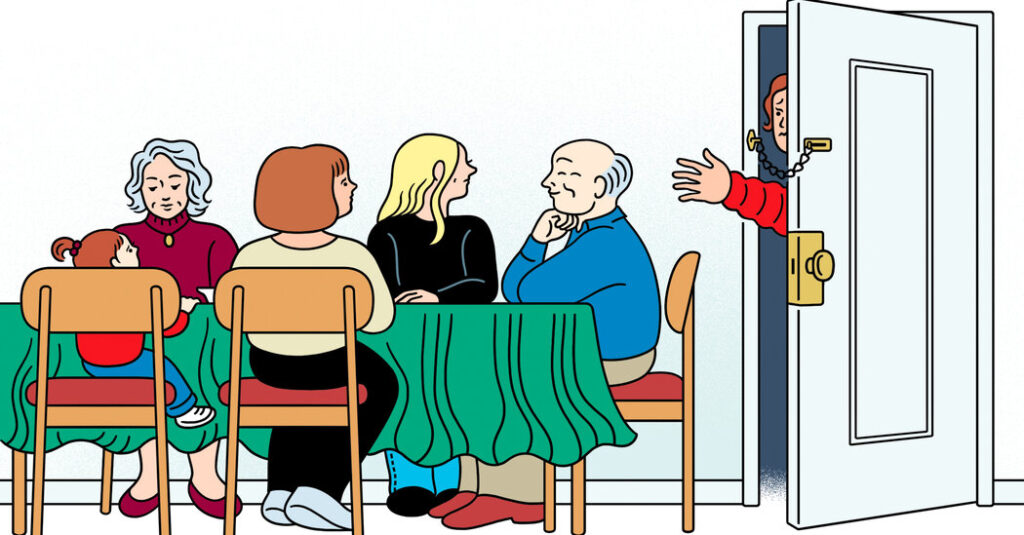
I’m part of a large extended family that has occasional reunions, usually organized around a birthday or anniversary. There are email lists that grow and shift and merge; siblings and cousins span the country. When plans began for our latest event, an agreement was reached to delete a particular woman from all invitations. This family member is brilliant but troubled and has become estranged from many people in her life, including her daughter. Because her daughter missed the last reunion, the family felt in all fairness that she should be included in this reunion, and that her mother should not.
Of course, the mother got wind of it. She is furious, bitter and threatening suicide. No one is up for trying to “fix” her. But my question is: What are the ethics of family gatherings? Is it wrong to exclude one (or more) members who would bring pain and anguish rather than joy? — Name Withheld
From the Ethicist:
People are invited to these gatherings because they’re family, not because they’re charming. But though boundaries are elastic, they’re not infinitely so, and conduct can override kinship. Inclusion is a value to be given serious weight here; it doesn’t trump everything else. What you’ve learned, though, is that there’s no keeping this person out of the loop. It’s a big extended family; people have social media accounts. And your family members shouldn’t have to be preoccupied with secrecy anyway. The news will get out, and learning that she wasn’t only excluded but kept in the dark about it will just compound the pain. As it evidently has.
What would make more sense is for someone in the family — you? — to tell her directly why she hasn’t been invited, while being very clear that it isn’t a negotiation. The message might be that she isn’t invited because she behaved badly in the past, or because her daughter needs space from her, or whatever the relevant circumstances are. I understand the temptation to avoid a conversation like that. But being up front leaves open the possibility of repair in the future and avoids the scenario you’re dealing with right now.
A Bonus Question
Recently I went through a rather bumpy breakup of my first queer relationship. It ended badly, and I would be perfectly content to never have contact with my ex-girlfriend again, except I know via social media and mutual friends that she is marketing herself as a counselor on consent and sexual positivity.
This is disturbing to me because during our relationship she took advantage of my lack of experience, often when we had been drinking. She was very much into kink (I am not), and I was left with bruises and confusion on more than one occasion. She would apologize afterward for causing any mental or physical pain, citing her rule that she should never “play while under the influence,” but it happened multiple times.
I’ve since moved on from this relationship, and I’m glad she’s not in my life. But am I under any ethical obligation to warn people (who would be paying her for these counseling sessions) that she’s not practicing what she preaches? I don’t want to be perceived as a bitter ex with a grudge, but I truly am disturbed that this person is selling herself as an authority on the subject of consent. — Name Withheld
From the Ethicist:
What you describe is disturbingly at odds with the image of a consent counselor. Still, there are limits on what you can responsibly do with what you know. You’re describing conduct that took place in an intimate relationship. What you’re not well positioned to do is assess how she behaves with clients, and her morning-after conversations don’t indicate that she lacks an intellectual grasp of the relevant concepts, despite her failure to practice them.
Nor do we think that potential clients, as a rule, have a right to know about private behavior that contradicts someone’s professional image. In less fraught contexts, we all know about the gap that can yawn between how people act in their professional and private lives, whether it’s the financial adviser who talks up balanced portfolios but makes reckless bets on her own Robinhood account or the driving instructor who drag races at night. We don’t assume that a former partner is obliged to inform clients about these vices.
Your situation feels very different from these cases. You believe that you’ve been seriously wronged by this person. It remains the case that how people behave in personal relationships is a poor predictor of how they’ll behave in professional ones. What you went through sounds painful and disorienting; your dismay is understandable. But exposing her private conduct in order to discredit her professional work isn’t the appropriate remedy. I’d let her professional claims stand or fall on her actual conduct with clients, and give yourself the freedom to keep severed ties severed.
Readers Respond
The previous question was from a reader who was struggling with whether to tell his son he didn’t think he should marry his fiancée. He wrote:
My son and I had a conversation a while back in which he laid out to me why he was breaking off a relationship that he had hoped would lead to marriage. His explanation was thoughtful, articulate and intelligent. He never severed the relationship, however, and some months after that conversation, he announced that he and the woman were engaged. For background, my son was previously engaged for a period of time, and that breakup, though mutual, hurt him deeply. He is in his late 30s and feels pressure to be married and start a family. My experience tells me that he is making a poor decision in going through with this engagement and that he will pay for it. As a father who has tried to intimate but not directly address my deep concerns, I am at a loss for what to do. — Name Withheld
In his response, the Ethicist noted:
Your son once gave you a cogent account of why he shouldn’t marry the woman who then became his fiancée. You think he was right then and is wrong now. Fair enough. Parents may see patterns in their children’s lives that the children, being in the thick of it, do not. … And helping those we care for to see their situation clearly is one of the duties of loving relationships, including familial ones. But it needs to be done with kindness and humility. You should be able to talk through your worries in a way that doesn’t sound as if you consider the case closed. … You should then listen carefully; don’t be too sure that you have a better grasp of the situation than he does. … But it’s his life, so either way I hope you make it plain that you’ll support any choices he finally makes and that, if he goes ahead with his plans, you’ll welcome his wife to the family.
(Reread the full question and answer here.)
⬥
I agree that it’s “better to probe than to proclaim,” if you must say something. As parents, we tend to worry about the pieces we’ll be left to pick up when our child is emotionally hurt. I wonder if the letter writer, having witnessed his child being hurt once before, is anxious about picking up the pieces once again. But preventing our children from being hurt is almost impossible. Better to steady yourself as a parent, forget trying to stop your adult child from making “poor decisions” and instead just be there for them. — Mel
⬥
As someone who was engaged but did not really want to get married, whenever I made a cry for help, I was overwhelmingly drowned out in positivity and optimism. Engagement is a conveyor belt of well-wishes. Societal pressure to get married is much more intense than many people realize, and this young man obviously confessed to his father as a cry for help. I hope his father steps in and prevents him from making a legally binding and potentially life-altering mistake, especially before any children are born. Also, is anyone thinking of this poor bride-to-be? Doesn’t she deserve to know she’s marrying a man who wanted to leave her shortly before becoming engaged? — Kelley
⬥
As a psychotherapist who has seen many iterations of this issue, my basic conclusion is that you aren’t going to alter the path of your child’s romantic journey, especially at the point in the relationship when they are planning to marry. By weighing in, you risk contaminating your future relationship with your son and daughter-in-law. Have trust enough in your son’s judgment to stay silent for now, and preserve your status as an objective observer for when your son may come to you for advice. — Russell
⬥
Telling your son he is making the wrong choice in marriage? Oh, my word — keep your lips sealed. There is a certain arrogance we have, as parents, that makes us think we know what we don’t. My daughter married “the useless boyfriend,” as I called him to friends more than two decades ago, and now he is a wonderful husband and a superb father. Thank heavens I kept my mouth shut. — Charlene
⬥
The combination of kindness and humility that the Ethicist recommends is exactly right. I would add that failing to raise the question now and resolve it could lead to something truly corrosive: an unspoken resistance to your child’s spouse that breeds insecurity and resentment in them for years. For the love of your child’s spouse, avoid that if you can. — Kevin
The post Was It Wrong to Exclude One Person From Our Family Reunion? appeared first on New York Times.