President Donald Trump’s border czar gave an incoherent legal “justification” for why ICE agents stormed a home and dragged a U.S. citizen and grandfather half-naked out into the snow.
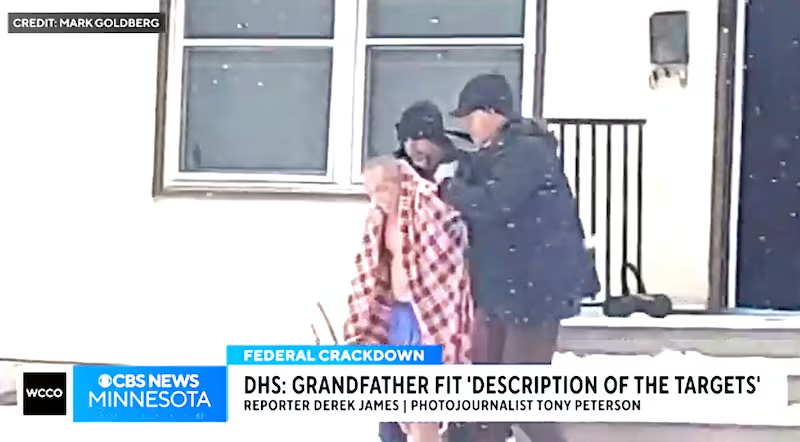
The Department of Homeland Security has faced renewed criticism after immigration agents forced their way into a family home in St. Paul, Minnesota, on Sunday and hauled out 56-year-old ChongLy “Scott” Thao at gunpoint while he pleaded with them that he was an American.
Thao, who came to the U.S. from Laos when he was four years old and has been a U.S. citizen since 1991, was forced out in subfreezing temperatures wearing only his boxer shorts and crocs, his grandson’s blanket wrapped around his shoulders.

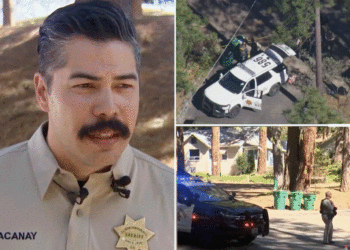
During an appearance Tuesday on The Will Cain Show, border czar Tom Homan tried to downplay the agents’ actions.
Thao’s detainment came as ICE agents were conducting a “targeted enforcement operation” looking for two undocumented immigrants who had been convicted of domestic violence and sexual assault, he explained.
The agents pulled over a vehicle registered to one of the two immigrants, but the driver turned out not to be the person they were looking for. Instead, he told the agents that the person they were looking for was in Thao’s house, Homan said.
“So, ICE went to the house where these two people were reportedly living, and they went in there, and they located this individual who matched the description,” he said. “But they couldn’t verify his identity because he was uncooperative. He failed to do a quick fingerprint check, he failed to do facial recognition. So, ICE detained him until they found out who he was.”

He didn’t say whether the agents had obtained a search warrant signed by a judge before entering the home, as required by the Constitution’s prohibition on unreasonable search and seizure.
Crucially, an ICE deportation warrant is not the same as a search warrant, and isn’t enough to enter a home without permission, according to the American Immigration Lawyers Association.
Thao told the Associated Press that the agents “didn’t show any warrant; they just broke down the door.” One of ICE’s targets had previously been married to a member of the Thao family and had lived at the home, but had since moved out, a relative told Reuters.
Thao also told the AP that he asked his daughter-in-law to find his identification, but that the agents said they didn’t want to see it.

Instead, they drove him to “the middle of nowhere” and made him get out of the car in the subfreezing temperatures so they could photograph him. Eventually, they realized he was a U.S. citizen with no criminal record and brought him home an hour or two later.
The Daily Beast has reached out to DHS and the White House for comment.
Speaking to Fox News, Homan offered a dubious explanation for why the detainment was supposedly legal.
“Let’s make it clear,” he said. “ICE can detain a U.S. citizen if they have probable cause of this person may have committed a crime. Short detainment and questioning, all you need is reasonable suspicion. You arrest a person and charge them, you need probable cause.”
That’s not quite accurate, though.
Law enforcement officers can briefly stop and detain people if they have reasonable suspicion that a person is engaging in criminal activity, but ICE agents do not have general policing powers.
They enforce federal immigration laws, meaning they can stop a person if there’s reasonable suspicion to believe the person is in the U.S. illegally.
When it comes to U.S. citizens specifically, ICE agents can only make an arrest if the citizen commits a crime in the agent’s presence, or if there’s probable cause to believe the U.S. citizen committed a felony, according to the Immigration and Nationality Act.
That means Homan’s claim that ICE agents can stop any U.S. citizen based on reasonable suspicion of any criminal activity is overly broad.
It’s also not clear how it’s relevant to Thao’s case.
Ignoring the fact that the agents refused to look at Thao’s identification, even if the ICE agents had reasonable suspicion to believe that Thao was one of their targets, they were looking for a previously convicted sex offender, not a suspect in an ongoing criminal investigation.
The courts have held that being a prior convict alone is not enough to establish reasonable suspicion of current or future crimes.
DHS has nevertheless repeatedly used the ICE targets’ criminal past to justify its warrantless search of the Thao family.
“As with any law enforcement agency, it is standard protocol to hold all individuals in a house of an operation for safety of the public and law enforcement,” DHS spokeswoman Tricia McLaughlin told Reuters in a statement.
The post Trump Goon’s Chilling Excuse for Detaining U.S. Citizen in His Underwear appeared first on The Daily Beast.