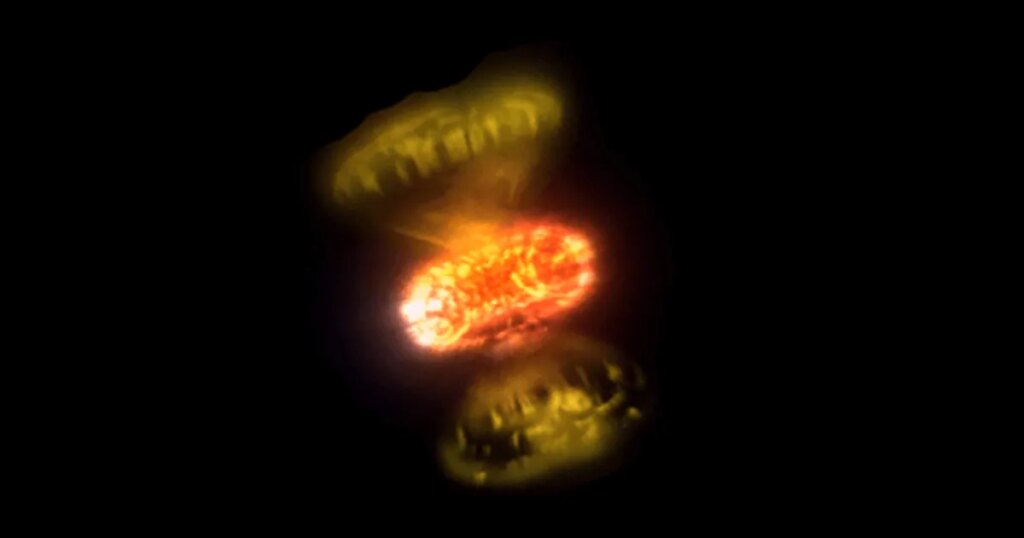
A pair of incredible images taken at the very moment two different stars exploded are also an accurate representation of how our feeble minds are being melted at the awesome but terrifying cosmic forces on display.
The images, taken with multiple telescopes at the CHARA Array at Georgia State University, captures a stellar calamity known as a nova, in which the extremely dense remnant of a star that was once like our Sun, called a white dwarf, siphons material from its companion star orbiting dangerously near it, eventually causing a thermonuclear explosion that the white dwarf ultimately survives. The detonation arises once the stripped material — primarily hydrogen — accumulates on the white dwarf’s surface and reaches critical mass. Novas, in other words, are naturally occurring hydrogen bombs, releasing in mere moments the energy our star emits in roughly 100,000 years.
Despite lighting up the night sky, astronomers could only infer what happens at the early stages of these formidable blasts, as direct observations proved difficult, not least of all because the exploded material appeared as a single point of light impenetrable to finer probing. Now, the new images are allowing them a peek behind the curtain.
“These observations allow us to watch a stellar explosion in real time, something that is very complicated and has long been thought to be extremely challenging,” said Elias Aydi, lead author of a new study published in the journal Nature Astronomy, and a professor of physics and astronomy at Texas Tech University, in a statement about the work. “Instead of seeing just a simple flash of light, we’re now uncovering the true complexity of how these explosions unfold.”
The images were primarily taken using a technique known as interferometry, in which multiple sources of light are smashed together to create an interference pattern that astronomers can analyze. This is enabled by collecting data using telescope arrays like CHARA, which is made up of dozens of antennas spread across a large area that, when all trained on the same point in the sky, act as one massive telescope. The CHARA data was then furnished with imaging taken by other telescopes such as NASA’s Fermi telescope, a space lens that watches for high energy emissions known as gamma rays, and the Gemini Observatory in Hawaii.
The work revealed that novas are far more complex than we give them credit for, and can’t be reduced to a single, destructive blast. One of the imaged novas, V1674 Herculis, proved to be one of the fastest novas on record, reaching peak luminosity before fading in just several days. It showed two distinct outflows of gas, suggesting that the explosion involved multiple powerful ejections of material that interacted with each other. But what was truly stunning was that these ejections emitted gamma rays which were detected by NASA’s Fermi, showing that the blasts are capable of producing some of the most energetic emissions in the cosmos that are typically associated with black hole-forming supernovas.
The other imaged nova, V1405 Cassiopeiae, seemed to unfold in spectacular slow motion, taking more than fifty days before finally ejecting all of its exploded material. Over the course of that nearly two month period, the white dwarf shrouded itself in a sphere of the stripped gas that eventually swallowed both stars, forming an extremely rare structure called a common envelope. Remarkably, when this envelope finally dispersed, the ejection produced its own blast of gamma rays that NASA’s Fermi was able to observe.
That both events produced detectable gamma rays shows that novas are “laboratories for extreme physics,” said coauthor Laura Chomiuk, a professor of physics and astronomy at Michigan State University, in the statement, which could help us “connect the dots between the nuclear reactions on the star’s surface, the geometry of the ejected material and the high-energy radiation we detect from space.”
More on space: Outer Space Is a Viscous Fluid, New Paper Claims
The post These Snapshots of the Moment a Star Exploded Will Fill You With Cosmic Dread appeared first on Futurism.