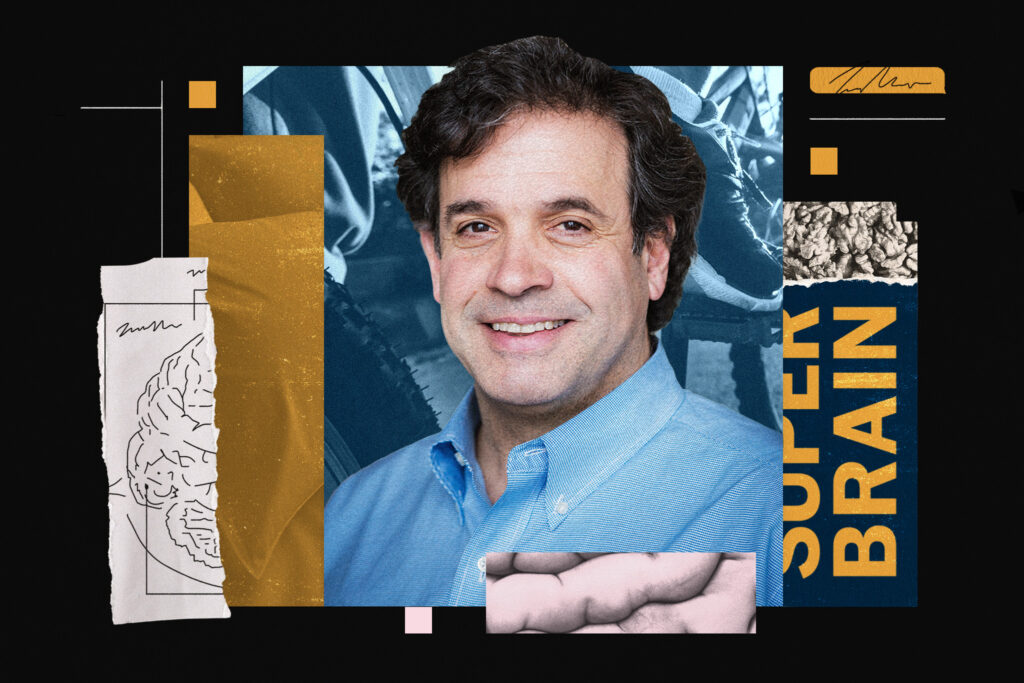
Long before “brain health” became a buzzword, Rudolph E. Tanzi was rewriting the science behind it.
The Harvard neurology professor and co-director of the Henry and Allison McCance Center for Brain Health at Massachusetts General Hospital is known for discovering three key Alzheimer’s genes. He has also written hundreds of journal articles in his 46-year career that helped shape modern understanding of neurodegenerative illness.
In 2023, he teamed up with holistic health guru Deepak Chopra to write “Super Brain,” challenging conventional thinking about the limits of the brain. Their work argued that the mind’s potential for growth and creativity far exceeds everyday use, and that people can consciously shape their brains to have superhuman capabilities and improve their own well-being at the same time.
Tanzi is also the architect of a lifestyle intervention plan for brain health known as SHIELD that emphasizes the importance of sleep, handling stress, interaction with others, exercise, eating well and learning.
Now 67, Tanzi credits his research with helping him stay mentally sharp, physically active and deeply engaged with his work.
“I’m doing more work and having more fun and excited than ever in my life,” he said. “Your world can be a young world or stable world completely based on the health of your brain. People don’t realize that.”
Here’s what SHIELD is, what it looks like in Tanzi’s daily life and his tips for continuing to age well:
Sleep
Aim for 7-8 hours of high-quality sleep each night. Adequate rest is essential for brain function and memory.
“When you sleep, you not only consolidate memories, but you drain toxins out of your brain,” Tanzi said. “You actually clean amyloid toxins — that’s the sticky material that triggers Alzheimer’s disease, and it usually does so two decades in advance of symptoms. … Every time you go into a deep sleep, it’s a rinse cycle for your brain.”
Tanzi doesn’t have a fixed bedtime, but he calculates backward from when he has to wake up to make sure he gets a minimum of seven hours of sleep. An hour before he needs to sleep, he turns off the TV and stops scrolling through Reels on his phone. “I am almost religious about seven hours of sleep or more.”
People often ask him for advice about what to do if they only got five or six hours of sleep, and he recommends power naps. “Even a short one in the office that results in a little drool on your desk — that’s good.”
Handling stress
Minimize chronic stress, which has been linked to accelerated cognitive decline.
“It induces cortisol, which is a toxic chemical in the brain.” Tanzi worries that the constant demands of modern life — such as from staying current on social media or responding to a steady stream of emails — have created unprecedented levels of stress.
His strategy of choice for handling stress is meditation.
Public health experts and physicians have pointed to stress as a major reason Americans live shorter lives than peers in nations with similar resources.
“Many people are stressed out because of the constant monologue in their heads — the monkey chatter. We as humans, to communicate with words, often have words going through our heads, so one trick you can do is sit back, close your eyes, and gently keep words and sentences from entering your brain. Just think of images … I have gone out of my way in my life to turn off internal monologue and dialogue as much as possible. … Every hour or two, close eyes, and whatever comes in your head is fine, as long as you’re not hearing words.”
“Obsessing over something that happened in the past or feeling anxious about the future, instead of being in the now,” can also be problematic, he said.
Tanzi traces some of his thinking to the philosophy of anthropologist and writer Carlos Castaneda, whose books Tanzi discovered early in his scientific career. Modern neuroscience, Tanzi argues, supports the idea that the constant need for validation can overstimulate stress pathways in the brain, eroding mental clarity and long-term brain health.
“He said if you want more intuitive flashes and creativity and just feel more mental power, turn off the internal dialogue,” Tanzi said. “I feel more excited now than in my 20s because I don’t let the words and what society thinks cause me stress.”
Interaction with friends
Maintain an active social life. Loneliness is associated with a higher risk of neurodegenerative conditions.
“That’s the stimulation that the brain likes. … Make sure it’s people you like. If it’s people you don’t like, that’s stress. … Ask yourself, how often each week do you interact with people who are not co-workers or household family members?”
Research has shown that social interactions have positive effects on our lives.
Due to his busy work schedule and because many of his friends do not live in the area, Tanzi isn’t able to see his friends in person very often. But talking via text or phone is enough, he said.
“I have different text friend groups, and I just take time to interact with two to three of them per day, but not being obsessive about it.” They include college friends such as his old fraternity brothers and a basketball group. “This is one way you use social media to benefit your brain.”
Exercise
Engage in regular physical activity to boost blood flow to the brain and support the growth of new neural connections.
“It does two things for the brain. It induces the birth of new nerve cells, a process called neurogenesis, and it happens in a part of the brain first affected by Alzheimer’s. It also gets muscles and blood flowing faster to release a hormone that breaks down amyloid.”
Tanzi points to a study, published in November in Nature Medicine, from Mass General that found that for every 1,000 steps a person takes, they stave off Alzheimer’s by one year.
Tanzi has an exercise bike in his office and normally uses it 30 minutes every other day at 80 to 90 rpm. On the other days, he takes a walk in his neighborhood at home, or if he’s in the office by Boston Harbor’s Charlestown Navy Yard.
Learning new things
Challenge your brain by trying new activities to strengthen neural pathways.
“Learning new things makes new connections called synapses. There are tens of trillions of them they make up a neural network that stores all your memories. … What leads to impaired cognition or dementia is when your synapses go downhill, and what you are doing is building up your synaptic reserve,” Tanzi said.
“As you get older, you become less secure and less adventurous and take less chances, and it’s my way or the highway. You are using the same synapses, and that’s bad for the brain,” he said.
Tanzi is a serious keyboard player on the side, and he’s always learning new music. (He’s so good, he’s even played professionally with Aerosmith!) He writes his own music, which he describes as “an ambient jazz that’s kind of chill.”
He also likes to learn by watching documentaries, reading books, both fiction and nonfiction, and listening to podcasts.
Diet
Follow a brain-healthy diet to support long-term cognitive health.
“This is the most important … to have a diet that makes the bacteria in your microbiome happy. When they are balanced in the right ratios, they actually create gut metabolites in your brain to get rid of amyloid plaque and quell neuroinflammation. We used to say what’s good for the heart is what’s good for the brain, and it turns out that’s true.”
Tanzi favors a Mediterranean diet full of fruits, vegetables and olive oil. “I’m mostly vegan, but if there’s a good pizza around, I’m going to have it.”
“Every single day, I need to take my medicine in terms of vegan food,” he said. When he snacks, it’ll usually be a piece an apple or pear, granola, nuts or seeds. “Bacteria in your gut love crunchy things that are not potato chips.”
Recently, Tanzi has been turning his attention to emerging research on how other external forces beyond food shape brain health. His next book, expected late this year or in early 2027, will explore the impact of diet and environmental exposures — what he calls the “killer P’s”: plastics, pollution, periodontal bacteria as well as processed foods.
The post 6 daily habits to slow aging, from a Harvard brain expert appeared first on Washington Post.