If you’re intimidated by weight training, a new study is full of reassurance.
Weight workouts don’t have to be complicated or grueling to be effective, the study found. Almost any kind of lifting led to increased muscle and strength in the study. Whether people lifted heavy weights or light, through many repetitions or few, the results were broadly comparable.
“Lift however you like to lift. That’s the lesson,” said Stuart Phillips, a professor of kinesiology at McMaster University in Ontario, Canada, and an expert in resistance exercise. Phillips is the senior author of the study, which was published last month in the Journal of Physiology.
The study also provided other lessons, some unexpected, including about the importance of genetics in our bodies’ response to weight training and how some of us may get stronger without getting much bigger — or vice versa — when we begin to train.
Do you have to lift heavy weights?
Gym culture is full of widely held beliefs about the best ways to lift, Phillips said, many backed by scant evidence.
“You’ll see guys who’ve been lifting for decades and swear you have to lift heavy” to gain substantial muscle mass and strength, he said. For them, weights must be hefty enough that you can barely grunt through eight or nine taxing reps before your arms or legs give out.
But mounting evidence suggests that heavy weights are overrated. A comprehensive 2023 review of hundreds of past experiments concluded that, compared with no exercise, any lifting — not just with heavy weights — “promoted strength and hypertrophy” or larger muscles.
But questions remain about the most effective weight workouts. If you use lighter weights, how many times should you repeat each lift? What drives muscle growth, if it’s not heavy loads? And will everyone make the same gains from the same workouts?
For answers, Phillips and his colleagues recruited 20 healthy, young men who didn’t normally weight train and checked the size and strength of their muscles. (They have a similar study underway with women.) The men’s limbs were then randomized to heavy or light lifting; that is, their right or left arm was randomly assigned to complete biceps curls using a heavy weight, while the other arm did the same exercise with a much lighter weight. Similarly, one leg did knee extensions against a heavy weight; the other leg completed the same exercise with a much lighter load.
The heavy weights were challenging enough that lifters could manage no more than 12 repetitions before reaching muscular failure, meaning they felt they couldn’t lift again. With the lighter weights, the participants lifted through as many as 25 repetitions before deciding they couldn’t do another.
Light weights work fine
The men worked out three times a week under the researchers’ supervision, increasing their weights once they could easily complete more than 12 heavy or 25 light repetitions. At the end of 10 weeks, the researchers retested everyone.
By then, the men’s muscles were almost all stronger and larger, with little difference between limbs. The arm that lifted light weights was just as buff as the one that lifted heavy and ditto for legs. Both approaches were equally effective.
This finding “reinforces the idea that load isn’t an important determinant” of muscular response, Phillips said. “Effort is.” If people lifted until their muscles tired, they got results.
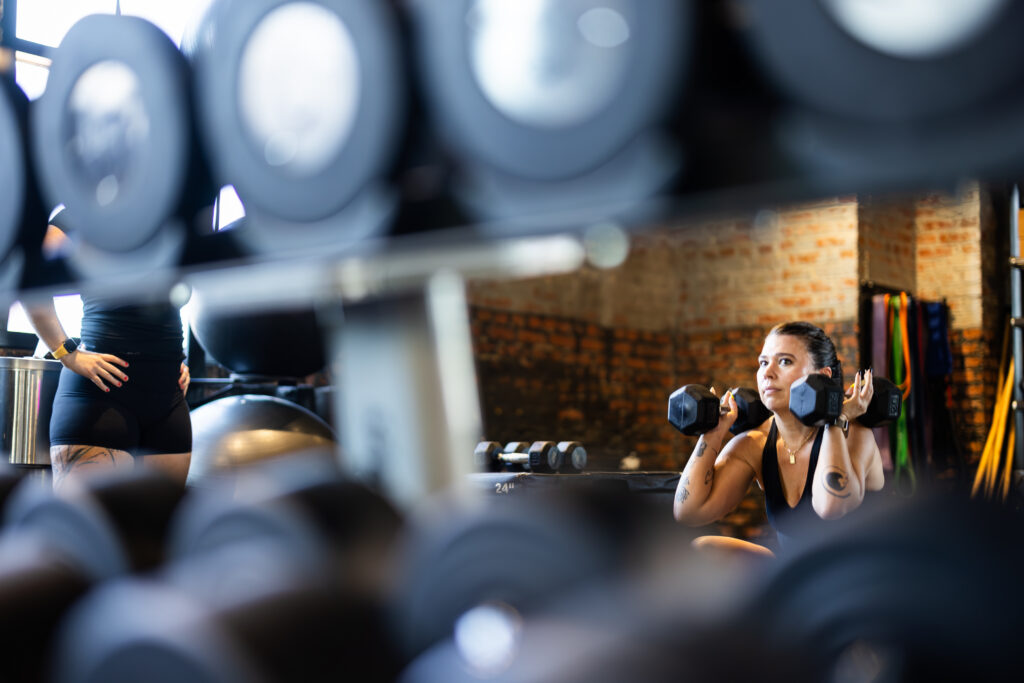
The practical takeaway is that you can “pick what works for you,” Phillips said. Have sore joints or little taste for big weights? Use smaller ones. Have limited time? You’ll finish faster with heavier loads.
But don’t expect your results to exactly mirror mine. There were substantial differences from one volunteer to the next. Some nearly doubled their strength or mass; others added less. And there was little relationship between bulk and strength. Some men got far stronger without growing much bigger, and some achieved almost the opposite.
These differences underscore the role of genetics. “To some extent, our muscular responses are baked in,” Phillips said. After 10 weeks of the same lifting routine, I won’t look precisely like you. But we’ll both be stronger and better muscled.
What about body weight exercises?
This study “was very well-designed,” said Brad Schoenfeld, an exercise scientist at CUNY Lehman College in the Bronx, who researches resistance training but was not involved with the new work. The findings suggest that “within broad limits, you can build similar amounts of muscle mass” with light or heavy loads.
The study has limitations, though. It involved only young men new to lifting. Phillips said he believes the results would be similar for women, older people and anyone who’s been weight training for years. But studies are needed with those groups to be sure.
The training also involved gym machines. Would the results be the same with body weight exercises? “I think so,” Phillips said, adding, “I’m counting on it.”
Much of his own training nowadays, at age 60, takes place at home, he said, and involves body weight work. “I’ve got enough space in my basement to do squats, do deadlifts,” he said. He repeats each exercise until he can barely finish another rep, he said. “I do what I preach.”
But the key point is that he does something, Phillips said, and regularly. “Based on self-report and participation data, about 80 percent of people do not lift weights at all.” He hopes his group’s study and other research will encourage more people to try some kind of resistance training routine, he said. “Let’s make 2026 the year of strength.”
Do you have a fitness question? Email [email protected] and we may answer your question in a future column.
The post You can get stronger with gentle weight training, new study finds appeared first on Washington Post.