FEAR AND FURY: The Reagan Eighties, the Bernie Goetz Shootings, and the Rebirth of White Rage, by Heather Ann Thompson
FIVE BULLETS: The Story of Bernie Goetz, New York’s Explosive ’80s, and the Subway Vigilante Trial That Divided the Nation, by Elliot Williams
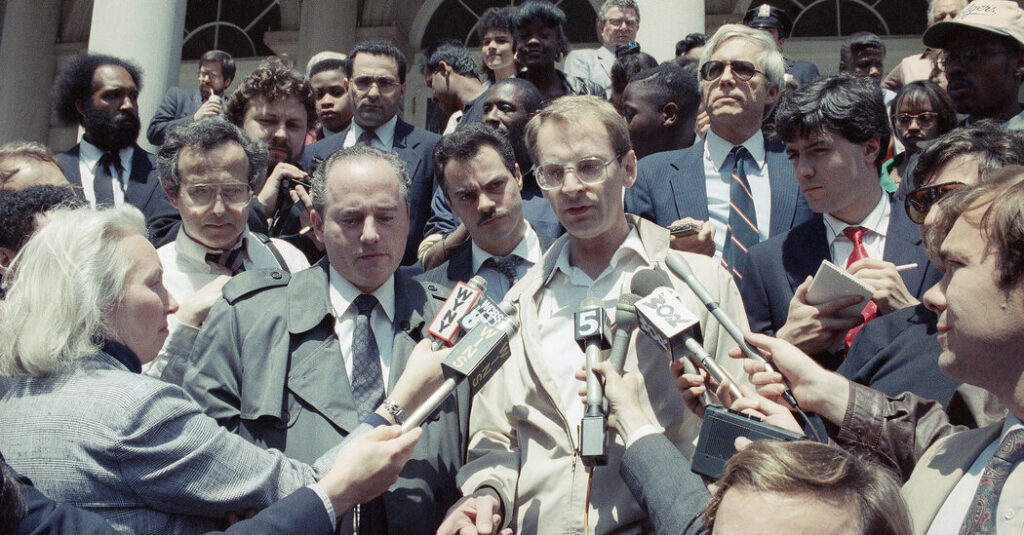
In early 2024, the CNN legal analyst Elliot Williams reached out to Bernie Goetz for an interview. Nearly four decades had passed since Dec. 22, 1984, when Goetz, a 37-year-old white man, boarded a downtown-bound subway train in Manhattan and shot four unarmed Black teenagers. The victims survived but were grievously injured. One was paralyzed from the waist down and left mentally impaired for the rest of his life.
Williams was writing a book about the case and looking to Goetz to help him understand what happened that day. Minutes into the conversation, Goetz started complaining: “I think we live a lot in a BS society.” He made broadsides about Black people. He denounced not only the prosecutor who tried to put him away but also the defense lawyer who helped him get a light sentence (Goetz served little more than eight months for gun possession). As for using deadly force against four teenagers, Goetz expressed no remorse: “They absolutely needed shooting.”
In the interview, Goetz, now 78, sounded both stuck in the past and acutely contemporary. The rank bigotry, the disgust with the legal system, the celebration of vigilante violence — all of that has become an undeniable part of our political culture in 2026.
Which may explain why two books about the Goetz case are being published this month: Williams’s “Five Bullets” and “Fear and Fury,” by the Pulitzer Prize-winning historian Heather Ann Thompson. Though the books share multiple points of overlap, they are vastly different. As a legal analyst, Williams dedicates much of the book to a play-by-play of the criminal proceedings. Thompson, whose previous book was about the 1971 Attica prison uprising, writes expansively about the Goetz case as both a reflection (of a city torn apart by neoliberal neglect) and a harbinger (of what she calls “the rebirth of white rage”). Thompson’s book is vibrant, powerful and moving; Williams’s, while adequate, suffers by inevitable comparison.
The shooting happened quickly, within the few minutes between express stops. Troy Canty, Barry Allen, James Ramseur and Darrell Cabey were traveling from the South Bronx to a downtown arcade, where they planned to jimmy open the coin boxes with screwdrivers and steal the change. Goetz entered the subway car at 14th Street with an unlicensed .38 concealed in his waistband and loaded with illegal hollow-point bullets. Canty went up to Goetz and asked for $5. None of the teenagers displayed a weapon.
Goetz shot Canty, followed by Allen and Ramseur. Then he shot at Cabey. Goetz told the police that after seeing Cabey slumped over on the subway bench but not bleeding, he said, “You don’t look too bad, here’s another,” and shot at the 19-year-old again, point-blank.
Thompson uses a range of sources to piece together a detailed portrait of Cabey, whose injuries — paralysis, coma and brain damage — were so severe that he could not testify at Goetz’s criminal trial. The night before the shooting, Cabey had been staying at his grandmother’s house, helping to care for her as she came down with the flu. One witness recalled seeing him sprawled on the subway bench, unable to move. “I didn’t do anything,” Cabey whispered. “He shot me for nothing.”
Neither book downplays the dire situation of New York in the 1980s, when mounting crime had the city on edge. Williams’s own family left Brooklyn the decade before for “the comfort and perceived safety of the New Jersey suburbs.” Thompson acknowledges the collapse in public safety, but she also emphasizes how it was exacerbated by a spiraling fiscal crisis, austerity and underfunded social services.
She adds that the tabloids found any story with a white victim and a Black “thug” to be a reliable generator of outrage and therefore attention. After the Goetz shooting, the tabloids printed misinformation about the teenagers brandishing “sharpened” screwdrivers, which was soon picked up by mainstream outlets as fact. (Though two of the teenagers had regular screwdrivers in their pockets, Goetz never saw them.) The result, Thompson says, was to turn the victims into villains.
In his criminal trial, Goetz was acquitted of the most serious charges, including attempted murder. The defense persuaded the jury that Goetz’s self-incriminating statements to the police — “I was gonna gouge one of the guy’s eyes out with my keys”; “my intent was to kill” — should not be held against him.
His lawyers argued that Goetz was the traumatized victim of an attempted mugging three years before. In other words, Goetz’s self-portrait wasn’t to be believed. As a gunman, he was acting out of fright, on “automatic pilot.” Goetz’s confession, too, was recast by his lawyers as a trauma response: He had presented himself as a ruthless and methodical shooter so that instead of feeling terrified and powerless, he could pretend to be someone in control.
Both books draw an arc from Goetz to latter-day vigilantes like Daniel Penny and Kyle Rittenhouse. Williams concludes “Five Bullets” with a rumination on the Goetz verdict. He makes a lawyerly distinction between the legal outcome (which he considers “supportable and sound”) and morality: “It falls to all of us as engaged members of the public to ensure that our laws and systems best serve an evolving society.”
Thompson’s conclusions are more capacious but also more direct. In 1996, Cabey’s family won a civil suit against Goetz and were awarded $43 million in damages that they didn’t receive because Goetz soon declared bankruptcy. In the decades since, Goetz has periodically resurfaced in the media as a quirky eccentric — a weed-smoking vegetarian who likes to feed the squirrels in the park. Cabey, though, receded from the news.
In her closing pages, Thompson includes a sobering discussion of how the rage that turned Goetz into a folk hero would one day “put American democracy itself in the gravest danger.” But she doesn’t leave it at that, choosing instead to end the book with a 1997 photograph of Cabey and his mother. He’s sitting in his wheelchair; she stands beside him with her arms resting protectively on his shoulders.
A mother and her child: It’s an affecting reminder of the love and patience that, amid all the forces of “fear and fury,” we cannot allow ourselves to forget.
FEAR AND FURY: The Reagan Eighties, the Bernie Goetz Shootings, and the Rebirth of White Rage | By Heather Ann Thompson | Pantheon | 543 pp. | $35
FIVE BULLETS: The Story of Bernie Goetz, New York’s Explosive ’80s, and the Subway Vigilante Trial That Divided the Nation | By Elliot Williams | Penguin Press | 357 pp. | $32
Jennifer Szalai is the nonfiction book critic for The Times.
The post How a 1984 Subway Shooting Foretold the Rise of Vigilante Violence appeared first on New York Times.