Nadia Garcia was showing a visiting friend around the Fairfax neighborhood one recent Saturday when she paused in front of a small shop on Melrose Avenue.
“We have to go in here,” Garcia recalled saying to her friend. They walked in and began to sift through a rack of women’s shorts and Lululemon leggings.
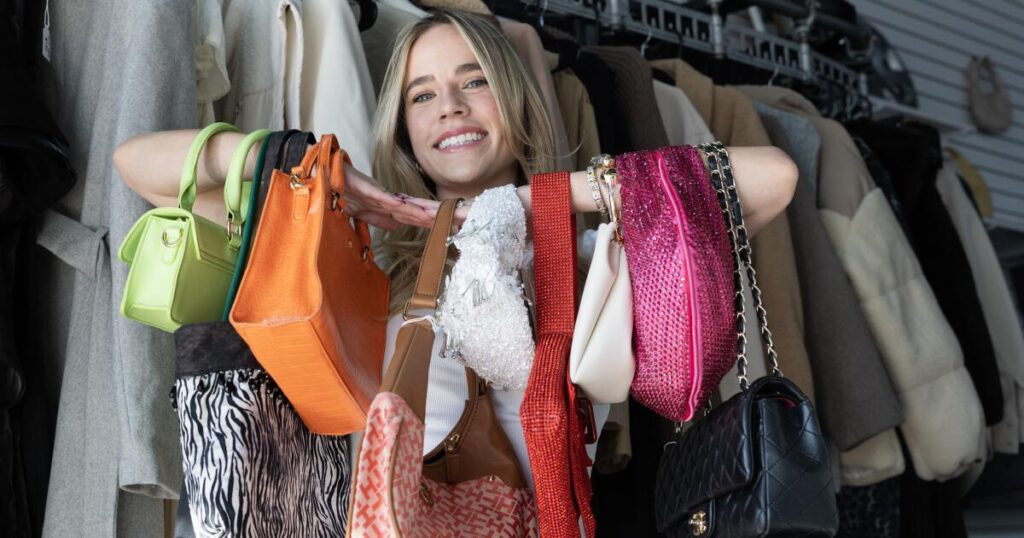
At a time when secondhand shopping is on the rise — with the global market valued at about $210 billion and projected to surpass $320 billion by 2030 — one Los Angeles consignment store has carved out a niche by sourcing its inventory from the overstuffed closets of Southern California social media influencers.
Detoure, which opened in April 2024, bills itself as an “influencer sourced thrift store.” Many of the store’s visitors are Gen Zers like Garcia, who said she was captivated by the concept after seeing it on TikTok.
“I knew it would be stuff that was geared towards my style and my interest,” said Garcia, a 26-year-old digital marketing manager.
Detoure’s name combines the words “detour” and “couture,” and reflects the business’ goal of providing a “detour” around buying new fast fashion, said founder Meghan Russell, 28.
The store tries to solve two problems at once. People who can’t afford to buy trendy clothes at full price turn to cheaper “dupes” that contribute to fast fashion waste, she said. Meanwhile, influencers, who rapidly cycle through clothes, receive so many brand-name gifts that they don’t have room to keep it all.
“We are taking clothes from the fashion inspo,” Russell said.
Influencers who want to become Detoure clients should have about 10,000 Instagram followers, Russell said.
“What’s really interesting about this concept is that it’s so rooted in influencers,” said Arizona State University fashion merchandising professor Nicole Craig. “I haven’t seen anything like this in a physical store.”
Influencer resale predates Detoure, according to Craig. But it looked slightly different.
The Kardashian-Jenners in 2019 launched Kardashian Kloset, an online resale platform selling designer clothes culled from the family’s extravagant closets. Websites like Poshmark and Ebay have also worked with influencers and celebrities, Craig said.
Some influencers go to Dresscue, an Atwater Village consignment store, because they can rent empty racks to sell their clothes, Craig said, though the store was not specifically designed for them.
For influencers, the store takes a ‘headache away’
Detoure has more than 250 influencer clients who can drop off their items or, if they live in Los Angeles or Orange County, have them picked up.
Given how many clothes influencers receive — one said she receives five packages per day — traditional resale options are not always a feasible solution, influencers said.
Detoure takes the “headache away,” said content creator Nicole Kramer.
Kramer said she used to spend hours waiting in line at local resale shops for a worker to sort through her clothes. She also tried selling garments on Poshmark and Mercari but found it time-consuming.
Content creator Hannah Dytrych mostly sends Detoure clothes gifted to her by brands. She said she hasn’t faced any pushback.
“They know that we receive a lot of items and there’s just not enough space to keep everything,” Dytrych said.
Russell estimates that the company has “saved” 100,000 items from landfills since she began selling online in 2021.
The company generated nearly $600,000 in sales in 2025 and became profitable last summer, according to Russell. The store employs six people, including Russell, and its main expenses are labor and monthly rent, which costs about $6,500.
Clothing prices are set at about 40% to 60% off retail, depending on condition, Russell said. Beauty products receive bigger markdowns; for instance, Rare Beauty’s liquid blush normally costs $25 but sold for $7. The store says it only accepts unopened products.
Influencers receive a cut of the sales usually ranging from 25% for lower-priced goods to 70% for luxury items, Russell said.
Items that don’t sell after several months are donated, returned to influencers by request, or marked for clearance.
Shoppers can occasionally pay $5 for two minutes to fill a bag with anything they want from a large mound of clearance items collected on the floor. These quarterly “pile sales” are a customer favorite, Russell said. The next sale is planned for Jan. 31.
Longtime Detoure client Elizabeth Weber estimates that she earns between $600 and $1,500 in commissions per month from the store.
The money was especially helpful when content creation was her main job, as that income “ebbs and flows,” said Weber, a past winner of the reality show “Love Island USA.” (She now works for a beauty mirror startup.)
From an apartment to Melrose Avenue
Raised near Modesto, Russell went to Cornell University and graduated in 2018 with a bachelor’s degree in global and public health.
Halfway through college, Russell spent two months in Tanzania assisting a nonprofit that taught female genital mutilation survivors how to make clothes to support themselves. The experience shaped her interest in ethical fashion.
“I was like, ‘If I’m going to work in fashion, I want to make a difference, instead of just adding more and more,’” Russell said.
Russell moved to Southern California after college and eventually became a marketing intern for a green jean brand. It was while attending an event through her job that Russell found herself listening to influencers vent about their “exploding” closets.
A thought occurred to her: Would their online followers, many of whom follow them to dress like them, be interested in buying items from their wardrobes?
“That was a light-bulb moment,” she said.
After surveying friends about what they didn’t enjoy about the thrifting experience, Russell cold-emailed 100 influencers she found on Instagram. Two replied, so she took their unwanted clothes home and built a website to sell them.
Detoure began hosting pop-ups in 2022, with the first taking place in her friend’s Mar Vista backyard. The pop-up went viral, according to Russell, so more followed, drawing long lines in cities including Costa Mesa, San Diego and New York City.
A $150,000 investment from the venture capital firm 500 Global’s accelerator program allowed Russell to move operations out of her apartment and into a warehouse. It also paved the way for the physical shop on Melrose Avenue, a prime destination for secondhand shopping in Los Angeles.
Russell has big dreams for her business. She calls 7555 Melrose Ave. her “first flagship store” and hopes to eventually open locations in Orange County and San Diego, where she already has a client base. One day, she’d like to open a store in New York.
For now, Russell is working on a web app for smaller U.S.-based influencers with at least 5,000 followers to upload items in their closets and directly ship them to customers. The platform, slated to launch later this year, is modeled after resale platforms like Depop, but built for influencers to share with their followers.
On a gray November Sunday, a handful of female customers braved a rainstorm to browse the racks at Detoure, which were well-stocked with clothes from Abercrombie & Fitch, Princess Polly and Revolve.
Repeat customer Patricia Rashidi, 31, said she drove from Woodland Hills to Detoure to buy a job interview outfit. Many other secondhand stores don’t carry larger sizes, she said, leaving with a black dress.
“Things easily catch my eye here,” said college student Tahtiana Crawford, 19, who was shopping for clothes that matched her Y2K-inspired style. “Then you check the price tag and it’s so cheap.”
The post As Gen Z turns to thrifting, a Melrose Avenue shop finds success in influencers’ overflowing closets appeared first on Los Angeles Times.