Choreography is not the same as directing, but every great choreographer has a director’s sixth sense. That sense steers dancers, trained or not, to commit to movement with crystalline conviction, and it can see the big picture with the body as narrator.
Dance places a frame around what is ephemeral; it shows the mind how bodies can hold onto air — and be held by it. Mario Banushi, a Greek-Albanian artist, showed that piercing ability in his wordless drama, “Mami,” which looks at motherhood, starting with a young woman giving birth. She is alone, nearly glowing in raw anguish, while Banushi makes it seem as if her wiry body were surrounded by sparks of electricity. In his brand of theater, movement is the unwritten text, opening a space for dreaming.
This silent play was presented at N.Y.U. Skirball as part of Under the Radar, one of several January performance festivals that have audience members making hard choices and scrambling to make curtain times around town. I could relate, having seen nearly a dozen performances, some of which ended up being dance in the setting of theater.
In “Mami,” in which the performers are often stripped of clothing, Banushi deftly shifts expectations of who is nurtured and who does the nurturing. (In one scene, a young man changes an old woman’s diaper.) But the drama has less to do with the relationships between mothers and children than with the passage of time. There is a rapt calmness to it all, a clarity that shoots through the senses.
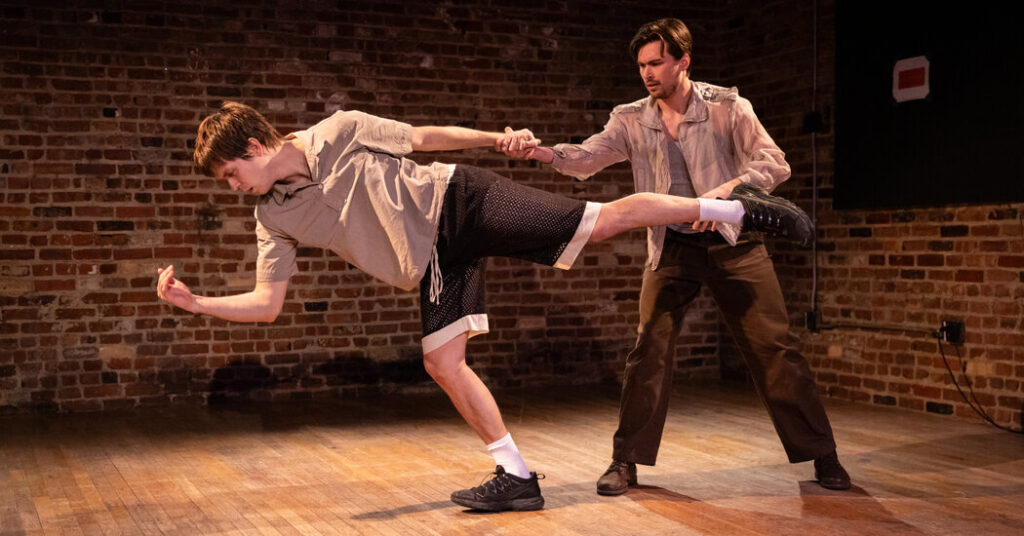
On a smaller scale, yet no less cinematic, was Isa Spector’s “Real Estate,” described as a domestic fantasy in three movements. Part of the Exponential Festival, “Real Estate,” performed at the Brick Theater in Williamsburg, is a slippery drama told through text and movement about a relationship between two men, played by Ari Dalbert and Sheldon Donenberg — actors whom Spector has seemingly molded into dancers.
Spector, expanding and toppling ideas about masculinity, has a nimble, light touch that gives emotions the kind of understated subtlety that grabs your breath. Both performers are excellent, but Dalbert transforms his physicality like a shape-shifting sprite. The angle of his eyes, his undulating spine, the way he slows down movement to a space of floating is infused with eerie longing.
Throughout “Real Estate,” Spector uses text — witty wordplay puzzles full of choreographic twists. But most important is how this is a dance duet told through a play in which Spector’s dream ballets, like choreographic miniatures, circle around the pleasure and pain of yearning.
Not everything I saw felt as fully formed. Cherish Menzo’s “Darkmatter,” another dance-theater hybrid presented as part of Under the Radar and shown at Performance Space New York, was overlong yet striking, with exceptional lighting by Niels Runderkamp that gave a glittering underworld a quality of plush depth.
The stage, at one point dripping in black paint, had an uncanny touch of the Upside Down from “Stranger Things.” But the performers were the centerpiece. Menzo and Camilo Mejía Cortés were taut and controlled at first; the surprise was how they, and their bodies, eased slyly into humor.
Also from Under the Radar was Dahlak Brathwaite’s “Try/Step/Trip,” a musical inspired by Brathwaite’s experiences: He was a spoken-word poet when he was arrested for possession of hallucinogenic mushrooms and entered a rehabilitation program to avoid prison. His story — he plays the narrator — is told through words and step, the percussive dance form. It’s a lively, sweet show, yet its earnestness made me wish for less talking and more dancing.
Under the Radar had two works dominated by props and focused around ideas of destruction and collapse. At the Chocolate Factory Theater, Autumn Knight’s “NOTHING: more,” an improvisational adventure with objects including a long sheet of lighting gel and a disco ball, featured three excellent dancers — Kayla Farrish, Dominica Greene and Jasmine Hearn — but lost its steam.
And Narcissister’s “Voyage Into Infinity,” with its upscale and intricate Rube Goldberg-like set, unfolded like a series of science experiments — fire often figured in, as did sparklers, and that was fun. But while “Voyage” was extravagantly playful, it also felt dated and, apart from the loud performance of a hardcore band, predictable.
At Live Artery at New York Live Arts, the choreographer Ruth Childs returned to New York with little to endear her for a third visit. In “fantasia,” she imitated and reacted to music in ways that struggled to rise above sophomoric.
Live Artery hosted a work with a more intriguing subject: majorettes. In “Major,” the choreographer Ogemdi Ude draws on ideas of seductive strength as she returns to the first dancers she knew and the first dance form she learned, at hometown football games.
Majorette dancing was born in the American South at historically Black colleges and universities in the 1960s. Ude might have attempted too much in this ambitious work in which she not only reclaims a dance style but mourns a lost girlhood.
Perhaps “Major” isn’t just one dance; it could be several. Its six main performers lit up the stage as they worked in and out of formations — there was also virtuosic twerking — but the pacing of the choreography also had lulls.
The ending, though, was the jolt that “Major” needed as young members of Brooklyn United’s dance and drum teams shared the stage with Ude’s dancers. It was an exceptional finale, an appearance that moved the majorette experience from the realm of memory to the here and now. It was loud and real, and Ude accomplished something unimaginable: She transformed the stage into a stadium.
Gia Kourlas is the dance critic for The Times. She writes reviews, essays and feature articles and works on a range of stories.
The post Mothers, Men and Majorettes: Finding the Dance in Theater appeared first on New York Times.