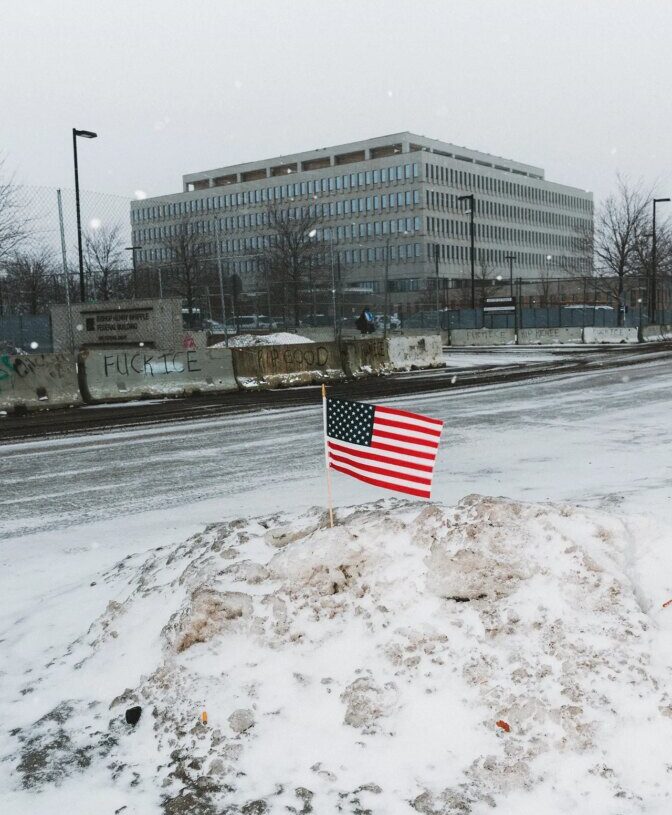
After an Immigration and Customs Enforcement (ICE) officer shot and killed Renee Nicole Good two weeks ago, the rules and rhythms of daily life in Minneapolis definitively changed. More than 2,000 federal officers have been let loose on the city purportedly in search of undocumented immigrants. Schools, churches, and daycares have all been in the crosshairs—there is no safe haven from ICE enforcement in the Twin Cities—and in response, the city’s residents have come together to create rapid response networks to protect their neighbors.
It is not the first American city to be under siege from ICE, and it looks like it may not be the last. President Donald Trump has said he’s weighing sending US troops to Minneapolis under the 19th-century Insurrection Act after the courts blocked his earlier mobilization of the National Guard in California and Illinois. Even if that doesn’t happen, thanks to the billions of dollars pouring into ICE coffers, roving bands of masked, armed agents have been unleashed across the country.
To better understand what life in an occupied American city is like, WIRED spoke to 10 people from a variety of backgrounds about their new normal. They all have rapidly adapted to a world where the safety of our neighbors—and ourselves—is a collective responsibility.
Interviews have been condensed and edited for clarity.
Anonymous, 37, elementary school teacher
When you wake up in the morning, you get dressed, you put on your whistle, just in case you happen to see ICE nearby so that you can alert other people. I go into work, where we try to make it as normal as we can for the kids, but there’s this level of anxiety the teachers have.
It’s most heightened when I’m out at recess and I’m having to scan: one eye on the kids, one eye on the perimeter. Today there’s a helicopter hovering above, and that’s stressing the kids out. It gives the adults a little bit of PTSD from the George Floyd murder. Back then, there was a lot of extra energy and chaos in our city. This is a different feeling, though. That was a little more anger, and this is more a feeling of fear.
If you’re outside, you blow a whistle to let everyone know to go inside. The kids know that. We had the full conversation, age appropriate of course: “There’s some unsafe stuff happening. If we’re outside and there’s something unsafe, just like if we’re outside and it starts pouring rain, we’ll blow the whistle a little bit early and we’ll go inside.”
I have to be careful to blow it slowly because they are used to hearing quick whistle blasts in their neighborhoods alerting them that ICE is there, and that’s stressful to the kids. One of them at recess said, “Make sure you’re doing it slowly so we don’t get confused.”
Brandon Sigüenza, 32, volunteer observer detained by ICE
I’d never really done any legal observation before January 11th, the date of my arrest. My friend asked if I wanted to do legal observation with her. I said, “Sure.” According to a neighborhood text group, there was pepper spray being deployed on a legal observer close to my friend’s house. So we decided to go there to make sure people were safe and to document. There were two unmarked SUVs parked in the middle of the road. There were multiple observers around them honking their horns. We approached from the east. And so when the agents did a 270-degree turn and started driving south on 16th Avenue, we were the first people able to turn with them. We decided to follow them. We followed them for about 40 seconds, less than a block. It was the first time I’d ever followed an ICE car, the first time I’d ever seen an ICE car.
“At one point, one [agent] said to my friend: ‘You need to stop. You need to stop obstructing us. That’s why that lesbian bitch is dead.’”
My heart was pounding. The car pulled over, and I just told my friend, who was driving, “Breathe, just take deep breaths.” But I was really talking to myself. My friend is super brave and she was screaming at them: “We’re not obstructing. You can move forward.” There were no cars in front of them when they pulled over. They were blocking us from going forward and there were observers’ cars behind us, so we couldn’t go back.
The ICE agents came out and some agents surrounded us. One was filming me. They didn’t tell us that they were ICE agents, but I assumed they were. I’d never seen an ICE agent before, so I was a little nervous. My friend kept yelling, “What are we doing to break the law? We’re not obstructing. Get the fuck out.” And I just said Renee Good’s name two times. I didn’t know what else to say, and she was kind of top of mind for me.
The agents were kind of on their way back to their car, an agent grabbed pepper spray out of this car, came to us, and methodically sprayed the intake vent. The two SUVs pulled forward for another 30 seconds. They stopped again. “The car is in park. You can go forward,” my friend yelled. She told me later she was thinking about Renee Good, and didn’t want there to be any doubt in their minds that the car could drive into them. We put our hands in the air. The agent replied, “Shut the fuck up.” An agent came to my side and said, “You are under arrest.” I just held my hands in the air and I waited for instruction. I didn’t know if he wanted me to come out of the car or stay in the car. At one point, one said to my friend: “You need to stop. You need to stop obstructing us. That’s why that lesbian bitch is dead.”
Then he smashed the passenger window. Another agent smashed the driver window at the same time. The doors were unlocked, but he never attempted to open the doors. He just smashed the window. I was just thinking about Renee Good and what happened to her, and all I thought was I need to stay calm and make this agent feel safe. So I put my hands in the air and I slowed my breathing as much as I could, and it was very surreal and kind of out-of-body, but the smashing itself was loud and chaotic. (Later, when I was frisked in the detention facility, they found glass in my coat pocket.)
“They were asking about things like, ‘Do you know any protest organizers? Do you know about any bombs that might get planted? Do you know if anyone would snipe an ICE officer?’”
On the ride, one of the agents warned: “What you guys are doing is really dangerous. We’re after some really bad guys.” Later, when we pulled into the garage, I saw an East African woman in detention in her twenties that reminded me of coworkers and friends of mine. I asked the ICE agent, “Is that one of the bad guys?” She did not respond.
I knew that on January 10th, Minnesota lawmakers were denied access to the building. So what was going into my mind is like, “Oh, I’m going to see it. I should try to remember as much as I can.” When I was being booked, there were 20 or 30 brown people in a line, mostly Hispanic, some East African. My friend and I were brought over to a special table that was for, I believe for US citizens. It had a little placard on it that said “Obstruction.”
An agent frisked me, took my passport, put it in a mesh bag, and had me sign something related to my possessions.
They put foot shackles on me and brought me to the USC area, which I found out meant US citizens. I was put in a 10-foot by 10-foot cell alone. The walls were painted yellow, and there were concrete benches. My friend and I were in adjacent cells, and there were two-way mirrors, and I just yelled, “I love you. It’s OK.” And that made an agent a little uncomfortable, and he moved me to an area in the hallway where I couldn’t see her.
They read me my Miranda rights before giving me one phone call. Afterwards, I was brought back to my cell and my eight-hour detention began. Later, when I was brought to the bathroom, I had to go through a bit of the facility, and that was when I saw the most people in detention. The cells were the same size as mine, which had three people, but they had 12 to 15 people. I could lay down on the concrete bench. These other people could not. There were a lot of people staring at the ground, people staring at the walls or staring at the ceiling. There wasn’t a lot of conversation in the cells. I heard screaming. I heard a lot of crying. It was the loudest I’d ever heard anyone cry. As I passed, I saw a woman using the bathroom, and there were three male government agents of some kind that were watching, and they were kind of making small talk, just chatting. Talking about where they are from and their kids.
Three different agents brought me into a room. They said, “I’m not ICE. I’m with the Department of Homeland Security Investigations. It looks like you might be in some trouble. Maybe we can help you out.” They were asking about things like, “Do you know any protest organizers? Do you know about any bombs that might get planted? Do you know if anyone would snipe an ICE officer?” And I said no. I’ve never met a protest organizer, and I didn’t know of anyone who would want to commit violence. All the people I know that are legally observing just want to prevent violence. I don’t have any undocumented family members or know anyone that’s undocumented. I refused, and that was it. I was brought back to my cell. My cellmate was offered the same thing.
Later, a woman on Facebook messaged me. She sent me a picture of a person and she said, “This is my boyfriend. I read your Facebook post. This is my boyfriend. He was detained on Sunday. I was wondering if you saw him in there.” I just broke down crying because I was like, “Jesus, fuck.” I should have looked more closely.
Adam Wish-Werven, 37, indie record label owner and parent
Even if I’m not being detained by ICE personally right now, I still feel the energy of it happening to other people. I’m witnessing a lot of emptiness. Minneapolis almost looks like a ghost town. Then there are moments and bursts of frenetic activity, people running around, when there are ICE agents present. A lot of people gathering with their phones.
Most days, I take my 2-year-old son to daycare and then work from home. A lot of the staff of the daycare are people of color, and I can definitely see that they are concerned, less happy. The owners sent out a mass text through the app that we use with the daycare letting us know their ICE protocol. They said they would be compliant with any “audits” happening. They used terminology that a lot of mainstream America would maybe want to hear, and they are small business owners. I think they are trying to avoid saying the “ICE raid.” What I believe they mean is if ICE agents showed up with a warrant, they would let them inside and, and take whoever they’re there to take.
I can’t imagine my 2-year-old having to witness violence. That’s deeply, deeply troubling to me. We just want to celebrate the joy of our child—he’s our only child—and we don’t know when the right time to have those talks is.
Aide Salgado, 41, consultant and investor for Latino businesses
I grew up in Minneapolis. My family started a business a really long time ago on Lake Street, back in ’96, ’97, back when no one wanted to be there and it was so cheap. It was one of those businesses that became very involved in the Latino community. We feel like in a way we built the neighborhood from the ground up.
Lake Street is a place where dreams were made. It’s a place where sweat and tears went into every building, every business. It’s a place where people found community and found the power of sorority. It’s a place where so many women found independence. That is why it became so iconic and why it’s becoming this battleground.
In 2020, I started consulting after the pandemic and George Floyd, when so many businesses really needed help. I keep drawing parallels to those days because no one knew when it was gonna end, no one knew how devastating it was gonna be, emotionally but also financially.
I recently decided to offer free 20- to 30-minute consultations to any business that needed to talk to someone about what’s going on. The first week of January, that’s when I started getting a ton of phone calls from people in the community—who own daycares, restaurants, barber shops—who were saying, “I really need to talk to you, can we create a contingency plan?”
Some of them are angry. Some people are more pragmatic. Some people cry.
A lot of times, I cry with them and then we hug, and I tell them, “I’m so sorry you’re going through this. This will pass, but you will still need to eat, and you will still need a roof over your head. I can’t help you with the legal aspect, and I can’t make this go away. But I can help you make sure you’re financially OK, so when this passes you can rebuild.”
A lot of them are not gonna survive. And the ones that make it through this are going to be very debilitated, financially and spiritually. But I also think resilience is our superpower.
David Brauer, 66, former journalist
Legally, I’m a US citizen, and ICE has no jurisdiction over me, none.
But I don’t leave my house anymore without a backpack that has supplies in it, pencil and paper so that I can record things. I always wear my heaviest clothes because it’s cold here right now, and I might be stuck in some cold place that I can’t get out of for quite a while. I’ve turned off the biometrics on my phone.
I rely on my passcode to open my phone, because if I’m stopped and they take my phone, they can hold it up to my face and unlock it. I carry my passport card now, just in case.
Lori Norvell, 54, school board member
It’s 14 degrees right now. But people are out walking their dogs just to get outside and patrol. When they leave the house, they have a whistle, a mask, and a bottle of water to keep themselves safe. You’re on text threads, where at any moment you might be getting notification that something’s going on relatively close to you and you need to get in the car and go.
I take alternative routes. To try to cover vulnerable spots. When I drive to the gym, I go down towards George Floyd Square, and rather than take the highway, I drive the streets to hopefully be a bystander that can help thwart some of this.
Yesterday I got out of the gym I go to, and a vehicle pulled up and it just sat there. It had really heavy-tinted windows, and I just stopped and I pulled my whistle out and I just waited. It became clear that they were meeting someone, so another car pulled up, and I could hear them talking and kind of laughing.
I was like, OK. All right. That’s cool. It’s just this hyper-vigilance of checking, and just looking out for each other, you know?
We used to never lock our door. And we lock our door all the time now. We don’t know when they’re coming to our neighborhood. It just feels like there are no rules or laws. Everything that you thought you knew before, when you could say, the government is gonna help us. The government is actually working against us right now. So it just, it, it really very much feels like we’re on our own.
Ryan Ecklund, 45, realtor who was detained after filming federal agents
I didn’t go looking for ICE. On Monday morning, the 12th, I dropped my son off at school at 9:30 am and drove back home. I realized on the way home that I needed to stop at the grocery store for yogurt and pears. There’s one less than a mile from my home, and as I entered the parking lot I saw what was clearly an ICE vehicle—blacked out windows, an out-of-state plate, and a driver wearing tactical gear and a face covering—rolling up and down the lane.
In that moment, something in my mind said, it’s your responsibility as a member of this community to hold them accountable for their actions, not to catch them doing something wrong or make a viral video, but simply let them know that we know they’re here. So I picked up my phone and just hit Record and I started following this vehicle. It was a silver Ford Explorer. They parked sideways and I parked a few spaces away. That silver Explorer then backed up directly behind my vehicle so that I couldn’t leave that spot.
“I realized that they either took the photograph and ran it through facial recognition software or ran my license plate so that they could figure out where I lived.”
One of the ICE agents in the passenger seat got out and approached my driver-side window. I was still recording and I rolled the window down and said, “Good morning, what can I do for you?” He grabbed a cell phone and took a photo of me. He didn’t say anything in response to me. He simply took my photo and then went back to his vehicle, and they slowly drove away.
I continued to follow. He turned out of the shopping center and onto a main road here and proceeded to turn into my neighborhood, and then onto the street that leads to my house, and then into the cul-de-sac that I live in. I realized that they either took the photograph and ran it through facial recognition software or ran my license plate so that they could figure out where I lived. Then, they led me right to my front door in a clear effort to show me that they know who I am, and they know where I live. It was a fear tactic, pure and simple. They’re not here to do a service. They’re not here to be focused on finding violent illegal immigrants. They’re just here to scare people, and that’s what they’re doing to me right now. They couldn’t have been clearer.
I continued to follow them out of the neighborhood. A few minutes later they stopped on a main road in the middle of traffic and both got out. There were two ICE agents at this point. I rolled down my window once again and said, “What can I do for you?” and one of the ICE agents said, “This is your one warning, you’re not allowed to follow us.” I said “I don’t need a warning, I’m a US citizen, I’m allowed to record your movements in public. I’m not impeding your investigation or your vehicle. I’m not causing a scene. I’m allowed to record you.”
They both got back into their vehicle and continued to drive.
As they continued, an additional unmarked ICE vehicle, a black Ford F150, joined the caravan in front. We drive about 200 feet off the main road and both cars box me in so I can’t drive away. Five ICE agents walk up to my driver’s side door. One says, “You were warned, you’re doing a lot of illegal things.” He opened my car door because it wasn’t locked. He didn’t instruct me to exit my car. Then another ICE agent climbed into the car to pull me out, and they pushed me to the ground and put handcuffs on me. They took my cell phone and threw it in the vehicle so my cell phone did not come with me. (Later, my wife followed my phone’s tracking to the abandoned car. There was an active real estate listing across the street, so she called another realtor who helped get Ring camera footage from the owner, which is how she confirmed I was detained).
They picked me up and escorted me over to a white unmarked passenger van, where I was put into the back seat and driven to the Whipple Federal Building near Bloomington, about a 25-minute drive, by three agents. I continued to tell them that I am a US citizen and what they’re doing is illegal, unconstitutional, they’re violating my rights. I also said to them that they’re in our communities, causing fear and alarm and making people feel anxious and paralyzed. I told them that they should feel ashamed for what they’re doing and what they’ve just done. There wasn’t a whole lot of response.
As we were going over an overpass to get onto the freeway, there was a bald eagle that flew overhead. The agent in the passenger seat said to the driver, “Hey, there’s a bald eagle, do you know what that means?” Then the driver said: “God is on our side.”
Valerie Aguirre, 24, manager at Valerie’s Carniceria in South Minneapolis
I work for my family’s business, a Mexican store and restaurant that sells authentic Mexican products, dishes, and meat. We’ve been in the community for 25 years. I manage the restaurant and deal with issues with customers or inventory, stocking, cleaning—anytime a coworker can’t come in for any reason I am there. Since I was little, I’ve always been very hard-working, so I remember the stores being like a second home, a lot of my coworkers are our family. They’ve been with us for many years. It always felt safe. It always felt secure.
We were unfortunately visited by ICE last week. They got two of our employees. It was a horrible, horrible, horrible situation. We closed for five days, and that’s when we decided to reduce the amount of hours [that we are open]. We were truly devastated. We were very scared for our coworkers. We still feel helpless. We don’t know how to help.
I’ll have coworkers, they do not go out at all, not even in the backyard or the front yard. We are scared because of the riots in 2020 for the George Floyd murder. It affected us, people came to vandalize our property. The feeling of being scared has not gone away.
A month and a half ago, everything was shifting. We had very little business. It was very, very, very slow. I knew that it was gonna get worse, and people were gonna feel less safe to go out and shop. Even my coworkers, they were feeling very, very unsafe and scared for their families. We are very short-staffed at this moment, so we have had to close a few days or reduce our hours. I decided to start up a delivery service and threw it on my Facebook page.
I literally just have paper and a phone. You can call at our phone number and we write it down. It’s not a computer system. We were slow at first, but over the last couple of weeks, once things started getting really, really bad, we got extremely flooded with phone calls. Strangers came into the store offering help. We have a lot of volunteers looking out for small businesses.
Anonymous, US Postal Service letter carrier and union steward
As letter carriers, we go to every house, every day, everywhere in the country. And we are part of these communities. I deliver to people, especially at businesses, and I see them every day. I give them Christmas cards. When you’re on a route for several years, you get to know the people of your route, you feel connected to them, you feel responsible for it.
That means if there is a dangerous situation, like there are thousands of masked men with assault rifles and body armor creating dangerous situations, I take that personally. Postal workers everywhere are personally endangered by federal agents acting with impunity in a violent way.
“It’s scary, but it also makes me a bit emotional because it’s a really beautiful thing to see people get organized and stand in solidarity with each other.”
I deliver in a predominantly immigrant working-class neighborhood, and starting weeks ago, people were a bit on edge. Businesses started locking their doors. There was less foot traffic, maybe a little more suspicion. They see a uniformed person and before they notice it’s a mail carrier, they might think, “Oh God, who is this? Oh, it’s the mailman. OK, we’re good.” Even today, a lot of my businesses were locked. They came to the door to grab the mail and to send outgoing stuff. You can tell the neighborhood’s a little bit on edge and a little scared and want this sort of what feels like an occupation to be over with.
This was compounded on my route early on, when there was an ICE raid on the building I was about to deliver to. It was rush hour and snowing pretty heavily. But the entire neighborhood came out. And it wasn’t just a bunch of outside agitators. It was people coming out of their homes and apartments to oppose what was going on. I had to continue my route as much as I could. I waited out until they were gone, but that became a whole standoff. They deployed pepper spray. I was like half a block up, and you could still taste it in the air.
Now, restaurants, clinics, daycares, they’re open, but their doors are locked. Before, there would usually be a basket either behind the front desk or on the side of the front desk that would allow me to walk in, drop the mail off, grab the outgoing mail, say hello, chat about the weather, and be on my way with the rest of my route. And that process is disrupted now, as security guards come to the door.
Since then, there’s been multiple times in my route where all of a sudden you hear whistles going off, horns honking in order to alert people to those who need to get inside and those who need to observe and help defend or whatever, get outside and show up. It’s scary, but it also makes me a bit emotional because it’s a really beautiful thing to see people get organized and stand in solidarity with each other, people who don’t know each other.
Abdikadir Bashir, executive director of the Center for African Immigrants and Refugees Organization (CAIRO) in St. Cloud
We have the highest concentration of Somali per capita in Minnesota, probably in the US. There was a lot of fear, a lot of anxiety, a lot of confusion on what to do for families that are settled here through refugee programs that are now targeted through the operation. Some of them have been detained in Minnesota, some were taken away to Texas, including a 16-year-old kid. It’s not just impacting the Somali community, it’s impacting everybody with the love of humanity in their hearts.
We created a call center where people who have questions about how this is going to impact them can call. Most of these people are working families. We are offering them guidance and support, talking to employers, sending letters to employers to provide them accommodation, connecting people with legal services.
They would like to go to a doctor’s appointment but are asking questions. Is it safe? Can I take my car? What if they follow me? Sometimes, we’re talking about a single-parent household, maybe with an older child, 15, 16 years old, so the mother would probably leave the rest of the kids with the older child. But she’s scared that things might happen to her or the kid while they are apart.
Sometimes they ask: Why are we being targeted when we were brought here by the US? Why is that same government also attacking us in the US now?
There’s no answer to that question.
Let us know what you think about this article. Submit a letter to the editor at [email protected].
The post ‘I’m Witnessing a Lot of Emptiness’: How ICE Uprooted Normal Life in Minneapolis appeared first on Wired.