Stocks took a beating Tuesday as President Donald Trump’s push to annex Greenland stirred up new trade tensions that spilled into global markets.
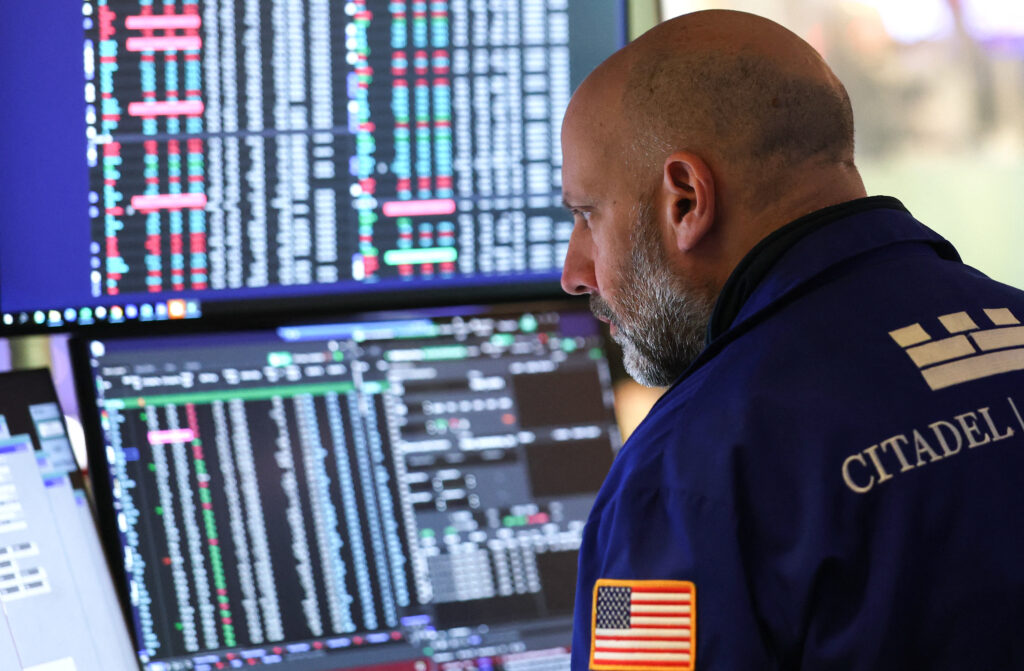
The sell-off accelerated throughout the trading day, with the S&P 500 index shedding 143.15 points, or 2.1 percent, to close at 6,796.86. The tech-heavy Nasdaq slumped 561.07 points, or 2.4 percent, to end at 22,954.32. And the Dow Jones Industrial Average tumbled 870.74 points, or nearly 1.8 percent, to settle at 48,488.59.
The trade-induced volatility came after Trump on Saturday threatened new tariffs on countries that oppose U.S. efforts to acquire Greenland. As global leaders met in Davos, Switzerland, Trump unleashed early-morning social media posts Tuesday and threatened to impose a steep levy on French wine and champagne, adding to broader concerns about his demand for U.S. control of the Danish territory.
“The fear trade is absolutely on right now,” said D.C.-based investment analyst Michael Farr, calling the White House’s pressure on Greenland “unprecedented.”
The Cboe Volatility Index, known as Wall Street’s “fear gauge,” surged 31 percent. The dollar lost nearly 1 percent, and Treasury bond prices dropped — signs of decreased confidence in U.S. markets.
Meanwhile, investors sought refuge in gold, a safe-haven asset, which moved up 3.7 percent to roughly $4,765 per troy ounce. Silver soared past $94, up 6.8 percent.
International markets suffered, too. European stocks sank, with indexes tied to Britain, Germany and France each falling between 1 and 2 percent before recovering somewhat.
The downturn in European stocks comes after Trump threatened over the weekend to impose 25 percent tariffs on eight European nations including Denmark, Norway, Germany and Britain unless they acquiesce to his demand that the U.S. acquire Greenland.
On Monday night, Trump sounded offon social media. He bashed Britain for handing over sovereignty of the island of Diego Garcia, the site of a U.S. military base and the largest of the Chagos Islands. Britain in 2024 said it would cede sovereignty over the archipelago to Mauritius, with the U.S. and Britain retaining operational control of the base.
He also threatened France with 200 percent tariffs on wine and champagne after French President Emmanuel Macron declined to join Trump’s “Board of Peace,” which is being billed as an international peace-building organization. A permanent seat on the board would cost nations $1 billion.
Although the timeline for these tariffs is unclear, several European winemakers sold off. LVMH, the Paris-based luxury goods conglomerate that owns Hennessy, Dom Pérignon and Moët & Chandon, sank 6.1 percent Tuesday.
It remains to be seen how Europe will respond, and what that will mean for U.S. markets and the economy. Chief among investors’ fears is that a European Union policy known as the Anti-Coercion Instrument — also called Europe’s “bazooka” — could impose steep tariffs on U.S. companies.
U.S. Treasury Secretary Scott Bessent brushed off those concerns in a television interview Tuesday. “Well, having worked with the Europeans, my guess is their next move will be to form a working group. The dreaded European working group,” he said on CNBC’s “Squawk Box.”
Markets were unsettled in Asia, too, as Japan’s Nikkei 225 sank 1.1 percent and bond prices dropped there.
China’s stocks largely held up as trade tensions focused on Europe; Hong Kong’s Hang Seng Index, which tracks a number of companies on the Chinese mainland, had fallen by a meager 0.3 percent by midmorning Tuesday.
Analysts gave a mixed outlook for equity markets in 2026.
Comerica Wealth Management chief investment officer Eric Teal said he sees more storm clouds on the horizon, especially given how high stock valuations were at the end of 2025. Markets this year have already been disrupted by geopolitical disturbances, once again calling into question where the effective tariff rate will fall, while the closely watched midterm elections could also bring uncertainty.
None of those factors “bode particularly well for robust market gains,” Teal said in a note to investors, as he recommended that investors diversify their holdings and “play defense.”
Still others believe that trade tensions could settle down. The level of volatility remains far lower than it was last April, when the Trump administration squared off in a trade dispute with China. And the Supreme Court is still considering whether the administration’s “reciprocal” tariffs are legal, a decision that could refund billions to U.S. companies depending on the outcome.
Some investors have grown accustomed to tariff-related uncertainty over the past year.
“Since April 2025, we have seen repeated tariff threats and counter-threats that ultimately have proven to be the opening bids in negotiations that have brought compromise,” said Paul Christopher, head of global investment strategy at Wells Fargo.
The tech sector, whose speculative investment timelines mean it tends to fare the worst in a sell-off, could also offset losses in other areas. Wedbush managing director Dan Ives, a longtime booster of tech stocks, said he believes last year’s artificial-intelligence-driven rally could continue to buoy markets, with Tuesday’s slump representing a buying opportunity.
“Our view is, just like over the last year, the bark will be worse than the bite on this issue and tariff threats as negotiations take place and tensions ultimately calm down between Trump and E.U. leaders,” Ives said in an email.
The post Stocks slide after Trump threatens new tariffs over Greenland appeared first on Washington Post.