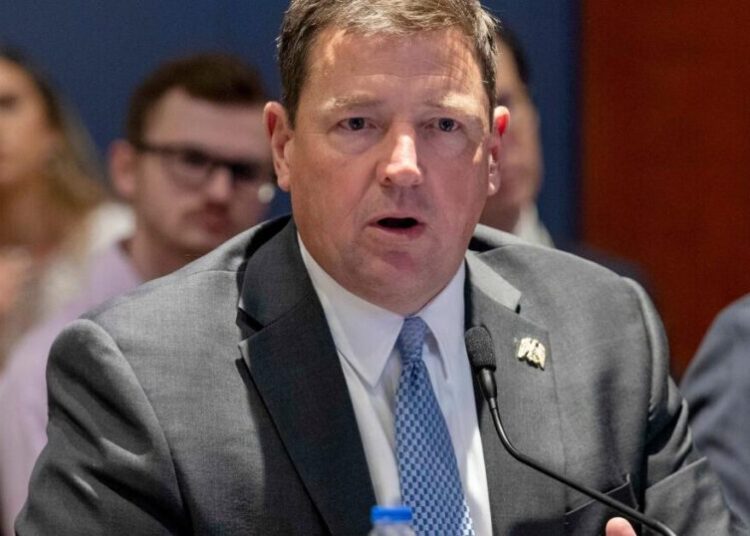
DAVOS, Switzerland — “Calm down the hysteria,” Treasury Secretary Scott Bessent said Tuesday. “Take a deep breath.” He was urging European counterparts and journalists not to read too much into the current kerfuffle over President Donald Trump’s desire to annex Greenland, which was followed by the threat of new U.S. tariffs on a group of European countries standing in solidarity with Denmark.
“America First” does not “mean America alone,” Bessent insisted at a Monday gathering in this Swiss mountain town, where he urged friends “to follow President Trump’s lead for global prosperity, peace and a restored international order.”
At the same time, Trump vividly illustrated why many attendees of the World Economic Forum, the preeminent annual meeting of political and business elite in the world, have a hard time feeling as sanguine as Bessent. Trump posted an AI image of European leaders, including most of the leaders of the Group of Seven major economies, huddled around his Oval Office desk, gazing at a poster of a map that showed the territories of Greenland, Venezuela and Canada as part of the United States.
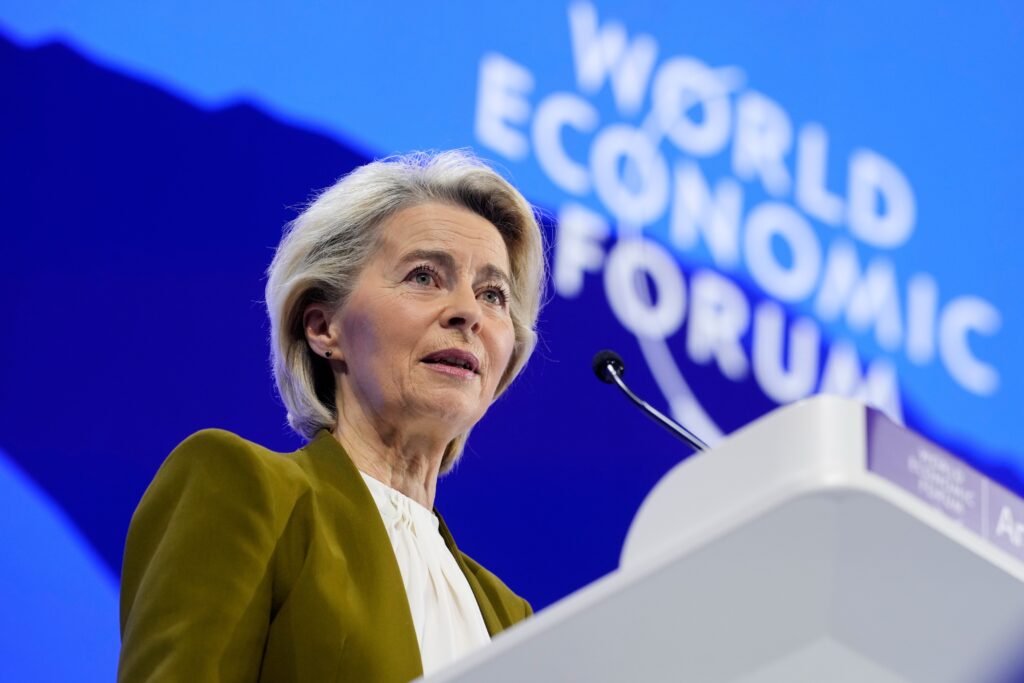
The surreal clamor over the Arctic island provoked by Trump has shadowed proceedings in Davos, and sharpened the sense of an emerging hinge point in ties between the United States and Europe. “When I started preparing for this year’s address, security in the high north was not the main theme,” European Commission President Ursula von der Leyen told delegates during her address. But, she added, Trump’s pressure tactics offer a reminder of how “Europe must speed up its push for independence, from security to economy, from defense to democracy. … The point is that the world has changed permanently, and we need to change with it.”
Von der Leyen welcomed recent trade deals forged between the E.U. and four South American nations, and talked about further diversifying Europe’s economies away from the uncertainty represented by the United States under Trump. She pointed to a possible mammoth new trade deal between the E.U. and India, which has also been hit by Trump’s trade wars. “Europe will always choose the world, and the world is ready to choose Europe,” she said.
The shift is palpable. The signs of the resistance were there even before this week’s summit began. Noisy protests against Trump snarled traffic over the weekend, as thousands made the trip up the mountain for the annual conclave of the global elite. Along the main Davos promenade, people could be seen sporting red “Make Science Great Again” hats and green “Make Europe Great Again” caps. In a major theater turned into Davos’s “climate hub,” dozens of European executives and activists gathered Monday evening to herald the advent of a new social media network named “W” — a European riposte to Elon Musk’s X. Why, the organizers argued, should Europeans publish content “on a platform owned by someone who wants to destroy Europe?”
In remarks Tuesday, French President Emmanuel Macron didn’t mention Trump by name but gestured at the geopolitical Wild West to which the White House seemed to be dragging the world. “It’s not a time for new imperialism or new colonialism,” Macron said. “We do prefer respect to bullies,” he added. “And we do prefer rule of law to brutality.”
A few years ago, Europeans in Davos would muse about “decoupling” from China. Now, von der Leyen spoke of “de-risking” in an environment made volatile by the continent’s most important ally and partner. Trump’s Greenland gambit, analysts say, threatens the integrity of the NATO alliance and many of the underpinnings of the transatlantic relationship. E.U. leaders are expected to meet this week to mull consider a response, including invoking an “anti-coercion” mechanism that could lead to sweeping reprisals against the U.S. and U.S. companies. Even European far-right leaders in countries like France and Germany — figures who have found plenty of common ground with Trump and the MAGA movement — have denounced the White House’s Greenland rhetoric.
“It’s quite absurd to have one NATO partner or ally wanting to take territories from another,” Jessica Rosencrantz, Sweden’s minister for E.U. affairs, told me. “We need to be very clear that this is not acceptable and we will, from the E.U. side, be united and strong in our response.”
But there’s widespread consternation that Europe’s response to a year of Trumpist disruption has been too meek and that the continent doesn’t have the leverage it would need in an actual standoff against Trump. “Europeans are frightened,” Julien Vaulpré, once a senior adviser to former French president Nicolas Sarkozy, told me. “People are frightened because Ukraine is not that far. They are frightened because there seems to be no limits to the behavior of the U.S. president.”
At the same time, Vaulpré argued, Europe needs to find more confidence in itself. “Europe is a huge market. It has a lot of savings and educated people,” he said. “There are some in the French business community who are starting to be a little fed up with lectures from American CEOs who are lapping at Trump’s feet and basically conveying and repeating his ideas.”
The frustration and antipathy toward Trump’s America extends well beyond Davos. Recent polling by the European Council on Foreign Relations — conducted before the latest round of sparring over Greenland — found that only 16 percent of Europeans consider the United States to be an “ally.” A larger proportion of Europeans surveyed see the United States as an “adversary” or “rival.”
“The secular trend is, every year that passes, Europe matters less to America, and America has mattered less to Europeans in terms of its security,” Mark Leonard, the Council’s director, told me. “But then obviously Trump has massively accelerated that. … It does feel like there’s a kind of regime change going on. Trump exemplifies this move against liberalism and a lot of the ideas which were at the heart of the normative idea of the West.”
Michael Jarlner, international editor of Politiken, a leading Danish daily, and a veteran Davos attendee, expressed bewilderment at the Trump administration’s approach. He extolled the deep affinity Danes feel for the United States, a bond that saw Denmark join with the United States in its wars in Afghanistan and Iraq.
“Normally, I would say it’s nice to be in Davos. It’s not so dramatic,” Jarlner told me. “This time, you have a feeling as a Dane that things will be very, very dramatic, but not only as a Dane. It’s about much more than Greenland. It’s about whether the USA will accept the liberal world order or will they break from that world.”
Sign up to receive WorldView, a free, thrice-weekly email newsletter from the international desk of The Washington Post.
The post At Davos, a European backlash to Trump appeared first on Washington Post.