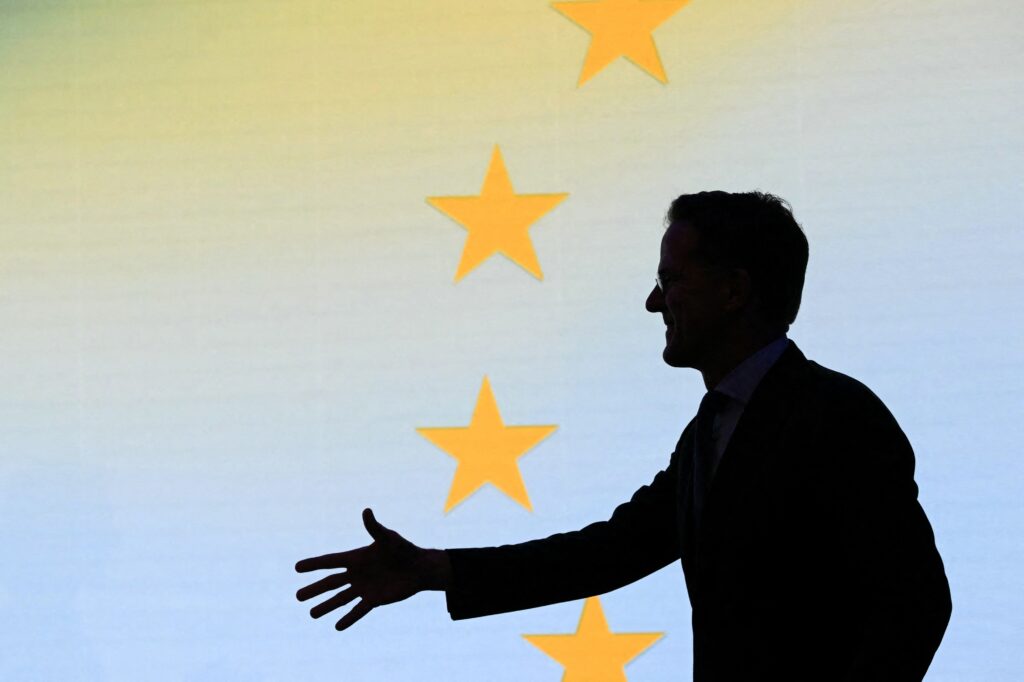
BRUSSELS — After a year of European leaders trying to charm President Donald Trump with flattery and dealmaking — lucrative promises to purchase U.S. goods, including weapons, visits with royals and gifts such as a custom-engraved golf club — Trump’s insistence on controlling Greenland has pushed transatlantic relations closer to a breaking point than leaders or analysts say they have seen in their lifetimes.
Some of America’s once-closest allies say they see no choice other than to hit back, and hard.
“Europe has very strong tools now, and we have to use them when we are not respected,” French President Emmanuel Macron said at the World Economic Forum in Davos on Tuesday. Macron complained of a world where “the only rule that seems to matter is the rule of the strongest.”
Others said Trump had exhausted Europe’s tolerance. “We tried to appease the new president in the White House … We’re dependent on the United States so we chose to be lenient,” said Belgian Prime Minister Bart De Wever, who is scheduled to meet Trump on Wednesday. “But now, so many red lines are being crossed that you have the choice between your self-respect — being a happy vassal is one thing, being a miserable slave is something else.”
Trump’s threats to impose punitive tariffs on European nations that opposed his demand for Greenland could hardly have presented a starker contrast in world views. His Truth Social post landed just as European Union officials were in South America signinga blockbuster free trade deal covering some 700 million people. The protectionist U.S. president, meanwhile, was weaponizing trade in a bid for a NATO ally’s sovereign territory.
For the Europeans, Trump’s hardball tactics may be less shocking than his goal — to buy or seize the vast Arctic territory, which is part of Denmark — a NATO ally that has long shown fealty to the United States. Some, like Macron, have expressed bafflement.
After years of European warnings of the risk that Russian President Vladimir Putin could push through Ukraine and try to bite off a chunk of allied territory, it was the U.S. president, leader of NATO’s most powerful nation, threatening a land grab.
As Trump arrives for talks with leaders in Davos, Switzerland, even the most optimistic concede that efforts to appease Trump are failing. Some leaders who have long urged restraint say there is a risk of a fundamental rupture.
“Nostalgia will not bring back the old order,” European Commission President Ursula von der Leyen said in her Davos speech on Tuesday. “It’s time to seize this opportunity and build a new independent Europe.”
“The proposed tariffs are a mistake, especially between long-standing allies,” von der Leyen said, recalling that she brokered a trade deal with Trump last year. “In politics, as in business, a deal is a deal, and when friends shake hands, it must mean something,” she said.
Still, she added, “Our response will be unflinching, united and proportional.”
The broader ramifications were made clear by the arrival in Davos of Kirill Dmitriev, Russian President Vladimir Putin’s top negotiator on a plan to halt the war in Ukraine that the White House has championed but the Kremlin has resisted — a plan that would require trust not just among friends, but lethal enemies.
Russian Foreign Minister Sergei Lavrov appeared to seek to exacerbate the discord, suggesting on Tuesday that Iceland — another strategically-located NATO member — could become Trump’s next target for acquisition.
Europe’s top leaders say they want to prevent things from spiraling out of control. But across the continent, lawmakers and politicians have cast this as Europe’s moment to show its teeth, or be eaten.
Some European leaders, including Macron and German Finance Minister Lars Klingbeil, are calling on the Commission, which coordinates trade relations for the entire bloc, to unleash what is nicknamed the E.U.’s trade “bazooka.” The retaliatory measure would go beyond tariffs on American goods like bourbon and blue jeans, and hit U.S. services, an area in which the U.S. benefits from a huge trade imbalance with Europe.
“We need to reach a deal and stop this madness, but I think the E.U. will lose everything if it appears weak now,” said Brando Benifei, an Italian member of the European Parliament who chairs the delegation to the United States.
After Norwegian Prime Minister Jonas Gahr Store texted Trump to defuse tensions, Trump’s response was jarring, European officials said. Linking his quest for Greenland to his grievance over the Nobel Peace Prize, Trump wrote back that he no longer needs to “think purely of Peace” since he did not win. He asked why Denmark, which has controlled Greenland for 300 years, has “a ‘right of ownership’ anyway?”
Europeans seem to realize the conciliatory approach in trade talks has run its course, said Benifei, a center-left lawmaker. “This strategy has been shown to fail. What I got from U.S. counterparts was that we were not credible … and the E.U. was divided,” he added. “I learned from the story of the past months that today, the only way to be credible is showing there can be serious consequences for the U.S. economy if we are threatened.”
Benifei and others said that increasingly bold rhetoric from European leaders, insisting they will not be “blackmailed,” reflects a hardening of European public opinion. “They know everyone feels there is a red line that has been crossed,” he said.
Until now, E.U. leaders have weathered some public criticism to avoid a full breach with Trump. At the height of Trump’s trade blitz, the E.U. held back on using its trade arsenal. The 27-nation bloc agreed to swallow some U.S. tariffs last year to preserve the relationship that has underpinned European security and economic interests for 80 years.
Fearing that Trump was being too conciliatory to Russia, the Europeans sought to hold the line at summits, showering Trump with praise for his peacemaking efforts. When the administration said it would no longer pay for Ukraine’s defense, the Europeans kowtowed. They promised to sharply increase military spending at NATO, and to buy U.S. weapons for Ukraine.
Even on Greenland, they offered Trump a deal: Diplomats have conveyed that they were ready to address grievances about Arctic security, expand U.S. military presence in Greenland and offer investment in mineral resources.
None of it has worked. European officials say they must now make clear things have gone too far, lest they appear unwilling to stand up for Europe and its citizens.
The dispute has even triggered warnings that a U.S. invasion of Greenland, which Trump has coveted for its strategic location and natural resources, would spell the end of NATO.
The risks of pushing back against Trump are big. Officials worry Washington could stop weapon sales to Ukraine in its fight against Russia, or withdraw some forces from Europe, for example.
The administration seems to believe Europeans will bend — as they have in the past.
Treasury Secretary Scott Bessent warned retaliation would be “very unwise” on Monday and mocked Europe’s penchant for bureaucracy. “I imagine they will form the dreaded European working group first, which seems to be their most forceful weapon,” he quipped.
At home, the E.U.’s critics contend the problem is not just a lack of leverage or options: The E.U., a trading power that represents one of the world’s largest three economies alongside the U.S. and China, has financial levers but often seems to lack the political will and unity to pull them.
When the E.U. accepted a blanket 15 percent U.S. tariff, leaders sold the deal as a way to restore stability. Instead, that deal is now in question, while eight European countries could face new levies.
Raphaël Glucksmann, a European Parliament lawmaker from France, said the threat of retaliation only deters an opponent who believes it. “We have in Europe the means to resist Trump’s blackmail. Do we have the will?” he wrote. “The days and weeks ahead will show what we are and what we want to be.”
Even some hard-line, E.U.-skeptic parties that otherwise have been buoyed by Trump’s MAGA movement came out against his effort to wrest away Greenland.
The heads of state and government of the bloc’s 27 nations will meet to discuss the crisis over dinner Thursday at a hastily called summit in Brussels.
European officials are weighing their options. The E.U. could reactivate tariffs on more than $100 billion worth of American goods. Policymakers suspended the package last year to sign the trade deal.
The bloc could go further, targeting American services in Europe, a major profit center for U.S. tech giants. The Anti-Coercion Instrument was designed for this kind of economic pressure, though the bloc has not triggered it since its creation in 2023.
This step would allow restricting the access of U.S. firms that do big business in the E.U. market, including Apple, Google or Meta.
Although the crisis has sparked a rare wave of pushback against Washington, however, E.U. capitals have often not been aligned on how to respond to Trump’s provocations.
German Chancellor Friedrich Merz has dampened expectations of a forceful response, saying he is seeking to avoid escalation. NATO Secretary General Mark Rutte has been reticent in public.
The Europeans repeatedly dispatched Rutte over the past year to be their “Trump whisperer” — along with Italian Prime Minister Giorgia Meloni, whom Trump has called “a beautiful young woman” and Finnish President Alexander Stubb, an Ironman triathlete and avid golfer — but have still ended up with the greatest transatlantic crisis in generations.
Meloni, a Trump ally from a hard-right conservative party, called his announcement a “mistake,” while acknowledging the president’s concerns about Arctic security.
Many E.U. officials are hoping retaliation will not be necessary. They want to wait to see if Trump follows through with his threat of new tariffs — 10 percent starting on Feb 1. and up to 25 percent by June.
The United States Supreme Court is also poised to ruleon whether Trump has the legal authority to unilaterally impose tariffs, which could throw a wrench in his plans.
Leaders in Denmark and Greenland are also still trying to find an off-ramp. Residents of Greenland, roughly 57,000 mostly Inuit peoplewho in recent decades gained more autonomy after a legacy of colonial rule, have been pretty clear that their land is not for sale to Washington.
And Danish Defense Minister Troels Lund Poulsen, after a meeting with Rutte on Monday, said that Denmark and Greenland were proposing a NATO mission to the territory.
Trump has so far refused these overtures. He expressed fury last week when troops from Denmark and other NATO countries arrived in Greenland for joint military drills.
It is those eight countries — Denmark, Britain, France, Finland, Germany, the Netherlands, Norway and Sweden — facing tariffs, even though they portrayed the deployment as an allied response to Trump’s complaints that Greenland was not sufficiently protected from Russia and China.
Beatriz Rios in Brussels, Kate Brady in Berlin and Michael Birnbaum in Washington contributed to this report.
The post Trump’s Greenland crusade pushes European allies to a breaking point appeared first on Washington Post.