Ever since Donald Trump started talking about taking Greenland away from Denmark, European leaders have hoped that his notoriously short attention span would save them. Mr. Trump’s threat of tariffs against eight European countries may be dimming those hopes.
After the European countries held a small military exercise in Greenland, Mr. Trump announced an economic punishment. He said he would impose new tariffs, starting at 10 percent on Feb. 1 and jumping to 25 percent on June 1, until Denmark agreed to sell Greenland to the United States. While Europeans worry that Mr. Trump’s demands could destroy NATO, Treasury Secretary Scott Bessent has suggested they have little choice. “The European leaders will come around, and they will understand that they need to be under the U.S. security umbrella,” he said. “What would happen in Ukraine if the U.S. pulled its support out? The whole thing would collapse.”
Outside threats can clarify minds. Europeans are slowly, painfully beginning to understand their true situation. The United States claims it needs to own Greenland for its national security. Now it has turned on Europe, demanding that it hand over territory and people to satisfy a president’s whim.
The only way to maintain European independence is to escalate back. To do this well, Europe needs to incorporate ideas into its economic thinking that seem alien to a continent that prefers soft power to hard security strategies — deterrence, credible threats and escalation dominance.
Repeated submission has gotten Europe into a mess. To get out, Europe needs to commit to not back down.
Credible commitments and tripwires are the strategic concepts of Thomas Schelling, the Nobel-winning economist and national security thinker who died in 2016. Mr. Schelling’s ideas shaped America’s nuclear strategy in the Cold War. He saw proxy wars and threats of missile strikes as the brutal language in which the Soviet Union and the United States bargained with each other, each seeking political advantage while avoiding mutual nuclear annihilation.
Mr. Schelling and his colleagues believed that great powers could deter attack by making credible threats of retaliation, even if actually hitting back would be difficult or painful. Ambiguity was the enemy of efficacy: Threats had to be specific, explicit and devoid of loopholes that could allow the deliverer to back down. The most credible threats were those that the deliverer had no choice but to carry out.
The notion of “escalation dominance,” developed by the RAND futurist and nuclear strategist Herman Kahn, plays a crucial role in determining who backs down and who doesn’t. Escalation dominance suggests that if a fight escalates into a tit-for-tat, the power more willing to endure pain and keep on hitting back will dominate. So long as other powers understand this, they won’t pick fights in the first place.
Such ideas may have motivated the eight European countries that ran a small military exercise in Greenland last week. They certainly didn’t think their brief expedition could defend a huge territory against an American military incursion. Instead, they were creating what Mr. Schelling called a tripwire.
During the Cold War, West Berlin was over 100 miles inside enemy territory and militarily indefensible. Mr. Schelling suggested that the United States stationed troops there so they would die if the Soviets attacked. Soviet leaders worried that if they stumbled into this tripwire, they might provoke a nuclear war. They preferred not to risk it.
Similarly, if America invades a territory that has the explicit military support of eight NATO allies, it has to worry that it will precipitate a much bigger political crisis. The tactics appear to have worked: The Trump administration quickly shifted from military threats to economic ones.
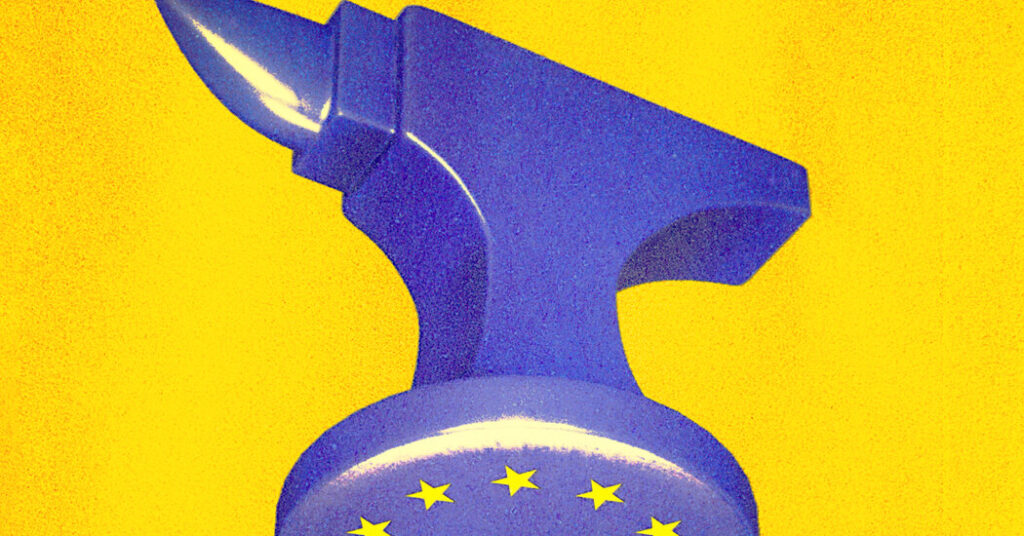
But the European Union appears to be less comfortable pulling from Mr. Schelling’s strategic playbook when it comes to economic warfare. European governments have dithered over how to fend off Mr. Trump for nearly a decade. Still, they do have an economic tripwire, however imperfect, if they can agree to deploy it: the so-called anti-coercion instrument, or trade bazooka, as it is often referred to.
The instrument was introduced in 2023, after European officials became alarmed by the increasing threat of trade weaponization. It is a platform for economic warfare, allowing European Union officials to deploy trade quotas, deny access to financial markets, revoke intellectual property, ban investment and impose import and export restrictions on countries that try to coerce Europe.
The anti-coercion instrument is very powerful in principle, but it has never been wheeled out onto the economic battlefield. It can only be deployed after fact-finding and consultation, providing European governments with opportunities to veto its use. In the past, larger E.U. member states such as Germany have cautioned against using it to avoid being dragged into economic conflicts that might hurt their national interests.
For now, the anti-coercion instrument is less a bazooka than a waterlogged firecracker. I have heard European officials claim that its mere existence is sufficient deterrent against attacks. But that’s not how deterrence works. If no one believes that you will use a weapon against him, no one will fear it.
Last year, one jaundiced European Union insider privately compared the anti-coercion instrument to the Doomsday Machine in Stanley Kubrick’s “Dr. Strangelove.” (Mr. Schelling was an adviser on the movie.) The fictional weapon was automatically triggered by a nuclear attack, but it was kept top secret, rendering its ability to deter futile. European officials, on the other hand, talk incessantly about the anti-coercion instrument, but it still fails to deter because they seem so extraordinarily reluctant to deploy it.
Now an attack is underway. Mr. Trump is using tariffs and other threats to force Europe into submission. So what next?
The European Union is hedging. It is considering imposing tariffs worth 93 billion euros (about $109 billion) on America but has yet to decide or activate the anti-coercion instrument. France has proposed using it, but a majority of E.U. states want dialogue with Mr. Trump before going further, and Germany’s chancellor has said that any retaliation would have to be one that “protects Germany’s interests,” which include maintaining exports.
This is exactly the kind of situation that the instrument was designed for. Europe, however, seems too timid to use it. Mr. Bessent has scoffed that Europe’s most forceful weapon is the “dreaded European working group,” suggesting it will never get around to using the instrument. Europe seems in no hurry to prove him wrong.
If Europe wants to retain its independence, it needs to commit to action. The anti-coercion instrument, for all its faults, is the best option that Europe has. It should start the process of activating it, and quickly announce the specific measures it would impose.
Such measures could include intellectual property revocations that could damage American Big Tech. The anti-coercion instrument also allows retaliation against individuals and businesses that act on behalf of coercive governments. The limits of these tools are murky and untested, but they could weaponize the Trump administration’s rampant cronyism against itself.
Billionaires and businesses that have entangled their interests with the president’s could suddenly discover that they are vulnerable. The investors and crypto enthusiasts who are salivating over taking Greenland’s minerals and setting up their very own private government there may discover that their fantasies come with a steep price tag.
The risk of using the instrument is that Mr. Trump will rush to Armageddon, immediately withdrawing all support from Ukraine. That would be a disaster for Europe. It would also be a disaster for America and for Mr. Trump, as markets would very likely crater and the trans-Atlantic relationship collapse.
The trick for Europe would be to stand firm and escalate gradually, responding to aggression in carefully modulated increasing doses, identifying targets that are awkward for Mr. Trump to defend, and providing an exit for de-escalation.
Europe needs to deploy its tripwire if it wants to deter Mr. Trump’s attacks, and possibly in the future, China’s. If it does, it likely has the bargaining advantage. Most Americans don’t agree with Mr. Trump’s trying to buy Greenland, and many more oppose the idea of taking it by force. Fantasies deflate quickly once real costs become obvious, but it is impossible for Europe to impose costs without incurring risks itself.
Henry J. Farrell, a professor of democracy and international affairs at Johns Hopkins, is the author, with Abraham L. Newman, of “Underground Empire: How America Weaponized the World Economy” and writes the newsletter Programmable Mutter.
The Times is committed to publishing a diversity of letters to the editor. We’d like to hear what you think about this or any of our articles. Here are some tips. And here’s our email: [email protected].
Follow the New York Times Opinion section on Facebook, Instagram, TikTok, Bluesky, WhatsApp and Threads.
The post Europe Has a Bazooka. Time to Use It. appeared first on New York Times.