In the nearly two days since a high-speed train crash in southern Spain, investigators have focused on whether a fault in the track could be to blame for the derailment of a northbound train that swerved into the path of an oncoming southbound train, resulting in a devastating collision that killed at least 42 people.
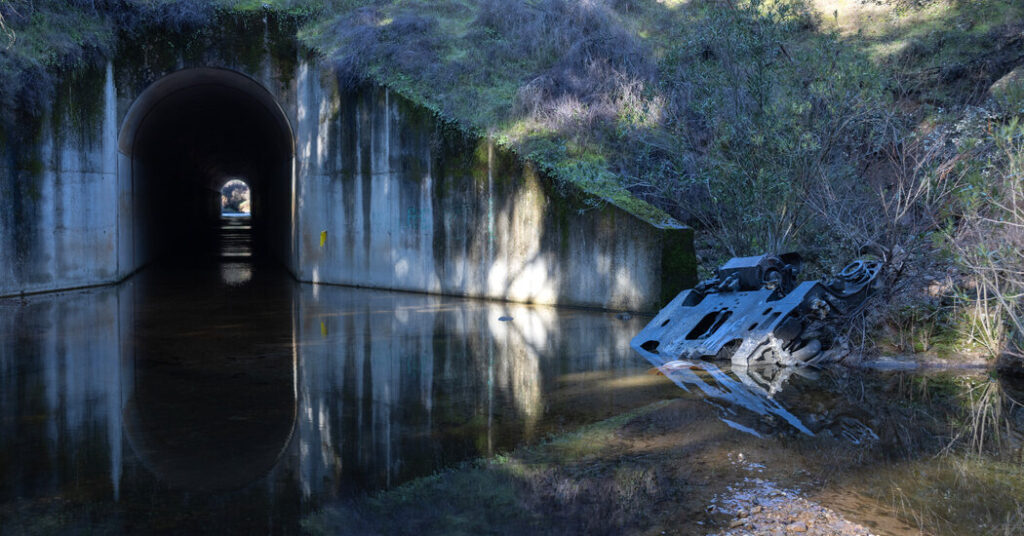
But on Tuesday, the emergence of a previously unreported train undercarriage — half submerged in a stream flowing through a steep-sided gully 900 feet from the railway — gave experts a potential new clue about what caused the crash.
The hulking piece of debris, seen by a photographer for The New York Times on Tuesday afternoon, was not marked or cordoned off by government investigators and had not previously been disclosed by officials. When shown images and maps locating the undercarriage on Tuesday, police officers assisting the investigation in Adamuz, a town in southern Spain near the city of Córdoba, first said they had been looking for it, and later said they knew about it, but could not comment on an ongoing investigation.
ADIF, a state-owned authority that manages much of Spain’s rail infrastructure, said on Tuesday evening that the part had been located by investigators, but did not respond to a question about when it was found. The Times was not able to confirm which train it came from, whether it landed there on Sunday, or how it got there.
Experts on Tuesday said the discovery of the undercarriage, if it indeed belonged to one of the two trains involved in the crash, could provide a critical clue to what went wrong, and whether parts of the train itself contributed to the disaster.
“This is going to be real important if this turns out to be the root cause of the accident,” said David B. Clarke, an associate professor and railroad expert at the Center for Transportation Research in Knoxville, Tenn.
One person briefed on the government investigation, who spoke on condition of anonymity because the person was not authorized to speak publicly about the case, said the photograph of the undercarriage appeared to show a set of wheels that could shed light on the cause of the crash.
The distance that the undercarriage appeared to have traveled from the tracks also could be an important piece of information, according to Andrew Maloney, a transportation attorney in New York who has specialized in civil lawsuits related to transportation accidents.
“The location of where parts are found can be critically important in reconstructing the accident sequence,” Mr. Maloney said.
If a part is found far from the crash site, “it could mean that it was the cause of the derailment,” Mr. Maloney said. “If it’s found with the rest of the wreckage or close by, it may mean it became detached after the derailment and collision.”
The Italian state-controlled railway group Ferrovie dello Stato, which is the majority owner of Iryo, which operated the derailed train, declined to comment about whether the undercarriage belonged to their train. Iryo did not return a request for comment. Renfe, the state-owned company that operated the second train, said questions about the undercarriage should be addressed to the investigators.
The new finding came as Spanish authorities struggled to identify the dead and used heavy machines to look for more bodies. On Tuesday evening, data provided by Spain’s Interior Ministry showed that 25 bodies still had not been identified. The Spanish police said they had received missing-person reports for 40 people.
The crash, Spain’s worst railway disaster since 2013, has deeply disturbed a country that depends on, and takes great pride in, its high-speed rail system, the largest in Europe and the second largest in the world, behind only China’s. Late Tuesday, a regional train in Gelida, Spain, derailed in Gelida, Barcelona, injuring around 15 people, according to Martí Anglada, a regional official.
Earlier Tuesday, many Spanish news reports focused on a different photograph, released by the Spanish police, of investigators examining a particular stretch of track near the disaster site. The Commission for the Investigation of Railway Accidents had said that it was examining the general condition of the track as a possible cause of the crash.
Óscar Puente, Spain’s transport minister, said in a radio interview on Tuesday that there had been “an initial break” in the track, but he added that “no technician is yet able to say whether it is a cause or a consequence” of the derailment. “If the rail broke first, we would need to find out why a solid steel rail broke,” he said.
Authorities said the crash would shut down service on the line between Madrid, Spain’s capital, and the southern city of Córdoba for weeks, raising concerns for the economy of a key area in southern Spain.
“It’s a line that connects and brings us a lot of economic and tourist flow. First of all, it’s going to be a long stretch until the track can be repaired. Secondly, there’s a feeling of insecurity that can spread,” said José María Bellido, the mayor of Córdoba.
Throughout the day, harrowing new details emerged from survivors of the crash.
Passengers on the northbound train recounted cars vibrating strangely, carriages lurching, suitcases tumbling and glasses sliding off tables onto the floor during the initial derailment. About 20 seconds later, around 7:45 p.m., the southbound train, operated by the national rail provider, Renfe, barreled into the derailed carriages. Its first two cars fell down a 12-foot embankment, a preliminary report said.
The northbound train, which had about 300 people aboard, continued for hundreds of yards before coming to a stop. Surviving passengers described wandering in the dark and cold through a scene strewn with corpses, as local residents rushed to help.
Jason Horowitz is the Madrid bureau chief for The Times, covering Spain, Portugal and the way people live throughout Europe.
The post Hidden In a Stream, New Clues About Cause of Spain Rail Crash appeared first on New York Times.