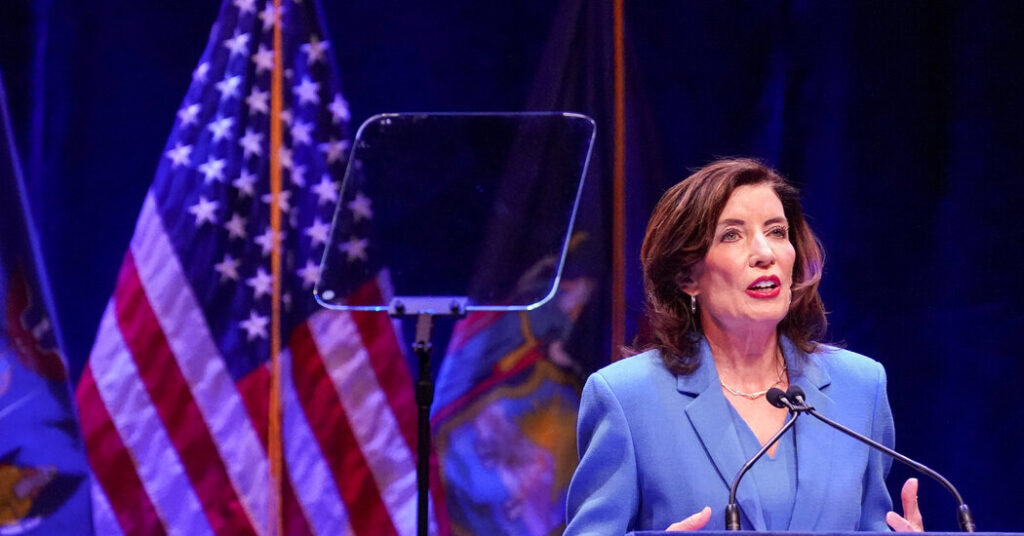
Gov. Kathy Hochul of New York on Tuesday released a preliminary $260 billion executive budget that called for significantly expanding child care services, lowering energy bills and rebuilding infrastructure — without raising income taxes.
The threat of more cuts from Washington hung over the state budget, helping deliver a spending plan that largely kept expenses stable. New York received $93 billion from the federal government this year, but it is unclear whether President Trump will match that level of funding in the fiscal year ahead.
The president warned last week that his administration would withhold funds from any state that contained a so-called sanctuary city that restricted collaboration with immigration officials. (New York has several.) The state cooperates with Immigration and Customs Enforcement on instances in which an immigrant is accused of a crime; it does not cooperate with civil immigration enforcement. The state is exploring legal options to fight such cuts, Ms. Hochul said.
Ms. Hochul said in a briefing with reporters Tuesday that in most years, economic uncertainty was the biggest budgetary risk that New York faced.
“The newest, most unpredictable challenge is something very different: direct attacks on states by the Trump administration,” she said.
The proposed budget calls for a $6 billion spending increase from the previous year, largely as a result of rising Medicaid, school aid and child care costs. The increase is smaller than in years past, as the state reckons with the loss of more than $10 billion in federal funds.
But a surging stock market and large Wall Street bonuses meant the state took in more tax revenue in than expected, helping Ms. Hochul avoid even tougher choices as she seeks re-election this year.
“This is not an austerity budget, but it is a disciplined one,” Ms. Hochul said Tuesday.
Ms. Hochul, a centrist, has repeatedly promised voters that she would not raise taxes, which she sees as counterproductive to the state’s efforts to attract business. She has kept her word in this budget, announcing that revenues were sufficient to cover the first two years of her proposed $1.7 billion child care expansion — which would raise the state’s child care spending to $4.5 billion in the coming year.
That commitment is a major win for Zohran Mamdani, the New York City mayor, who made universal child care a key part of his election agenda. Mr. Mamdani had proposed a wealth tax to help fund the expansion, but he seems satisfied with Ms. Hochul’s funding method.
While income taxes are not increasing, there are other revenue raisers tucked into the state’s 140-page budget briefing book. Ms. Hochul wants to maintain the 7.25 percent corporate franchise tax rate, which was temporarily raised from 6.5 percent in 2021. It was slated to expire this year, but the governor wants to keep the higher rate through the 2029 tax year.
A 75 percent wholesale tax on tobacco products, which already exists, will now apply to smokeless produces like Zyn, Ms. Hochul said. The hope is that this will decrease the use of these items, while also increasing the amount state receives from this tax by $50 million.
Ms. Hochul also provided more details on her plans to eliminate taxes on tips. No taxes would apply to the first $25,000 of tipped income for single people earning up to $150,000 and couples earning up to $300,000.
The governor is also proposing a broader range of tools to increase the supply of child care programs across the state, including changes to zoning. These efforts will be overseen by a new Office of Child Care and Early Education, which will be set up in the coming year.
And this being an election year, the budget also includes a bevy of investments targeted at constituencies Ms. Hochul will hope to win in November.
She is proposing to spend $153 million to recruit and retain corrections officers — a key priority of upstate communities where prisons are among the larger employers. Long Island is likely to benefit from $3.75 billion to overhaul water infrastructure.
And New York City will receive money to expand its program for freezing rent for older New Yorkers and disabled people. Ms. Hochul is proposing to lift the income cap on that program from $50,000 to $75,000 in the city, as well as in Westchester, Nassau and Suffolk Counties.
Under the executive plan, the state would maintain $14.6 billion in reserves. That’s down from $21 billion it had before it paid off a chunk of unemployment insurance debt last year, but considerably more than the $ reserves the state had on hand when Ms. Hochul took office in 2021.
Even so, Andrew Rein, the president of the Citizens Budget Commission, said it wouldn’t hurt to maintain frugality, given the uncertainty coming from Washington.
“It would be good to have another couple billion,” he said.
Grace Ashford covers New York government and politics for The Times.
The post Hochul Unveils $260 Billion N.Y. Budget That Avoids Raising Taxes appeared first on New York Times.