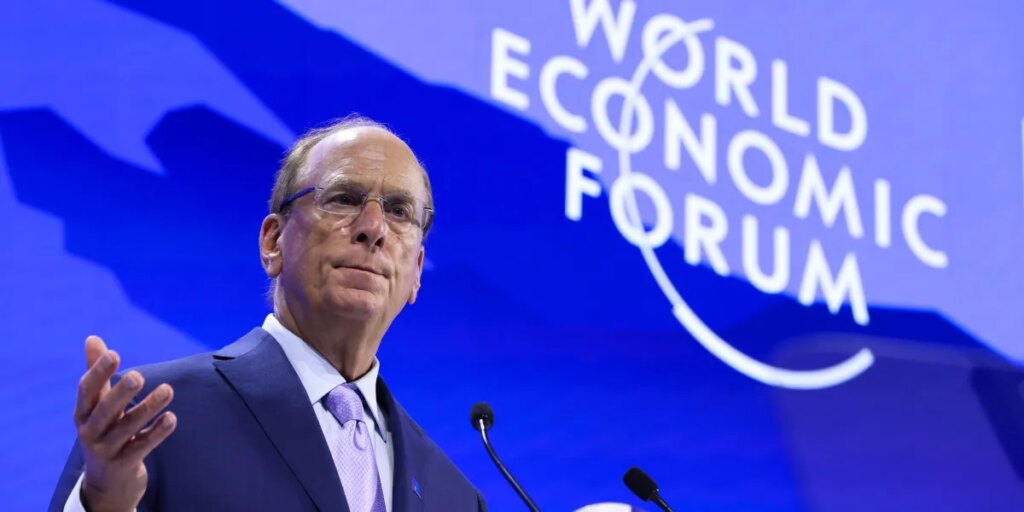
BlackRock CEO Larry Fink opened the World Economic Forum in Davos, Switzerland, with a stark message to the global elite: AI’s unfettered growth risks pummelling the world’s working and professional classes. Beyond that, he warned that it could be capitalism’s next big failure after a 30-year reign after the Cold War that has failed to deliver for the average human being in society.
In his opening remarks on Tuesday at the gathering of thousands of executives and global leaders, the billionaire boss of the world’s largest asset manager—often called one of Wall Street’s “Masters of the Universe”—said that as those in power discuss the future of AI, they risk leaving behind the vast majority of the world, just as they have for much of the last generation.
“Since the fall of the Berlin Wall, more wealth has been created than in any time prior in human history, but in advanced economies, that wealth has accrued to a far narrower share of people than any healthy society can ultimately sustain,” Fink said.
Fink, who has used his annual BlackRock letters and annual appearances at Davos to set the agenda for a more progressive kind of capitalism, even one that is arguably “woke,” making him at times the face of ESG and of stakeholder capitalism, warned that the gains of the tremendous wealth creation since the 1990s have not been equitably shared. And the capitalist ideology driving AI development and implementation forward could come at the expense of the wage-earning majority, he added.
“Early gains are flowing to the owners of models, owners of data and owners of infrastructure,” Fink said. “The open question: What happens to everyone else if AI does to white-collar workers what globalization did to blue-collar workers? We need to confront that today directly. It is not about the future. The future is now.”
Fink’s past critiques of capitalism
Fink, who was appointed interim co-chair of the World Economic Forum in August 2025, replacing founder Klaus Schwab, has long espoused the reshaping of capitalism, seeing it as a responsibility of large asset managers like himself. Fink was formerly vociferous about the importance of environmental, social, and corporate governance (ESG) investing, and has argued that climate change is reshaping finance, creating an imperative for executives to reallocate their capital to address the crisis accordingly. In a 2022 letter to investors, published the day before the Davos summit, Fink emphasized a model of “stakeholder capitalism” of a business’s mandate to serve not just shareholders, but employees, consumers, and the public.
Fink’s new primacy in Davos is the first without Schwab, following allegations that he had expensed more than $1 million, billed to the World Economic Forum, on questionable travel spending, as well as claims of workplace misconduct and research report manipulation. The BlackRock chief emphasized the need for the gathering to demonstrate its legitimacy in part by showing that it’s concerned with more than just swelling growth of companies and countries, but also the economic welfare of its employees and citizens.
“Many of the people most affected by what we talk about here will never come to this conference,” Fink said. “That’s a central tension of this forum. Davos is an elite gathering trying to shape a world that belongs to everyone.”
Though BlackRock announced in early 2025 it would roll back many of the diversity, equity, and inclusion goals it created a few years before, Fink has once again used his spotlight to call on leaders to transform their capitalist sensibilities, this time in how they imagine the AI future.
The cost of the AI boom
Last year capped an explosion of growth in the AI sector, with Morningstar analysts finding a group of 34 AI stocks, including Amazon, Alphabet, and Microsoft, shot up 50.8% in 2025. AI firms and investors have seen their wealth skyrocket in the past year, with Per the Bloomberg Billionaires Index, the median increase in net worth last year was nearly $10 billion among the 50 wealthiest Americans. Google co-founder Larry Page and Sergey Brin, for example, got $101 billion and $92 billion richer, respectively, in 2025.
The BlackRock CEO noted these gains, however, have been reserved for the richest few, alluding to a K-shaped economy of the rich getting richer, while the poor continue to struggle: The bottom half of Americans, in short, are not cashing in on the AI race. Although Fink didn’t get into the politics of utilities setting electricity prices, it seems the poor are actually paying higher bills to support the data centers powering the AI boom. According to Federal Reserve data, the poorer demographic owns about 1% of stock market wealth, translating to about 165 million people owning $628 billion in stock. Conversely, the top 1% of wealthiest households own nearly 50% of corporate equity.
Fink’s framing of the post-Cold War era as one of exploding inequality represents a mainstreaming of a once niche view that has become increasingly mainstream in the 21st century. While the triumph of the west over communism was seen as the ultimate victory for capitalism, as epitomized by Francis Fukuyama’s The End of History and the Last Man, history has in fact continued. The unprecedented rise of China as an economic superpower, through its fusion of socialism and capitalism “with Chinese characteristics,” has complicated the narrative, as has the inequality alluded to by Fink.
An internal critic of the post-Cold War world order is Andrew Bacevich, a military veteran and historian who likened the collapse of the Soviet Union in 1989 as “akin to removing the speed limiter from an internal combustion engine.” Bacevich’s 2020 book The Age of Illusions: How America Squandered Its Cold War Victory, was an early articulation of the once niche viewpoint that Fink lent support to on Tuesday.
What AI’s growth means for workers
Similarly, the risks of the AI boom on workers extends beyond who has a stake in the technology industry’s growth. Nobel laureate and “godfather of AI” Geoffrey Hinton has previously warned this explosion of wealth for the few will come at the expense of white-collar workers, who will be displaced by the technology.
“What’s actually going to happen is rich people are going to use AI to replace workers,” Hinton said in September. “It’s going to create massive unemployment and a huge rise in profits. It will make a few people much richer and most people poorer. That’s not AI’s fault, that is the capitalist system.”
Some companies have already leaned into culling headcount to grow profits, including enterprise-software firm IgniteTech. CEO Eric Vaughan laid off nearly 80% of his staff in early 2023, according to figures reviewed by Fortune. Vaughan said the reductions happened during an inflection point in the tech industry, where failure to efficiently adopt AI could be fatal for a company. He’s since rehired for all of those roles, and he would make the same choice again today, he told Fortune.
According to Fink, sustaining a white-collar workforce will depend on the world’s most powerful people creating an actionable plan that will defy the critiques of capitalism that has, so far, stood to predominantly benefit them.
“Now with abstractions about the jobs of tomorrow, but with a credible plan for broad participation in these gains, this is going to be the test,” Fink said. “Capitalism can evolve to turn more people into owners of growth, instead of spectators watching it happen.”
The post BlackRock’s billionaire CEO warns AI could be capitalism’s next big failure after 30 years of unsustainable inequality after the Cold War appeared first on Fortune.