One year and a seemingly infinite number of news cycles ago, Donald J. Trump returned to Washington.
The city was drunk with expectation and dread that first weekend leading into his inauguration. Trump supporters palled around town in pedicabs blaring “Y.M.C.A.” Plutocrats partied on yachts in the Potomac. Tech billionaires sat cheek to jowl in the Capitol Rotunda, licking their lips. Democrats looked in a daze.
The president who had been left for political dead was regenerated, bigger and bolder than ever, back inside the building that a mob of his supporters attacked four years earlier. The world tried to wrap its head around the thought — the reality — of a second Trump presidency. What would it be like this time?
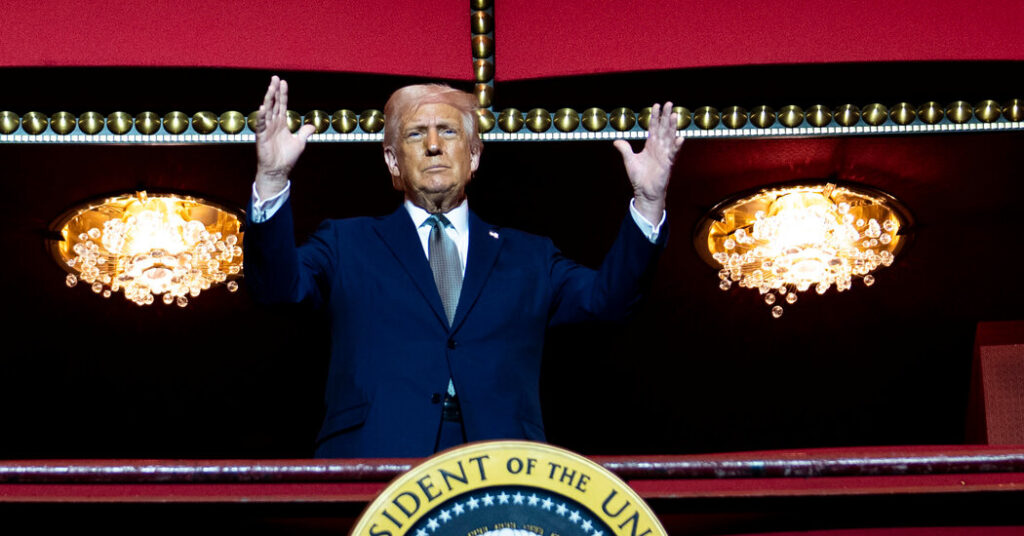
The official photograph of Mr. Trump printed inside the programs that day was a startling image that thrilled some and terrified others. Bathed in eerie light from below, high-powered strobes reflected in his eyes, he glared out from the portrait and into the future he was about to conjure for us all.
Ordinarily, by the one-year point in a presidency, it is possible to connect certain dots so that a coherent picture begins to come into focus, showing us where a president is taking the country.
In this case, there is conspicuousness — Mr. Trump seems to be everywhere, in everything — but there is little consistency or predictability.
This has been the great truth of Trump II so far, and anyone who has spent time in Washington this past year has experienced it in some way big or small. European leaders. Republican allies. Military commanders. Media executives. Financiers. Oilmen. Journalists trying to make sense of the daily machinations.
None of these people have any idea what tomorrow holds. It doesn’t seem knowable.
At a business forum in Qatar last month, Donald Trump Jr. said that “what’s good about my father, and what’s unique about my father, is you don’t know what he’s going to do.”
The son called the father “the most unpredictable person, probably in the history of politics.” He wouldn’t get any argument there from anyone in Washington.
The president’s supporters sent him back to this place to disrupt. They see his ability to keep everyone guessing as one of his supreme strengths, a strategy unto itself.
But one year since his return to power, this question has only deepened: Is there a strategy behind all this terrific unpredictability — or does it reflect the absence of one?
Tariffs come on. Tariffs come off. Tariffs come on again, but only partially. Tariffs come off again.
The Trump administration spent the last six months trying to hash out a trade deal with the European Union. That deal blew up spectacularly this weekend after Mr. Trump suddenly decided to threaten eight European nations with new tariffs until they agree to sell Greenland to the United States.
Trump Administration: Live Updates
Updated
- Judges Seek to Fill Top Prosecutor Job in Virginia
- Greenland’s prime minister says he cannot rule out a U.S. attack.
- Canada’s prime minister says there has been a ‘rupture’ in the world order.
The very same European heads of state now being threatened by Mr. Trump had spent the year making pilgrimages to Washington, separately and then all together in August, to endear themselves to him. Oftentimes, it seemed to work.
At that August confab, Mr. Trump talked about how much he admired everyone gathered at his table. He said that Prime Minister Keir Starmer of Britain was “my friend.” President Emmanuel Macron of France had “been with me from the beginning.” The NATO secretary general? “Doing a fantastic job.”
Maybe, on that day, Mr. Trump really did feel that way. But so what? These days, the Europeans are conducting military exercises in Greenland amid Mr. Trump’s increasingly menacing designs on the icy land mass in the North Atlantic.
The president spent half the year bullying Canada until Canada’s new prime minister went to the White House. “I love Canada,” Mr. Trump claimed at that meeting. Asked then what “concession” he wanted from Canada, he said only “friendship.” But how can the Canadians be sure?
How can anyone be sure of anything?
One morning last week, Mr. Trump announced that he was close to invoking the Insurrection Act of 1807 to send troops into Minnesota to put down the protests that had broken out after an ICE agent shot and killed a woman there.
The very next morning, this extraordinary development was off. As he traipsed across the South Lawn of the White House to make his way down to Palm Beach, Fla., for the weekend, Mr. Trump casually declared that there was no need for the Insurrection Act. Preparing for the possibility that Mr. Trump might change his mind again, the Pentagon told 1,500 active-duty troops to ready for a possible deployment to Minnesota.
One of the most illuminating things Mr. Trump said this year was that it was important for the United States to actually own Greenland “because that’s what I feel is psychologically needed for success.” Psychologically important for him, or for the United States, he was asked? “Psychologically important for me,” he answered.
His psychology is his doctrine. Foreign policy, the economy, domestic politics — all plans and policies in Washington now come filtered through the overmastering prism of this “unpredictable” psyche.
He is the capo dei capi of chaos.
So many events this year have been so absurd, so abrupt, or so operatic that they have contributed to a general atmosphere of destabilization — of entropy and caprice and expediency — in the capital.
Remember Elon Musk? He was such a central character for the first half of the year, lording over cabinet meetings, giving news conferences while standing beside the Resolute Desk, until one day his time in Washington was over.
He showed up to the West Wing for his last day of work with a black eye (which he blamed on his toddler). Mr. Trump gave him an oversize novelty key to the White House and sent him on his way. A few days later, the two men got into a nasty fight in which the mogul accused the president of covering up Jeffrey Epstein’s crimes and the president threatened to use the power of the government to destroy the mogul.
What was the public to make of any of this? The two are said to be friends again.
One morning in October, everybody in Washington woke up and, poof, the East Wing was gone. The president had insisted his plans for a White House ballroom would pay “total respect to the existing building.” Well, the building doesn’t exist anymore. All that’s left of the East Wing is a pile of mud that’s been dumped in the middle of a public golf course in the Potomac. Cranes currently encircle the White House, and the plans for the ballroom keep changing.
The president seized control of the Kennedy Center and put a crew of right-wing political operatives in charge of it. Ticket sales plummeted. He decided to host the Kennedy Center Honors himself. Ratings plummeted. His name was put on the front of the building. The Washington National Opera departed. He has declared the institution saved.
Presidential mood swings play themselves out in televised cabinet meetings that can go from dark and stormy to sunny and funny over the course of an hour. The morning after he single-handedly provoked this weekend’s diplomatic uproar, as European leaders hurriedly convened an emergency meeting in Brussels, Mr. Trump directed his motorcade to … a furniture store in Palm Beach.
White House officials did not respond to an inquiry asking what sort of furniture he was looking to buy.
On balance, there has been no balance. Only imbalance. Sometimes, a measure of imbalance is what’s needed to shake up sclerotic institutions, relationships, old ways of thinking — and that is what Mr. Trump’s supporters sent him back here to do one year ago to the day.
But a lot of what’s happened since last January has left much of Washington and the world with what seems like a strange new variety of American vertigo.
Shawn McCreesh is a White House reporter for The Times covering the Trump administration.
The post One Year In, Searching for a Strategy Behind Trump’s Unpredictability appeared first on New York Times.