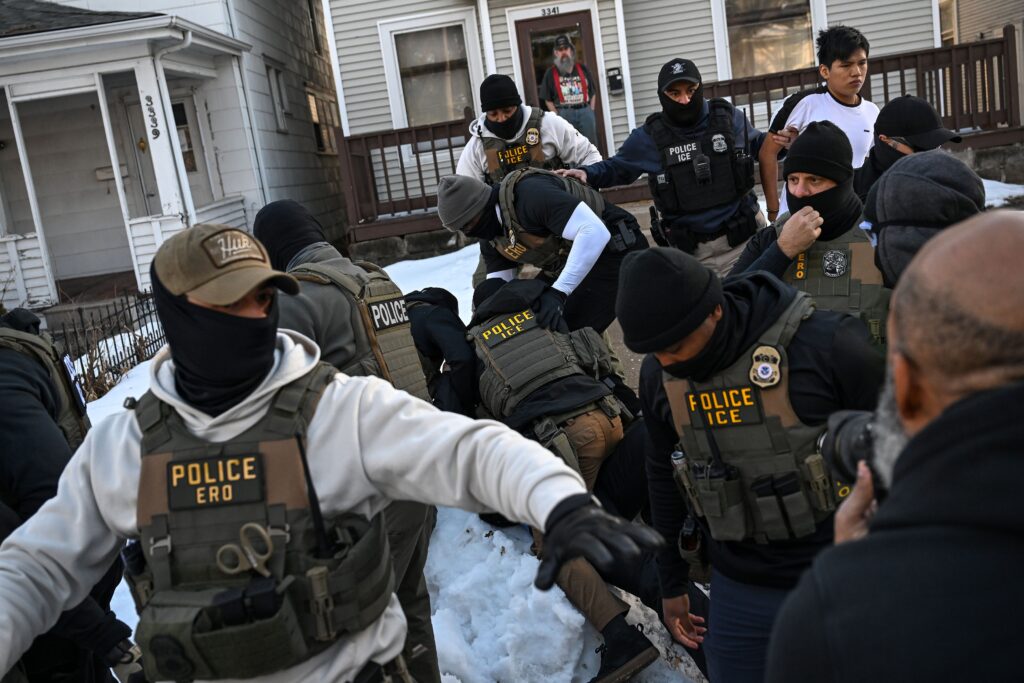
MINNEAPOLIS — On the seventh Friday of the largest immigration enforcement operation in a U.S. city, during a presidency defined by the issue, a growing cadre of activists searched tinted car windows for masked federal agents. A man facing a deportation order in connection with a rape more than 20 years ago begged one of those agents for a final moment to say goodbye to the mother of his children. A child care worker blowing desperately on a whistle sprinted after two federal officers pursuing a person. And a 22-year-old Ecuadorian asylum seeker ventured out nervously to a new job in a city that seemed to be tilting on end, in a country threatening to shake her loose.
An estimated 3,000 people have been arrested since Operation Metro Surge began, according to Homeland Security officials, following crackdowns in Chicago, New Orleans, Portland, Memphis, Charlotte and Los Angeles.In relative terms, Metro Surge dwarfs those other efforts, with more officers — about 2,000 to begin with — flooding the streets of Minneapolis and St. Paul, which together have a population about one-quarter the size of Chicago and less than one-fifth the size of Los Angeles.
The saturation of federal enforcement has reoriented aspects of public life, especially for non-White residents, both documented and undocumented. The choices people make have changed: dropping kids at school, or going to school at all; whether to shop, and what to shop for; whether to go out at night; whether to drive to work; whether to go to a doctor’s appointment. Federal officers roam in tinted SUVs most hours of the day. And thousands of civilians, many of them U.S. citizens with no deportation risk, have organized themselves into a highly coordinated campaign to thwart those officers. The sounds of car horns and whistles, megaphones and profane chants have become the soundtrack to daily life in the Twin Cities’ most diverse neighborhoods. Residents posting cellphone videos on TikTok, Instagram and X make up a collective online photo album of a city under stress.
And that was before an ICE officer fatally shot a woman who had positioned her car in the middle of the road as law enforcement gathered several blocks from her home. Since Jan. 7 when Renée Good was killed, administration officials have pledged to deploy up to 1,000 more officers to the Twin Cities and even weighed whether to send military troops to quell what one official called an “insurrection.” Then, a week later after Good’s death, an ICE officershot a man in the leg in during an attempted arrest, prompting bitter and violent late-night protests.
On a frigid Friday last week, The Washington Post set out to document a city where the full weight of the federal government has descended, upending daily life. The day started outside a squat, concrete block of a building named for a 19th-century Episcopal minister who defended the rights of Native Americans. The Bishop Henry Whipple Federal Building has become the new heart of the Twin Cities, pumping out a steady stream of ICE officers into the frozen streets and drawing them back hours later, their vehicles bearing the handcuffed results of their unrelenting searches.
7:30 a.m.
Who needs a lawyer?
Tracy Roy, 35, legal director at Immigrant Law Center of Minnesota, walked through the gates of the federal building to offer legal assistance to immigrants, many of them Somalis, Eritreans and Venezuelans, who had arrived for appointments that morning. Some were refugees who needed to be “re-vetted,” according to the letters they received from the Department of Homeland Security.
Roy scanned the packed room and asked if anybody lacked legal representation and wanted it. She knew, but didn’t say aloud, that for some having a lawyer likely wouldn’t matter.
“There’s been a huge attack on refugees in our communities. A lot of folks are going into Whipple and not coming out,” Roy said, fighting back tears. “We have refugees woven into our communities.”
8:11 a.m.
A tense school drop-off
Andy Bowden-Browne pulled out of his garage in South Minneapolis for a morning ritual that had become increasingly fraught since ICE came to town. He was a citizen, and not a person of color, and he didn’t fear arrest. But he could see the effect the crackdown was having on the schools his children attended and he was on edge.
His 14-year-old stepson sat up front, a black hoodie pulled over his dark hair. Bowden-Browne’s 3-year-old daughter, Charlie, was strapped into her purple car seat, pigtails bouncing. She was talking about “the elephant” — an ICE protester in the crocheted gray face mask that was supposed to look like a rat but looked to Charlie like an elephant.
Bowden-Browne pulled into the lot of his daughter’s Spanish language immersion day care center and started to unbuckle her. Suddenly, his head turned skyward at the sound of a helicopter. He carried Charlie into school, past three observers standing guard.
The second stop was Roosevelt High School, which made national headlines after federal agents tackled people outside and released chemical irritants as classes let out on the afternoon that Good was killed. Now, the school district was offering students the option of attending classes virtually. His stepson said his classrooms were already emptier.
As Bowden-Browne approached the school, he drove past a pair of observers stationed on the corner and up to the entrance. His stepson stepped out of the car. “Be safe,” Bowden-Browne said.
9:50 a.m.
Chasing the chasers
A person ran down Central Avenue, a major thoroughfare full of businesses run and staffed by immigrants. Two ICE officers in tactical gear gave chase.
A community volunteer sprinted after them, following the trio onto 24th Avenue NE. She held her phone in one hand, with the video function recording, and a whistle in the other.
Video she shared with The Post shows two uniformed, masked ICE officers loading a person into a gray Ford hatchback.
“As I came around the corner, they were already putting the person in the back,” said the woman, who asked to be identified only by her initials, O.S., out of fear of government retaliation. The detention was over in minutes, she said, and ICE officers did not say anything to her. “I was still whistling as they drove off.”
10 a.m.
A call for reinforcements
Liam Davis Temple, who works for Minneapolis City Council President Elliott Payne, rushed to the same neighborhood moments later, leaving a congressional field hearing in St. Paul conducted by Reps. Ilhan Omar (D-Minnesota) and Pramila Jayapal (D-Washington) where U.S. citizens testified about detentions and alleged abuse at the hands of immigration agents. Davis had seen reports on an ICE watcher Signal group chat that two people had been detained near Central Avenue and there were few people around to help.
Davis Temple posted a request on Instagram for more volunteers. Neighbors arrived with whistles to find him at PILLLAR Forum Café & Bar. The coffee shop had supplies for volunteers, including hand warmers, whistles, water and handmade “ICE OUT” signs.
Light snow started to fall as volunteers reported another ICE car sighted nearby — it appeared to be the same gray hatchback involved in the foot chase, Davis Temple said. Snow was falling more heavily as the car passed and Davis blew his whistle.
“They just waved,” he said, laughing ruefully.
Around the same time, President Donald Trump posted on Truth Social that many of those protesting ICE’s operation were “paid professionals” and “Troublemakers, Agitators and Insurrectionists.” (Later in the day, news would leak that the Justice Department planned to issue subpoenas for Gov. Tim Walz and Mayor Jacob Frey as part of an investigation alleging they are obstructing federal law enforcement officers.)
Back outside PILLLAR, a Black SUV with Indiana license plates zoomed past with another SUV on its tail — a watcher. Volunteers reported on Signal that it was a suspected ICE vehicle headed to The Quarry, a local shopping center where ICE officers have been staging.
“It’s kind of like chasing ghosts,” Davis Temple said as he stood on a corner.
10:21 a.m.
On guard at the memorial
Officer Hassan Robertson sat in his Minneapolis Police Department vehicle, keeping watch over Renée Good’s memorial. Signs, flowers, photos, poetry and other items were piled up across the area where Good’s SUV crashed after she was shot.
At that moment a Fox News chyron read: “MN protests rage as Trump weighs Insurrection Act.” But the memorial site has been peaceful, Robertson said. Roberston said the police department is commited to upholding the dignity and respect of citizens and noncitizens. When asked whether ICE officers shared that commitment , he paused.
“I mean, I think we’ve all seen the same videos,” he said.
Will it make his job easier when ICE leaves?
“What I can say is everything is very political,” he said. “We’re trying our best.”
11:20 a.m.
A protest gets shut down, temporarily
Protesters, sometimes dozens of them, have been an almost constant and vocal presence outside the Whipple building since the start of the surge. Periodically, ICE officers push them back when they gather in the street in front of the gated entrance. Late Friday morning, agents formed a line across the entrance, wearing helmets and carrying billy clubs and rifles that shoot pepper balls. When one man refused their orders to move, several agents pounced on him, securing his hands behind his back with zip ties.
Moments later, as agents advanced across the street, another protester was singled out, and four agents pinned him to the ground and worked to get his hands behind his back. A fifth agent pressed the muzzle of the pepper ball rifle into the man’s lower back.
A few feet away, ICE watchers who knew the man scrambled to remove him from several Signal chat groups, in case agents seized and searched his phone. A woman on a megaphone repeatedly called the agents “cowards.”
A third man was tackled and handcuffed while he stood on the sidewalk. Agents pulled a motorcycle helmet off his head and tossed it over a fence into a nearby parking lot. He said he was told he was being charged with obstructing federal officers; he was released less than an hour later.
“It’s a bluff,” he said before returning to screaming obscenities at officers in cars leaving the federal building. “They have absolutely nothing they can charge me with.”
Inside the federal court building in downtown Minneapolis, U.S. District Judge Katherine Menendez was putting the finishing touches on an order that would bar DHS officers from arresting people who are peacefully protesting or retaliating against them with pepper spray and tear gas.
11:40 a.m.
An unplanned farewell
Soon, three slush-stained vehicles tore out of the front gate of Whipple and through an intersection lined with protesters screaming curses. Eight miles away, they pulled off the highway in Eagan, where five more government vehicles had surrounded Naly Hang and Blong Xiong in their rented black pickup.
Xiong, who was born in Laos, had been convicted in state court for being part of a group rape of a 12-year-old more than two decades ago, in 2003, when he was 20 years old. He was sentenced to 13 years in state prison and had rebuilt his life after he got out. He had a job as a machinist. He married a woman who forgave his criminal past and had three children. And he’d managed over the years to avoid a standing deportation order tied to his conviction. He was in the country illegally, he knew, but authorities hadn’t enforced the order. Now, as he headed to a podiatry appointment, the government had found him and was ready to make him leave.
Xiong asked one of ICE officers if he could have a private moment, with the windows rolled back up, to say goodbye to his wife and mother of his children, aged 8, 7 and 6.
The agent granted his request. Xiong apologized for marrying her, for his crime and for not being there to support her. She said it wasn’t his fault, then agents took him into custody.
“We knew it was coming. We prayed every day not to come across all of this. He had to go to the doctor,” Hang said through tears. “He was honest with me up front about what happened in his youth. He said I gave him a second chance at life.”
11:48 a.m.
A supply run
Inside an Ace Hardware store, three people walked over to a display stationed near the entrance. The rack held whistles, goggles, face shields, neon vests, personal alarms, three types of respirators and an emergency horn — there was only one horn left.
“Are these all the respirators you guys have?” one of the shoppers asked an employee. The man examined his options, grabbed a pack and got in line to check out.
Feet away from the display, an employee was on the phone with a customer: “That respirator mask you ordered? I just wanted to let you know we have it in the store.”
1 p.m.
Emergency food delivery
Feben Ghilagaber,a member of Minnesota’s hospitality union Unite Here Local 17, set out at 1 p.m. from the United Labor Centre in St. Anthony in a rental car with cardboard boxes stacked across the back seat. She had spent the morning packing groceries for five of the 100 or so fellow members who had requested help because they fear going out.
Ian Lewis, 48, a Unite Here member from California, drove while Ghilagaber, 52, called the families they were headed to.
“¿Qué pasa, amiga? This is Feben from the union. I’m bringing food for you, okay?”
The mood grew tense as they neared a home in South Minneapolis. Ghilagaber, who is a U.S. citizen of Eritrean descent, said she has learned to carry her passport, watch for the SUVs with tinted glass that ICE agents drive and to circle the block before arriving at someone’s home. Sometimes, the people they deliver to are too nervous to step onto their front porches.
“Just open the door,” Ghilagaber said on the phone as they pulled up to a house. “Don’t go outside.”
“They cry when they see you,” she said. “[I’m] probably the first person they’ve seen in a couple of weeks.”
1:20 p.m.
Shackled and shuffling
At Minneapolis-St. Paul International Airport, several vans and buses pulled up on the tarmac. Slowly, some 70 men and women who had been apprehended by immigration agents this month exited the vehicles in hand restraints. Nick Benson, bundled up in a parka shell, fleece-lined pants and heavy-duty boots, was watching from on top of the parking garage.
Benson works in flight data analytics and has made a hobby of aviation photography. He had been glued to flight data all morning, something he has done since the beginning of the ICE operation to record deportation flights coming and going from the airport.
An airplane with Eastern Air Express painted on the side taxied into the private jet facility, tucked between the airport’s two main terminals. Benson watched as staff exited the aircraft and began to unload shackles from the cargo hold, restraints he believed had been used on the previous flight and were being returned for future use. The last detainees were all women.
“I noticed one of them was wearing a pink jacket, looked like a little old grandma,” Benson said. “She was very slow going up the steps.”
2 p.m.
The commander speaks
Gregory Bovino, a Border Patrol commander, emerged from the parking lot of the Whipple Building and joined a group of federal officers. It again was time to clear the intersection leading to the main entrance.
Bovino, who often stands at the front of a phalanx of officers during their operations, gave an interview to NewsNation reporter Ali Bradley. She asked why people who are not being targeted for removal are nevertheless being asked by federal officers to prove their citizenship. Homeland officials have repeatedly said agents are not racially profiling residents but only asking people in the vicinity of enforcement operations for identification, despite witness accounts and social media video demonstrating otherwise.
“For me to ask someone their immigration status, I think that’s a pretty benign, fantastic way to help determine immigration status,” Bovino said.
“Ali, are you an American citizen,” he asked the reporter, who is white. “And we go from there. Was that intrusive? … That’s not intrusive. That’s what we’ve done for over a century. Interacting with the public is something that we’re specialists at.”
2:30 p.m.
A ride to a new job
Daniela, a 22-year-old who came to the United States from Ecuador in 2024, caught a ride from the founder of a local nonprofit organization to her new job working in food prep in a restaurant.
She has a work permit and has a pending asylum case. With ICE patrolling the streets of her city, “Dani,” as she is known, is too scared to drive herself to work. For the last month, she said, she’s gotten rides from whoever’s willing. Lately, she’s asked people to come up her driveway, so she doesn’t risk being spotted as she walks to the curb.
Asked what she would want people to know about what her life is like right now, Dani, who asked to be identified only by her first name because of her uncertain legal status, began to type into a translation app on her phone.
“I want you to know that we don’t want to hurt anyone, that we come to this country with dreams of a better world,” a robotic voice read aloud as tears dripped down her cheeks.
3 p.m.
Check-in time for a watcher
Payne, the president of the Minneapolis City Council, arrived at the massive parking lot of a shopping center that ICE officers have used as a staging area.
“E.P. checking in?” the dispatcher on Signal asked. Then others checked in with code names: Raspberry, Plank and Greenbelt.
At 3:30 p.m., Payne and a staffer notified the Signal dispatcher of a suspicious car with a “Thin blue line” sticker and Florida plate.
“So sus,” Payne said, using common slang for “suspicious.”
But it turned out to be an Amazon driver.
“We are in this weird place right now where we have council members out hearing about their tactics,” he said, referring to ICE officers who have taken to camouflaging themselves with hijabs and kaffiyehs, and masking their vehicles with handicapped parking placards and fake snow on their license plates.
4:48 p.m.
Isolated at home
At a home in South Minneapolis, the shades of every window were drawn. The front door was locked. Newly delivered care packages from the kids’ school sat in the kitchen — a box filled with apples, tuna, blackberries and other food.
Upstairs, three boys, 8, 14 and 15, played video games, while their uncle, Alex, 25, cooked estofado de pollo, a late lunch of chicken stew and rice. The children, all of them born in Ecuador, were still in pajamas.
They had not attended school in a month. The 14-year-old had not so much as left the house in two weeks, he said. Their mother told them they could no longer go out or to school because of the risk of getting picked up by ICE. (The family is seeking asylum in the United States, and The Post agreed not to use their full names because they fear detention.)
Soon, the youngest, who had just turned 8, came bounding down the stairs in a blue shirt and red plaid pajama pants. “GOOD VIBES” was printed across his small chest. In the living room, a piñata on the wall was still intact.
He could not have a real birthday party this year because the family couldn’t risk having people over, his older brother explained. The 8-year-old knew it was not safe to go outside, but he didn’t really understand why, his older brother said. Asked what he wants to be when he grows up, the younger boy smiled: “Police.”
Late afternoon
A mother delays the truth
Hang waited at home for her children to return from school, unsure what she would say about their father getting detained that morning outside his doctor’s office.
She decided to delay telling the real story of her husband’s pending deportation for at least a day. In the meantime, she deflected with a fib, telling the children their father went on a vacation to her parents’ farm.
“When I tell them,” she said. “I’m afraid they’ll hit rock bottom.”
7 p.m.
A noisy protest begins
In the dark and increasingly bitter cold, about 50 protesters gathered for a “wide-awake” demonstration outside the Home2 Suites, a hotel in Bloomington, a suburb south of Minneapolis, where ICE officers were staying. The plan was to make a lot of noise — shouting through megaphones, banging pots, pans, drums and cow bells — in an effort to disturb the officers and pressure the hotel to expel them.
The temperature had dropped to 11 degrees, it was still snowing and a cold wind whipped the group. They planned to stay until 9 p.m. to avoid violating a noise ordinance that would take effect at 10 p.m.
“Police are our biggest obstacle. We’re nonviolent: We don’t want to get arrested,” said Megan Newcomb, an organizer from the climate change group Sunrise Movement Twin Cities.
Protesters chanted “Defend democracy!” and “What do we want? ICE out! When do we want it? Now!” A few cars honked in support.
Bloomington police pulled over the cars and cited them for improper use of their horns. But when a pro-ICE passenger leaned out of a passing car and shouted “ICE, ICE, baby!” police did not stop the car.
By 8:15 p.m., police said protesters had to stop using cowbells and megaphones because they were too loud. Yet inside the hotel, ICE officers and other guests couldn’t hear the protest.
7 p.m.
An ‘unhappy hour’ ends
South of downtown, Russom Solomon had little to do as he manned the bar in front of an almost empty room at the Red Sea, his Ethiopian restaurant and event center in Cedar-Riverside. Happy Hour had just ended and there was no music playing. Only the occasional clack of billiard balls from a small group playing pool in the corner broke the silence.
“Customers are afraid,” said Solomon, 61. He estimated he has lost about half of his usual business since the surge began.
Solomon spent the morning watching the news and texting a group of DJs who wanted to cancel a scheduled gig that night. He said he’d tried his best to change their minds. Now he wasn’t sure they’d have a crowd to play to.
Solomon would probably close the restaurant several hours early, around 11 p.m., he said. He wondered if he could afford to keep it closed Saturday as rumors spread that an anti-immigrant rally planned to march through the neighborhood.
“Where is this heading?” Solomon said. “For how long is it going to last?”
9:43 p.m.
A welcome release
A car pulled out of the gates of the Whipple building and turned left. A man in the crowd of protesters strode up to the window, gestured to the woman inside, then turned back to the crowd.
“She just got out!” he announced.
Protesters, including someone in an inflatable frog costume and a woman holding a Mexican flag, exploded in cheers. In the passenger seat, a woman wearing a hijab smiled, waved and gave a thumbs up.
Five minutes later, seven federal vehicles emerged in a line from the gates and turned right, leaving through a different exit. Protesters jeered. The unmarked SUVs, and the people inside them, drove into the night.
McDaniel reported from Washington.
The post One day of the ICE operation in Minneapolis — and the activists fighting it appeared first on Washington Post.