The arsonist started the fire in the library, investigators said, incinerating shelves of prayer books and destroying two Torahs. The flames and smoke then spread rapidly through Beth Israel, the oldest synagogue in Mississippi, reaching the congregation’s Tree of Life display, with its ever-growing foliage of brass leaves.
The leaves were engraved with messages celebrating bar and bat mitzvahs, weddings and the memories of family members and friends who had died. Some simply contained words of gratitude from one congregant to another — a way, as one put it, to recognize someone for “being a mensch.”
The tree was a prominent manifestation of what Beth Israel has been for more than a century: a refuge, a nucleus of fellowship for Jews in a part of the world where they are a tiny minority that could be overlooked and misunderstood.
Now the tree was lost and, for the time being, so was that refuge, as the damage to the building was severe enough to displace the congregation indefinitely.
“That’s our history right there,” said Michele Schipper, who has worshiped at Beth Israel for some 40 years and could trace her family’s story through the leaves.
The attack on Jan. 10 — carried out, investigators said, by a 19-year-old driven by his hatred of Jewish people — has exposed once again the pernicious threat of antisemitism, as attacks and other incidents have increased.
But the aftermath of the fire has been a heartening reminder of something else: The congregation might be small — with just over 140 families — but its members are not alone. They have one another. They also have a kinship with the broader community that has been forged over generations.
A number of Christian churches have offered help, including space to worship until the temple is restored. One church was returning a favor: When a group splintered off from a Baptist congregation in the mid-1960s, wanting one that wasn’t segregated, Beth Israel let members use its old temple until they could find a permanent home.
“It’s not feeling like ‘us against them,’” said Rachel Myers, a leader in the congregation and longtime member. “It’s feeling like ‘all of us against him.’”
Last week, a civic event originally planned as a sort of pep rally for the city became a vigil for Beth Israel. “In Jackson, we should know better,” Mayor John A. Horhn said as he led the crowd in prayer. “Lord, make our city a place where everyone can worship freely and live without fear.”
Hate-fueled perpetrators had targeted the synagogue once before. The Ku Klux Klan bombed it in 1967, just months after the congregation finished building the synagogue, in retaliation for its rabbi’s speaking out in favor of racial integration. Then, as now, congregants were forced to reconcile the warmth and camaraderie that defined so much of their experience living in Jackson with a flash of darkness that threatened to eclipse it.
“There’s frustration and there’s sadness and there’s anger,” Zach Shemper, the congregation’s president, said. “Being resilient means you acknowledge those feelings, and then you think about the next step.”
The congregation dates to 1860, when a group of Jews in Jackson bought land for a cemetery. Next came a simple wooden house of worship, which burned down in 1874. A local newspaper appealed for donations to help “our Jewish neighbors” build the synagogue — one of the earliest signs of the congregation’s becoming part of the city’s social fabric.
From early on, Beth Israel’s leaders were deliberate about connecting with the community around them. That’s why the temple was built in 1967 on Old Canton Road, a strip lined with Christian churches.
“I don’t think that’s a coincidence,” said Stuart Rockoff, the executive director of the Mississippi Humanities Council, who has studied the history of Jews in the South. He is also a member of Beth Israel.
Mississippi has one of the smallest Jewish populations in the country, according to the Jewish Virtual Library: fewer than 3,000 people, in a state of nearly three million. It is a deeply Christian place where 100-foot crosses loom over interstate highways, business meetings sometimes begin with prayers offered “in Jesus’ name,” and one of the first questions that new acquaintances ask is, “Where do you go to church?”
“You have to work hard in places like Jackson, Mississippi, to maintain your Judaism,” said Ms. Schipper, a Jackson native and the chief executive of the Goldring/Woldenberg Institute of Southern Jewish Life. It was housed at Beth Israel and was also displaced by the fire.
Members have often had to be ambassadors for their faith and culture. “That’s part of your job, whether you like it or not,” Dr. Rockoff said.
One tradition is opening their doors to the community every year for the Beth Israel Bazaar, at which matzo ball soup and corned beef are served. When the tradition returned last year for the first time since the pandemic, the temple’s “kugel krewe” made 60 pounds of the noodle variety.
In many ways, the outreach has succeeded. When the “where do you go to church” question comes up, Dr. Rockoff said, “Beth Israel is an acceptable answer.”
Some congregants said that as fears of antisemitism intensified in recent years, they believed their community had a measure of insulation from the worst of it — an assumption that held even immediately after the fire.
That morning, Ms. Myers and a few other congregants were reviewing security camera footage to send to the fire marshal when a hooded figure suddenly appeared in the frame. She gasped.
The suspect, who faces federal and state arson charges, was turned into the F.B.I. by his father after he admitted to setting the fire, telling his father that he had “finally got them,” according to an affidavit. He later told investigators that he specifically sought out the temple because of its “Jewish ties,” they said.
“I really thought it was an electrical fire,” Ms. Myers said. “That, I think, says a lot about how I’ve been living my Jewish life here.”
In the 1960s, before the bombing, many Beth Israel members were wary, if not outright opposed, when Rabbi Perry Nussbaum, a Canadian new to the South, visited imprisoned civil rights activists and pushed for an integrated association for the city’s clergy, whom he invited to meet at the temple.
Even as the broader Jewish American community took pride in its involvement in the civil rights movement, many Jews in the South kept their distance.
One explanation was “wanting to keep themselves and their families and livelihoods safe and not make too many waves,” said Rabbi Debra Kassoff, a congregant and community organizer. She learned soon after moving to Mississippi about this history and how it is still being wrestled with, as descendants of that generation balance empathy for the situation they were in and regret that they did not do more.
After the bombing, white and Black ministers organized a “walk of penance” on Old Canton Road.
“Penance was an interesting way of framing it,” Dr. Rockoff said, “almost apologizing for the culture that had led to that sort of violence.” A couple months later, the K.K.K. attacked again, setting off explosives at Rabbi Nussbaum’s home.
In many larger American cities, Judaism is reflected in a constellation of synagogues and organizations serving different denominations, movements, geographic roots, ethnic and racial histories and political ideologies. In Jackson, a city of about 140,000, they all have to fit in Beth Israel.
“Everyone recognized that we want to have a place where we can bring our Jewish selves,” Rabbi Kassoff said.
“I don’t mean to make it sound completely idyllic,” she added. “There are disagreements. There are resentments. There are people who stop turning up from time to time.”
But she and others believe that navigating those differences has made the congregation stronger.
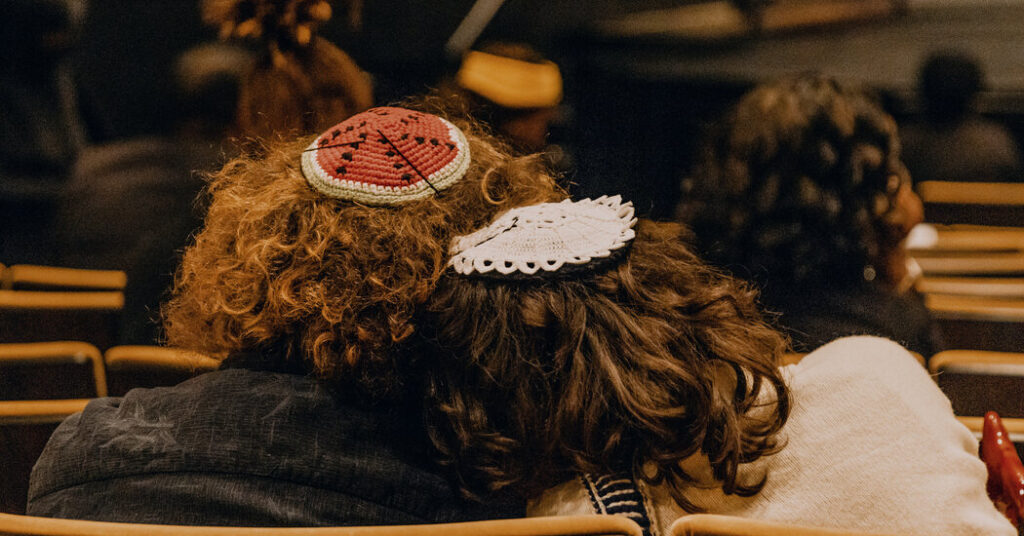
On Friday evening, the congregation’s members gathered again for services for the first time since the attack. They were in someone else’s house of worship, borrowing space from the Baptist church that had once borrowed it from them. No one knew when they could return home.
Still, they were together, and for now, that was enough.
Rick Rojas is the Atlanta bureau chief for The Times, leading coverage of the South.
The post Struck Again by Hatred, a Mississippi Temple Says There Is More to Its Story appeared first on New York Times.