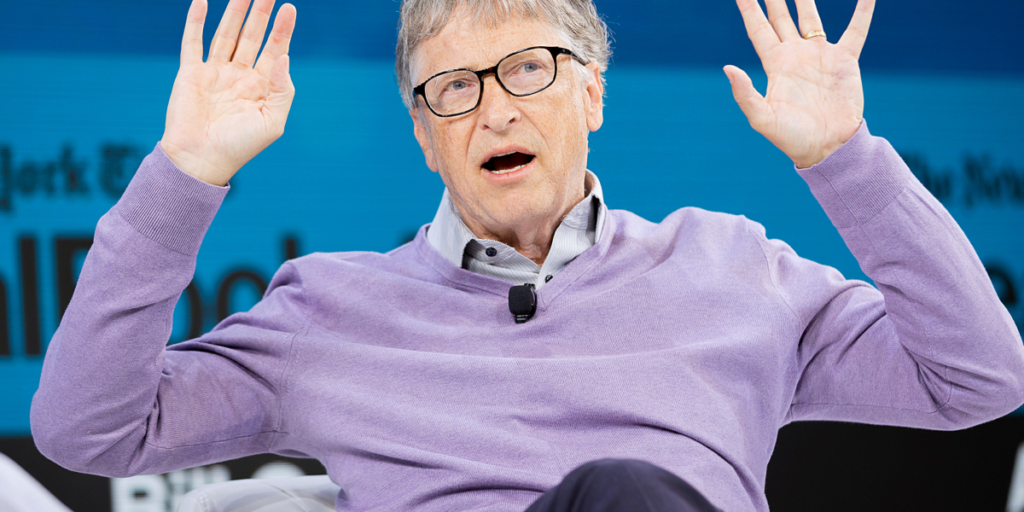
Billionaire Microsoft cofounder Bill Gates, JPMorgan CEO Jamie Dimon, Nvidia’s boss Jensen Huang, and Elon Musk have all made the same prediction in recent years: The workweek is about to shrink. Automation will take over routine tasks, they argue, freeing workers’ time and pushing a four-day work week toward becoming standard. Gates has even floated the idea of a two-day workweek.
But Mark Dixon, CEO and founder of International Workplace Group (IWG) CEO isn’t buying it. From his vantage point, running the world’s largest flexible office provider—with more than 8 million users across 122 countries and 85% of the Fortune 500 among its customers—the math doesn’t add up.
“Everyone is focused on productivity, so no time soon,” Dixon says flatly.
“It’s about the cost of labor,” Dixon explains to Fortune. The U.S. and U.K. are experiencing significant cost-of-living crises. At the same time, he says, businesses are experiencing a “cost of operating crisis.”
“Everyone’s having to control their labor costs because all costs have gone up so much, and you can’t get any more money from customers, so therefore you have to get more out of people.”
Essentially, companies can’t afford to pay the same wages for fewer hours, and they can’t pass the difference on to customers. So any time ‘freed’ by automation is far more likely to be filled with new tasks than handed back to workers.
Elon Musk says work will be optional in the future—but this CEO says AI may create more work, not less
Silicon Valley’s loudest voices frame AI as a route to more leisure. The world’s richest person and the boss of Space X, Tesla and X, Elon Musk has gone as far as predicting work will be completely “optional” and more like a hobby, in as little as 10 years.
In reality, Dixon suggests that this scenario would only happen if there’s not enough work to go around, rather than bosses suddenly becoming benevolent. But in his eyes, AI will most likely create more—not less—work.
Every major technological shift, he argues, has followed a similar arc: fear of displacement, followed by an expansion of opportunity.
“AI will speed up companies’ development, so there’ll be more work, it’ll just be different work,” he says.
In 19th-century Britain, Dixon recalls English textile workers protesting against new automated machinery, fearing it threatened their livelihoods, lowered wages, and de-skilled their craft during the Industrial Revolution. They were called Luddites.
“They went around the country smashing up the looms to stop progress. But look, in the end, you’ve heard of the Industrial Revolution. That’s what came from those looms and factory production.” As mass production made goods more available, retail grew; more managers were needed to oversee the machines; the middle class grew, and so on.
Likewise, there was a similar palpable fear when computers first burst on the scene in the 1980s. The 1996 book Women and Computers detailed people fearing becoming “a slave” to machines and feeling aggressive towards computers.”
But since the explosion of the PC (and then the internet, the Cloud, social media, and so on), most professions have undergone a digital rebrand—instead of disappearing altogether.
Copywriters now use laptops instead of typewriters; designers rely on Adobe Photoshop instead of pen and paper; and a plethora of IT roles were created along the way.
“It’s impossible to stop progress,” Dixon concludes.
“Companies have to do what companies have to do, and it’s really important for young people coming into the marketplace to work a little bit harder on really selecting the right jobs, the right avenue, getting extra skills in things like AI. Whatever job you’re going to do, you’ve got to be good at tech.”
The post Forget the four-day workweek: CEO of the world’s largest workspace provider says it’s not coming, despite what Bill Gates and Elon Musk predict appeared first on Fortune.