In theory, Immigration and Customs Enforcement describes itself as “the Department of Homeland Security’s premier law enforcement agency, mitigating transnational threats and safeguarding our nation, communities, lawful immigration, trade, travel and financial systems.”
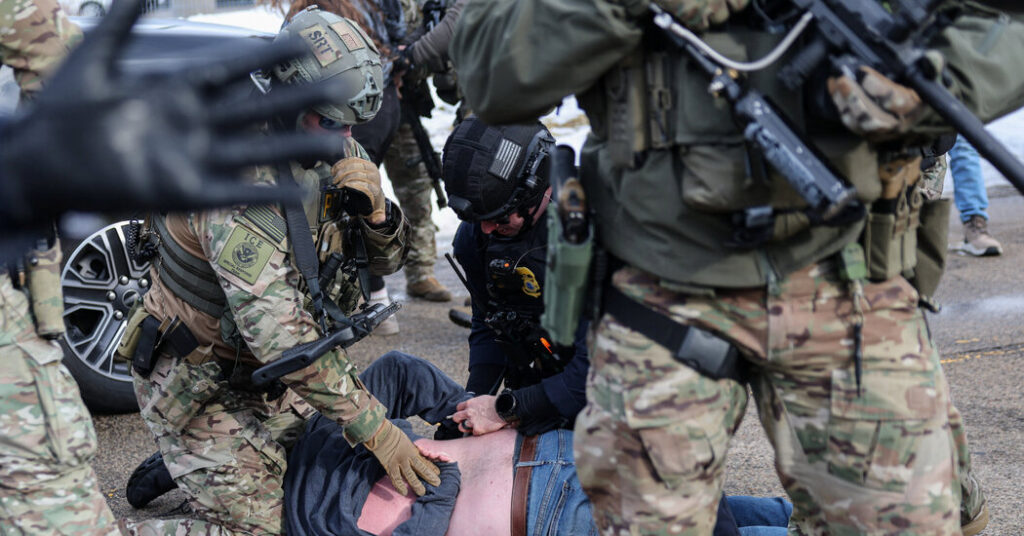
In practice, the Trump administration has turned legions of ICE agents into a violent and unaccountable domestic police force, empowered by claims of immunity to exercise force against American citizens and immigrants alike.
A 233-page court order issued Nov. 20 by Sara L. Ellis, a federal judge in the Northern District of Illinois, reveals the scope of duplicity, lying and open abuse of power by ICE and Homeland Security officials. She addressed civilian complaints that ICE violated constitutional rights during its pursuit of undocumented immigrants in Chicago, writing,
While defendants argue that they used less lethal force as a de-escalation technique to reduce the risk of harm to both agents and the public, plaintiffs have marshaled ample evidence that agents intended to cause protesters harm and that no legitimate governmental interest justified their actions.
In its efforts to triple the number of ICE agents in the field, the administration has adopted recruitment strategies that appear to be designed to appeal to white nationalists and supremacists, including the use of what amounts to an unofficial anthem of theirs, “We’ll Have Our Home Again,” in a recruitment ad.
According to numerous reports, the Department of Homeland Security has cut back on new employees’ training about abiding by constraints during potentially hazardous confrontations. In addition, the Trump administration, according to court documents, fails to enforce those rules and regulations in places such as Minneapolis.
Instead, the department has shown employees a video of Stephen Miller declaring:
To all ICE officers: You have federal immunity in the conduct of your duties. Anybody who lays a hand on you or tries to stop you or tries to obstruct you is committing a felony.
You have immunity to perform your duties, and no one — no city official, no state official, no illegal alien, no leftist agitator or domestic insurrectionist — can prevent you from fulfilling your legal obligations and duties. The Department of Justice has made clear that if officials cross that line into obstruction, into criminal conspiracy against the United States or against ICE officers, then they will face justice.
On Jan. 8, Vice President JD Vance took the message a step further, opening the door even wider for ICE agents engaged in violent confrontations, declaring in the wake of the shooting death of Renee Good the day before:
The precedent here is very simple. You have a federal law enforcement official engaging in federal law enforcement action. That’s a federal issue. That guy is protected by absolute immunity.
For his part, President Trump’s initial reaction to the escalation of violence in Minneapolis in the aftermath of the Good’s has been to say that he may invoke the Insurrection Act and send in military forces to enforce the law.
In an email, Deborah Fleischaker, a former assistant director for regulatory affairs and policy and later acting chief of staff at ICE during the Biden administration, disputed the scope of Miller’s and Vance’s claims:
ICE agents have qualified immunity, not absolute immunity. Qualified immunity already provides ICE agents with significant protection against legal action, and the concept of absolute immunity seems to me to be unconstitutional and un-American.
The claim that ICE agents have absolute immunity sends a message, however, that the administration will defend law enforcement actions, regardless of what they might be. Law enforcement agents see that message, which could embolden agents to become more aggressive as a result.
In an article on Jan. 14, “The Trump Administration Can’t Stop Winking at White Nationalists,” Eric Levitz, a senior correspondent at Vox, captured the administration’s explicit appeal to members of the radical right.
“The administration,” he wrote,
opted to associate its immigration agenda with a Nazi slogan: Adolf Hitler’s regime famously advertised its rule with the tagline “One people, one realm, one leader.” Three days after Renee Good’s killing, Trump’s Department of Labor tweeted, “One Homeland. One People. One Heritage. Remember who you are, American.”
Under Trump, Levitz went on to say,
the official accounts of federal agencies have repeatedly referenced white nationalist memes and works.
On Jan. 9, the Department of Homeland Security posted, “We’ll have our home again,” a lyric from an anthem adopted by the neofascist group the Proud Boys and other white nationalist organizations. This was accompanied by a link where one could sign up to join ICE.
Last August, D.H.S. shared an ICE recruitment poster beneath the phrase “Which way, American man?” — an apparent reference to the white supremacist tract, “Which Way, Western Man?” which argues that “race consciousness, and discrimination on the basis of race, are absolutely essential to any race’s survival. … That is why the Jews are so fiercely for it for themselves … and fiercely against it for us, because we are their intended victim.”
In October, the U.S. Border Patrol posted a video on its Facebook page of agents loading guns and driving through the desert, as a 13-second clip of Michael Jackson’s song “They Don’t Care About Us” plays — specifically, the lines “Jew me, sue me, everybody do me, kick me, k*ke me.”
Just as the administration is turning ICE into a welcoming home for right-wing extremists, it has eroded the barriers to violence by weakening enforcement of rules and reducing training.
In a recent interview with Isaac Chotiner of The New Yorker, Fleischaker described these trends. “As somebody who has watched ICE for many, many years,” she told him, “what they’re doing now is unprecedented.” She continued:
And, to the extent that I thought cooperation was important — very important, previously — ICE now doesn’t seem to be following the typical rules of engagement.
And I personally would be less inclined to cooperate in some of these ways that I think are really fundamentally important simply because of the ICE overreach.
Fleischaker noted:
There were always people within ICE who thought that they were being unfairly constrained. And I think that the Trump administration has empowered that line of thinking, and those people, and taken off the shackles.
And so ICE is feeling unconstrained in the way that it conducts enforcement. There are certainly people there now — not new recruits, people who’ve been there for years — who are thrilled with the direction that ICE has been moving in.
How has training changed?
Obviously, just the very idea that they’ve chosen to make the basic training for ICE recruits 47 days because Trump is the 47th president tells you how seriously they take it.
They are just looking to make training easier and faster as the number of agents continues to grow. And I think that that’s a very scary outcome.
What did Fleischaker say scared her?
We’re seeing unconstrained immigration enforcement, and I think that that has a lot of bad outcomes. And I think that it is, to be honest, not in support of public safety. Law-enforcement officers are supposed to be public-safety officers. This, to me, feels like it is not only not supporting public safety but it is reducing public safety in the sort of unconstrained, aggressive, nontargeted mechanism that they’re using to conduct immigration enforcement.
A Washington Post article on Dec. 31, “ICE Plans $100 Million ‘Wartime Recruitment’ Push Targeting Gun Shows, Military Fans for Hires,” showed how the Department of Homeland Security is seeking out those who want to subjugate and subordinate.
Drew Harwell and Joyce Sohyun Lee, reporters for The Post, wrote that the administration is using “ads targeting people who have attended UFC fights, listened to patriotic podcasts or shown an interest in guns and tactical gear.”
The department uses social media to appeal to prospective ICE agents, they wrote, “with calls for recruits willing to perform their ‘sacred duty’ and ‘defend the homeland’ by repelling ‘foreign invaders.’”
The ICE hiring website, Harwell and Lee wrote, “portrays immigration as an existential threat. ‘America has been invaded by criminals and predators,’ reads the website, which includes an image of Uncle Sam. ‘We need you to get them out. You do not need an undergraduate degree.’”
ICE abuses have revealed the crucial importance of alternative media — including Vox, Axios, Noah Smith’s Substack and 404 Media — in describing in great detail the accumulating body of evidence pointing to a federal agency run amok.
On Dec. 8, for example, an Axios reporter, Monica Eng, listed 12 of ”the biggest disputed allegations by D.H.S. officials and the evidence or court actions that overturned them.”
Here is one:
Both D.H.S. officials and Border Patrol commander Greg Bovino publicly stated, and he repeated under oath, that he threw tear gas at a crowd in Little Village after he was hit or almost hit with a rock. Video evidence directly contradicted it.
During his three-day deposition, Bovino admitted he was not hit until after deploying tear gas, then that same day presented a new justification — that a rock “almost hit” him before he gassed the crowd.
On the final day, Bovino admitted he had been “mistaken” and confirmed no rock hit him until after he launched the first canister.
And here is another:
Border Patrol agent Charles Exum claimed that Miramar Martinez rammed her car into his vehicle on Oct. 4, after which he shot her five times. Court documents show Exum later bragged about the shots and drove the car to Maine.
By Nov. 20, U.S. States Attorney Andrew Boutros’s office dropped felony assault charges against Martinez, whose lawyer said she was the one who was rammed and the victim of unjustified force.
Not to be outdone, on Jan. 10, Smith described the “consistent record of brutality, aggression, dubious legality and unprofessionalism in Trump’s second term”:
Here’s a video of ICE agents in Arkansas beating up an unarmed U.S. citizen. Here’s a video of ICE agents arresting two U.S. citizens in a Target. Here’s a story about a similar arrest. Here’s a video of an ICE agent brandishing a gun in the face of a protester. Here’s the story of ICE agents arresting a pastor who complained about an arrest he saw. Here’s a video of ICE agents arresting an American citizen and punching him repeatedly. Here’s a video of ICE agents threatening a bystander who complained about their reckless driving. Here’s a video of ICE agents arresting a man for yelling at them from his own front porch. Here’s a video of ICE agents making a particularly brutal arrest while pointing their weapons at unarmed civilians nearby. Here’s a story about another ICE killing, this one in Maryland, under dubious circumstances. Here’s a video of ICE agents savagely beating and arresting a legal immigrant. Here’s a video of ICE agents storming a private home without a warrant. Here’s a video of ICE agents pulling a disabled woman out of a car when she’s just trying to get to the doctor.
It may seem tangential, but any reasonable review of this increasing hostility between federal agents and the public should take into account the possibility of anabolic steroid use (or abuse). Legal and illegal steroid use has become increasingly common among law enforcement officials, although testing and punitive actions are very rare, despite the threat of excessive force and violence by government officials.
The Drug Enforcement Administration describes anabolic steroids as “synthetically produced variants of the naturally occurring male hormone testosterone that are used in an attempt to promote muscle growth, enhance athletic or other physical performance and improve physical appearance.”
In some individuals, according to the agency, “anabolic steroid use can cause dramatic mood swings, increased feelings of hostility, impaired judgment and increased levels of aggression (often referred to as ‘roid rage’).”
John Hoberman, a historian at the University of Texas, Austin, and the author of “Dopers in Uniform: The Hidden World of Police on Steroids,” described the effects of steroid abuse on police behavior:
These drugs can produce emotional instability in armed men who are in a position to act out their drug-fueled anger, irritation and aggressive urges on civilians. Anabolic steroids appeal to men who join police forces in order to achieve dominance over others.
I asked Hoberman during a phone interview how widespread the use of anabolic steroids is in law enforcement. He replied:
My impression from having covered this since 2005 is that it’s very widespread. There are 1,800 departments in this country, and to the best of my knowledge, not one tests. The unions are going to cry bloody murder, because it’s a privacy invasion. The police chiefs do not want to catch somebody.
Would his estimate of widespread usage apply to ICE?
Hoberman said, “This is Trump’s goon squad, for Christ’s sake.”
There are no scientific measures of steroid use in law enforcement, although there is extensive anecdotal evidence.
A 2010 series by Amy Brittain and Mark Mueller in The Star-Ledger found, for example, that hundreds of police and emergency responders had acquired illicit steroid prescriptions from one New Jersey doctor, Joseph Colao:
In just over a year, records show, at least 248 officers and firefighters from 53 agencies used Colao’s fraudulent practice to obtain muscle-building drugs, some of which have been linked to increased aggression, confusion and reckless behavior.
Six of those patients — four police officers and two corrections officers — were named in lawsuits alleging excessive force or civil rights violations around the time they received drugs from him or shortly afterward.
Others have been arrested, fired or suspended for off-duty infractions that include allegations of assault, domestic abuse, harassment and drug possession. One patient was left nearly paralyzed after suffering a stroke his doctor attributed to growth hormone prescribed by Colao.
The reporters also found that employees paid for the prescriptions through their government health care programs and that police magazines carried ads for steroids.
In 2007, Susan Donaldson James, then a reporter for ABC, wrote:
From Boston to Arizona, police departments are investigating a growing number of incidents involving uniformed police officers using steroids. So-called juicing has been anecdotally associated with several brutality cases, including the 1997 sodomizing of Haitian immigrant Abner Louima in New York City.
Jones quoted Gene Sanders, a police psychologist in Spokane, Wash., who estimated that “up to 25 percent of all police officers in urban settings with gangs and high crime use steroids — many of them defensively. ‘How do I deal with people who are in better shape than me and want to kill me?’ said Sanders, who worked as a street cop in Los Angeles in the 1970s and saw steroid use soar in the 1990s.”
Let me turn back to Ellis’s order in the civilian complaint case that I mentioned at the outset. In challenging the interpretations of events by the Department of Homeland Security and ICE, she wrote:
-
Repeatedly shooting pepper balls or pepper spray at clergy members shocks the conscience.
-
Tear gassing expectant mothers, children and babies shocks the conscience.
-
Shooting a pepper ball at a protester from about five feet away shocks the conscience.
-
Pointing a gun at someone for exercising their First Amendment rights shocks the conscience.
-
Videotaping while driving into concerned neighbors standing in the street shocks the conscience, particularly when the agent later explains it just happened despite “driving slowly.”
-
Tackling someone dressed in a duck costume to the ground and leaving him with a traumatic brain injury, and then refusing to provide any explanation for the action, shocks the conscience.
”Turning to Bovino,” Ellis went on, “the court specifically finds his testimony not credible”:
Bovino appeared evasive over the three days of his deposition, either providing “cute” responses to plaintiffs’ counsel’s questions or outright lying.
When shown a video of agents hitting Rev. Black with pepper balls, Bovino denied seeing a projectile hit Rev. Black in the head. In another video shown to Bovino, he obviously tackles Scott Blackburn, one of plaintiffs’ declarants. But instead of admitting to using force against Blackburn, Bovino denied it and instead stated that force was used against him.
Ellis’s conclusion?
Overall, after reviewing all the evidence, the court finds that defendants’ widespread misrepresentations call into question everything that defendants say they are doing in their characterization of what is happening at the Broadview facility or out in the streets of the Chicagoland area during law enforcement activities.
This is not happening just in Chicago. On Friday, U.S. District Judge Kate M. Menendez issued a ruling similar to Ellis’s, in another case concerning citizen complaints against ICE, charging abusive behavior in Minnesota.
“Plaintiffs have established an ongoing, persistent pattern of defendants’ chilling conduct,” Menendez wrote, noting that “that conduct includes the drawing and pointing of weapons, the use of pepper spray and other nonlethal munitions, actual and threatened arrest and detainment of protesters and observers and other intimidation tactics.” On Monday, the Trump administration announced that it would appeal Menendez’s ruling.
In the meantime, will the judge’s injunction requiring ICE to end unconstitutional treatment of protesters prove effective?
Abigail Jackson, a White House spokeswoman, called the ruling a “dishonest, left-wing narrative.” She added, “Here’s the truth: Federal agents have acted lawfully to protect themselves and ensure the integrity of their operations when individuals attempt to intervene.”
In other words, ICE can do no wrong.
The Times is committed to publishing a diversity of letters to the editor. We’d like to hear what you think about this or any of our articles. Here are some tips. And here’s our email: [email protected].
Follow the New York Times Opinion section on Facebook, Instagram, TikTok, Bluesky, WhatsApp and Threads.
The post ‘This Is Trump’s Goon Squad, for Christ’s Sake’ appeared first on New York Times.