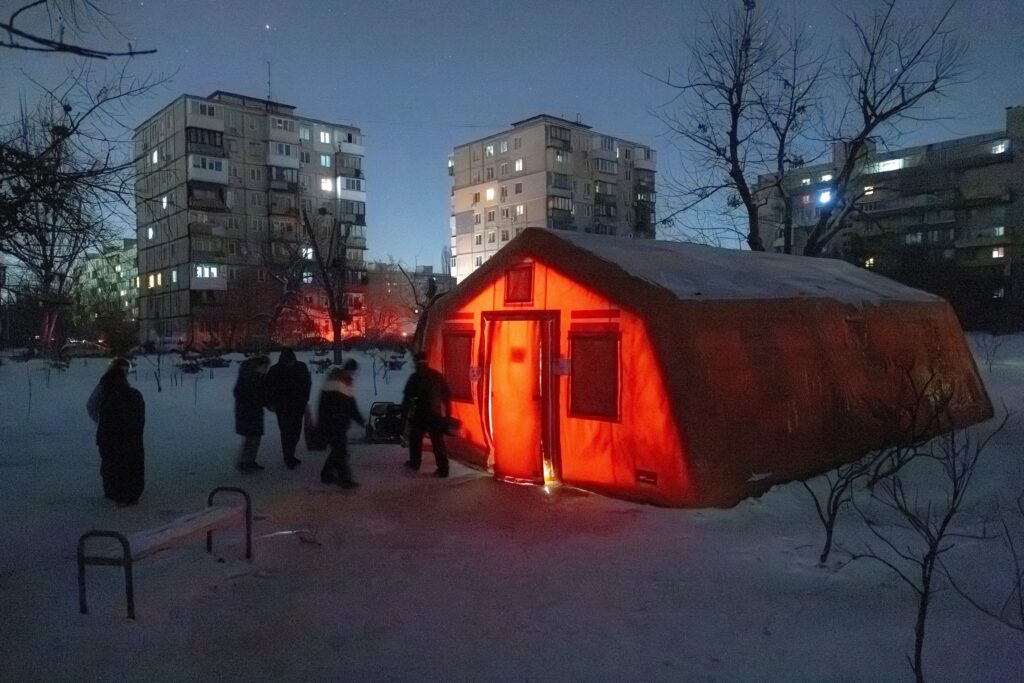
KYIV — It’s a bitterly cold Saturday night here, the temperature 10 degrees Fahrenheit and falling, and a few pedestrians are skittering down the icy sidewalks to get inside before the midnight curfew. Because the heat is out in some homes in the wake of savage Russian bombing of power facilities this month, they may have to visit one of the hundreds of warming centers in the city to get through the night.
This grim winter scene is a snapshot of Russian President Vladimir Putin’s brutal strategy for victory. By pounding Ukraine’s sources of power and heat, he hopes to freeze the country into submission. President Donald Trump sometimes talks as if he agrees with Putin that Russian victory in this bloodbath is inevitable — and that Kyiv must give up territory in a peace deal.
But conversations here Sunday with Ukraine’s new Defense Minister Mykhailo Fedorov and other senior officials convinced me that this bleak picture is misleading. Ukraine will soon deploy a new generation of domestically produced air-defense interceptors, powered by artificial intelligence, that could allow the country to fight on indefinitely.
“We have a clear plan about how to stop Russia in our skies,” Fedorovsaid in a meeting Sunday in the defense ministry’s headquarters on a quiet Kyiv side street. A few minutes later, he signed an agreement with the U.S. defense software company Palantir to build an advanced AI “Dataroom.” It will use the millions of bits of sensor data and imagery that Ukraine has gathered over four years of war to train AI systems that can predict Russian attacks — and then guide cheap, autonomous interceptors to defeat them.
“It’s not about us winning, but about us becoming unconquerable,” said Andrii Hrytseniuk, chief executive of Brave1, a technology incubator that has coordinated Ukraine’s astonishing battlefield innovation with drones and AI. “The war stops when the enemy realizes that its political goals cannot be achieved,” he argued.
I traveled here with Louis Mosley, a Palantir executive vice president who since 2022 has overseen the company’s attempts to help Ukraine fight an “algorithm war” against Russia. If the new Dataroom effort works as planned, six months from now, Ukraine will have the framework for a nationwide system of autonomous air-defense missiles that could finally make Ukraine’s cities safe from Russian attack. (The Post paid my share of the cost of the trip.)
The Dataroom project illustrates a crucial variable in this war. In its desperate attempt to fend off Russia, Ukraine has developed what may be the world’s most innovative defense-technology sector. Fedorov embodies this drive. He’s just 34, dressed like a tech bro in a simple sweatshirt. But back in 2022, he convinced President Volodymyr Zelensky to seek help from Palantir and Starlink, and launched a project known as the Army of Drones.
Another champion of using technology aggressively has been 40-year-old Lt. Gen. Kyrylo Budanov, the former chief of military intelligence, who Zelensky just elevated to head his presidential administration. This tech savvy is a big reason Ukraine has survived the onslaught from the much larger and more powerful Russia.
Brave1 coordinated this technology push. When the war began, Ukraine had just seven companies making small drones; a year later, it had 70, and today there are 500 — producing millions of aerial drones annually, according to Hrytseniuk. Another 280 companies are developing autonomous ground vehicles — unmanned tanks, in effect. In 2022, nearly all of Ukraine’s attack strikes were from artillery; today, nearly 90 percent are by drones.
The war has produced an extraordinary arms-industry boom: Brave1 told me Ukraine’s defense manufacturing capacity has surged 35-fold — growing from $1 billion in 2022 to an estimated $35 billion in 2025. The defense ministry authorized more than 1,300 new models of domestically made weaponry for service in 2025, a 25 percent increase over the previous year.
Though Ukraine has fought Russia to a stalemate on the ground, its biggest weakness has been air defense. Relentless Russian attacks have destroyed power and heating plants and other critical infrastructure. Ukraine wages a brave nightly battle against as many as 1,000 missiles and drones, but the attacks have made life miserable for civilians. The Dataroom interceptor project is an attempt to create an air-defense shield to end this nightly onslaught.
“No country in the world has the experience of defending itself against air attacks on the scale Ukraine is facing today,” explained Fedorov in an email Monday. “In learning how to counter these attacks, Ukraine is building … the next generation of AI-enabled air defense.”
Ukraine defenses must be cheaper than Russia’s attacking drones and missiles. And they must operate instantly, nationwide, to respond to attacks more quickly than humans could. That’s the system Dataroom is building using Ukraine’s library of data to train its AI system to recognize an incoming attack and target it with precision. The AI software will be integrated with homemade interceptors built by Ukraine’s ever-expanding defense tech sector
“We will be trading pawns for rooks,” says Hrytseniuk. The “Octopus,” for example, costs just a few thousand dollars, but Ukrainian officials say it can reliably hit Shahed attack drones costing much more. The Octopus has a radius of nearly 200 kilometers and can carry electro-optical, infrared or thermal targeting sensors — which will be trained on AI to recognize attackers. The cost ratio means Ukraine can keep sustain its defense against the Shaheds.
Trump continues to press Russia and Ukraine for a peace agreement, and U.S. negotiators believe that a deal is achievable this year. They’ve agreed with Zelensky’s team on a “prosperity plan” to rebuild Ukraine’s economy, and they think they have 95 percent of the details of a security agreement in place. The big remaining hurdle is Russia’s demand for territory in Donetsk that Ukraine still controls, at a cost of thousands of Ukrainian lives.
Putin doesn’t want to make concessions because he still thinks he can win. But Ukraine’s new network of AI-driven air defenses will make that less likely. If Ukraine can protect the civilians on Kyiv’s frozen streets — and reassure them that they won’t face another winter in the deep freeze, even if the war continues — perhaps Putin will reconsider his bet.
The post Frigid Kyiv kindles a high-tech plan to keep Russia at bay appeared first on Washington Post.