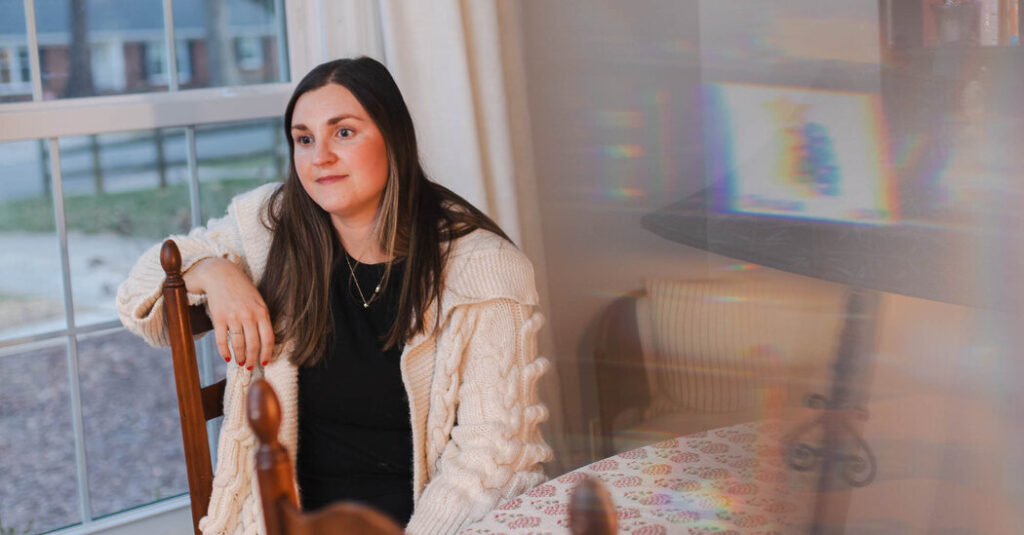
Emily Sliwinski got home from the hospital after giving birth to her first child three years ago, and almost immediately began spiraling.
Her thoughts raced; she was unable to sleep; she began hallucinating that her dog was speaking to her. She became obsessed with solving the national shortage of infant formula, covering a corkboard with notes and ideas.
About a week later, Ms. Sliwinski, of Greensboro, N.C., went to a hospital emergency room, thinking she would be given medication to help her sleep, she said. She had no history of mental health issues. When doctors decided to commit her for inpatient psychiatric treatment, she became so agitated and fearful that she slapped her mother and her husband.
She spent 11 days in the psychiatric hospital, but it didn’t help. “Every day I was trying to figure out where I was and what was happening,” Ms. Sliwinski, 33, recalled.
Doctors there did not connect her symptoms to childbirth, she said, and diagnosed her with schizophrenia. It was only when her family got her transferred to a specialized perinatal psychiatric unit at the University of North Carolina at Chapel Hill that doctors zeroed in on the right diagnosis: postpartum psychosis.
Ms. Sliwinski’s delayed diagnosis reflects an issue simmering in the highest echelons of American psychiatry. For more than five years, a group of women’s health specialists have been pushing for postpartum psychosis to be listed as a distinct diagnosis in the Diagnostic and Statistical Manual of Mental Disorders, the thousand-page guidebook that influences research funding, medical training and clinical care.
But two committees at the apex of the D.S.M. have been split over whether to add it. “Psychiatry’s Bible,” as it is sometimes known, has raised the evidentiary bar for including new diagnoses — only one, prolonged grief syndrome, has been added since 2013.
The stakes in the postpartum decision are especially high. Postpartum psychosis often strikes women with no history of mental illness, who in the weeks after giving birth are seized by paranoia or delusions. It occurs in one or two in every 1,000 births, and is considered a clear psychiatric emergency, usually dictating hospitalization. In the worst cases, it can lead to suicide or infanticide.
Advocates for the change say D.S.M. recognition would have an immediate and practical effect: Doctors would receive more training, researchers would receive more funding, and when women stood trial for hurting their children, judges would take it seriously as a mitigating factor.
“This is the strongest phenotype in psychiatry, with such a clear onset, such a clear trigger, such a clear biology there,” said Dr. Veerle Bergink, the director of Mount Sinai’s Women’s Mental Health Center and the lead author on a paper that lays out the D.S.M. proposal, published last fall in the journal Biological Psychiatry.
D.S.M. officials stress the responsibility they bear if they add inexact or confusing definitions to the manual. A central problem, they say, is where postpartum psychosis would fit it into the D.S.M.’s classification system, which sorts severe disorders into chapters, like Schizophrenia Spectrum and Mood Disorders. Dr. Bergink’s proposal would classify the disorder as a type of bipolar disorder.
But postpartum psychosis is multifaceted, sometimes including features of bipolar disorder, depression and schizophrenia. Many patients’ symptoms wax and wane, adding to the complexity, experts said.
A misleading definition, the manual’s editors say, could steer clinicians away from permanent diagnoses, or to incorrectly assign the label and order unnecessary drastic interventions, like involuntary hospitalization and separation from their babies.
“It seems simple on its face, but when you drill down, I think there are a lot of complexities,” said Dr. Kimberly Yonkers, a specialist in maternal mental health who is chair of the committee for revising the fifth edition.
“We just want to be careful,” she said. “We want to do no harm.”
A diagnostic fog
By the time Ms. Sliwinski was transferred to U.N.C.’s perinatal psychiatry unit, the previous psychiatric hospital had cycled her through about a dozen medications, she said.
Dr. Anne Ruminjo, a psychiatrist who saw Ms. Sliwinski when she came into the U.N.C. unit, quickly recognized what she considered to be obvious red flags.
She noted that Ms. Sliwinski had not slept in days and that the nurses at the previous hospital had recorded “how agitated she is, and she’s shouting and argumentative, and then starts getting paranoid around them thinking they’re trying to hurt her, and then starts hitting herself, and hitting them, and hitting her family, which is all very out of character for her.”
The severity of the symptoms and their rapid onset after childbirth made Dr. Ruminjo think “ding, ding, ding, ding — this is probably postpartum psychosis,” she said.
Dr. Riah Patterson, director of U.N.C.’s perinatal psychiatry program, said it is common for the condition to be misdiagnosed, and her unit often receives such patients from other hospitals. In women with no psychiatric history, she said, an abrupt change in mental status soon after delivery should be seen as linked to a postpartum condition.
“People don’t develop schizophrenia immediately after the birth of their child,” she said.
The U.N.C. doctors treated Ms. Sliwinski with lithium, and gradually stopped the mix of prescriptions she had come in with, Dr. Patterson said.
“I think things were super stable after that,” said Ms. Sliwinski, who was discharged after eight days and continued taking lithium.
The proposal currently before the D.S.M. would diagnose the disorder up to 12 weeks after childbirth, in women who experience persistent mania, delusions, hallucinations, thought disorder, disorganized behavior or depression with psychotic features.
It has its roots in European hospitals’ mother-and-baby units, where women experiencing serious mental health issues are allowed to stay with their babies during treatment, under the close watch of doctors and nurses. Dr. Bergink, who is Dutch, has treated an estimated 300 women with the disorder in the units, and published large studies based on European data.
Analyzing so many cases led her to view the condition as closely related to bipolar disorder. Last spring, presenting her work at the annual convention of the American Psychiatric Association, Dr. Bergink offered a sketch of a typical patient — a new mother with rushed speech and racing thoughts who seems both elated and paranoid.
“She rambles on and on, and you really cannot follow her,” she said. “She’s worrying about her husband, because he doesn’t see how special the baby is, and she is not sure that she can trust him. Maybe he wants to harm the child.”
Criteria added to the D.S.M. in 2013 allow doctors to diagnose bipolar disorder, psychosis or major depression “with peripartum onset.” This solution captures the disorder’s heterogeneity but doesn’t draw the same kind of clinical attention that a stand-alone diagnostic listing would, some mental health experts said.
“You see someone who has psychotic symptoms, they happen to be postpartum, and no one’s quite sure what to call it, so it gets lumped any number of places,” said Dr. Samantha Meltzer-Brody, director of U.N.C.’s Center for Women’s Mood Disorders and a co-author of the proposal to add a stand-alone diagnosis to the D.S.M.
She said a distinct D.S.M. category would prompt doctors to think that “if you’re seeing acute postpartum onset of psychotic symptoms, that’s called postpartum psychosis, and that gets it out of this weird gray zone.”
The proposal lays out an argument for including the disorder in the bipolar chapter. It says that most women have mood symptoms, and only a subset experience hallucinations without mood symptoms; that the most effective treatments, lithium and electroconvulsive therapy, are also first-line treatments for bipolar disorder; and that genetic studies have identified a shared risk architecture.
The authors acknowledge it is not a perfect solution. Nearly 30 percent of women who experience postpartum psychosis do not meet the criteria for bipolar disorder, according to the largest study in the United States of women who have experienced postpartum psychosis. The findings showed that the condition “may not always be associated with bipolar disorder and emphasize the need for further research into effective treatments and the long-term management.”
But Dr. Bergink stressed the human cost of delaying the move — women who are misdiagnosed, or sent home with reassurances about the “baby blues.” She recalled some of the most tragic outcomes, including the recent case of a woman who shot her baby and herself, and another who jumped off a building with her child.
“We are so ridiculously far behind in women’s mental health to start with,” she said. “At some point, perfect is the enemy of the good.”
‘We want to do no harm’
In interviews, D.S.M. officials encouraged patience. They say they had no doubt that postpartum psychosis exists; in the fifth century B.C., Hippocrates described a woman who became delusional, confused and insomniac days after giving birth to twins.
The bigger problem is that it does not fit perfectly into any of the manual’s chapters, which are used to train doctors to understand a disorder and directly affect the treatments patients receive. Dr. Yonkers said there had been objections from committee members who saw it as a depressive or psychotic disorder and resisted classifying it on the bipolar spectrum.
“We have to figure out where in the book is it going to go,” Dr. Yonkers said. “That may be the best fit of all the options. But it may not be a perfect fit. And that’s an issue.”
In recent years, the manual has come under criticism for steps that led to unintended consequences. The most glaring of these was the decision, in the D.S.M.’s fifth edition, to fold Asperger’s disorder into autism spectrum disorder, which inadvertently led to a 60-fold increase in autism diagnoses.
Dr. Yonkers said she was concerned about vagueness and overlap. Some patients may have depression with psychotic features and should not be given mood stabilizers, as bipolar patients are; others may have chronic bipolar disorder and would not benefit from being labeled as having psychosis.
“One of the things we do as a committee is we evaluate the evidence in the request to make sure we’re not doing any harm,” she said.
Given the heterogeneity of the disorder, she said, the best solution might be to stick with the current formulation of characterizing existing diagnoses as having “peripartum onset.” She and several other experts said they considered that language adequate and said the D.S.M.’s lack of a more specific designation was not causing cases to be missed, given that patients typically have such noticeable symptoms.
Carrie Bearden, a professor of psychiatry at the Semel Institute for Neuroscience and Human Behavior at the University of California, Los Angeles, said members of the Serious Mental Disorders Committee, which she chairs, agreed that “treatment of this condition is of paramount importance,” but was split on whether creating a separate diagnostic category was the best way to ensure it. A slim majority favored that option, but a substantial minority voted to remain with the current formulation, in which major disorders can be diagnosed “with peripartum onset.”
“There was not a clear consensus,” she said, and the narrow margin felt insufficient for a change of this consequence. One reason for this, she said, is a sense that the D.S.M.’s decisions cast such a long shadow over psychiatric practice.
“It’s science, but it’s also a group consensus,” Dr. Bearden said. “It also has a major influence on treatment and on policy. So we can’t just go with, well, this is the best evidence that we have at the moment, so let’s take a very decisive action.”
Experts in maternal mental health said the D.S.M. would have to balance the benefit of raising awareness against the risk of codifying a disorder that is not fully understood.
“Do I think that there are patients who have postpartum psychosis who do not necessarily meet the criteria for bipolar disorder? Yes,” said Dr. Lee Cohen, who directs the center for women’s health at Massachusetts General Hospital and leads the country’s largest postpartum psychosis study.
“Do I think it’s the end of the world if it falls in the bipolar section of the D.S.M.?” he continued. “I think I’m way more concerned about it not getting in than it being not a perfect fit.”
Dr. Margaret Spinelli, a specialist in postpartum psychosis at Columbia University, said she worried that placing the condition in the bipolar category would cause emergency room doctors to miss it if “it’s not right there under psychosis.”
But Dr. Spinelli, who herself submitted a proposal for a distinct D.S.M. designation several years ago, said the benefit of greater prominence in the D.S.M. outweighed those concerns.
“I have evaluated 30 women who killed their babies — not one was diagnosed properly,” said Dr. Spinelli, who has testified in court in infanticide cases. “I don’t care if it’s under bipolar, but it is a unique kind of illness.”
The meaning of a diagnosis
Watching from the sidelines are advocates for women’s mental health, among them many women who have survived episodes. Kriti Lodha, 35, who had no history of psychiatric illness, was hospitalized with manic symptoms after her daughter’s birth in 2021.
Convinced she was an unfit mother, Ms. Lodha tried to persuade family members to take her place, by stepping in as the baby’s medical proxy.
Seven weeks elapsed before a reproductive psychiatrist mentioned postpartum psychosis as a possibility, something she ascribes to low awareness of the disorder in the field. Ms. Lodha said she doesn’t care where it appears in the D.S.M., as long as it appears.
“To me, it’s less about the categories, and more about how do we actually legitimize, prioritize, normalize this illness by having it in the D.S.M.,” said Ms. Lodha, who is now on the board of directors of the nonprofit Postpartum Support International.
Getting the diagnosis is not a panacea, warned Lisa Roth. When her son was 2 months old, Ms. Roth was so alarmed by the bizarre thoughts flickering through her mind — that her ex was watching her from the trees, or drugging her food — that she put her son in the car and drove herself to McLean Hospital.
The staff snapped to attention and hospitalized her, calling her ex to come get the baby. They diagnosed her with postpartum psychosis and told her that her delusions were common ones for women with the illness. “I was like, ‘Oh, that makes sense,’” Ms. Roth said.
But the hospitalization had prompted an intervention by social services workers, and three years passed before she regained custody of her son. Now, as an advocate, Ms. Roth, 41, favors recognition in the D.S.M. but warns other women that receiving the diagnosis “could stigmatize you horribly.”
For Ms. Sliwinski, the diagnosis proved to be a breakthrough.
After her hospitalization, she attended an intensive outpatient treatment program for two months and then transitioned to a therapist, continuing on lithium. She said the hardest part was feeling that she had missed precious time with her daughter, but in the three and a half years since her episode, she has “never had any more psychosis symptoms or anything like that.”
In March, she had a second baby, continuing her lithium treatment during the pregnancy and working closely with her psychiatrist and a maternal-fetal medicine specialist to ensure the medication did not have adverse effects on the fetus. When the baby was born, she had no psychiatric issues, and she said her doctors are currently tapering down her lithium dose.
She said she had previously been unfamiliar with postpartum psychosis and wanted to share her experience to help others become aware of the condition.
“My brain literally broke,” she said. “I’m not ashamed of it. I mean, I’m not proud of it, but it was completely out of my control.”
Ellen Barry is a reporter covering mental health for The Times.
The post Will ‘Psychiatry’s Bible’ Add a Postpartum Psychosis Diagnosis? appeared first on New York Times.