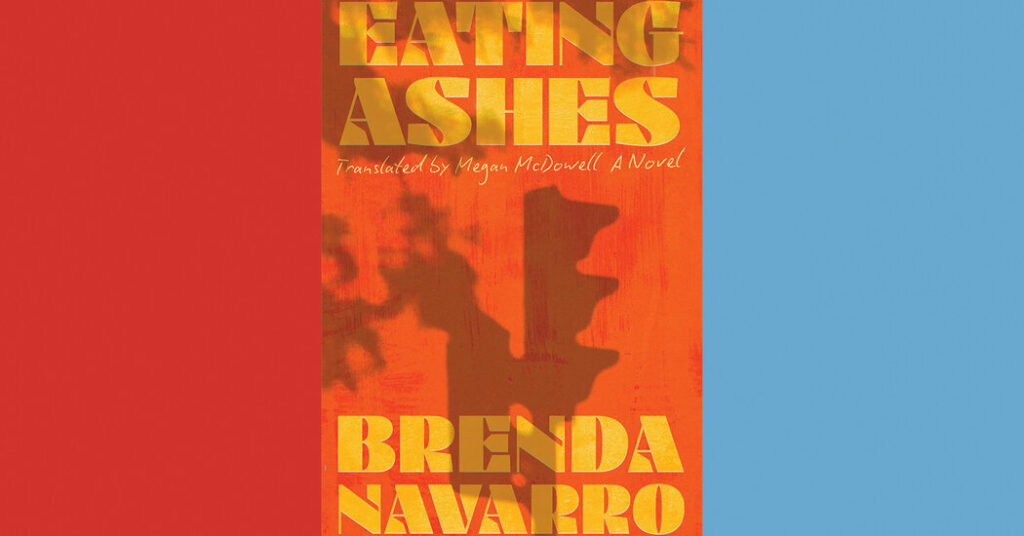
EATING ASHES, by Brenda Navarro; translated by Megan McDowell
If you, like me, have coped with an earth-shattering loss by bingeing on literature about mourning, you’ve probably come across many books that rely on clichés derived from the obsolete psychiatric framework known as “the five stages of grief.”
Fortunately, a rising star of Latin American literature has written a novel that refuses to reduce grief to a scheduled tour through ennobling sorrows. Recounting the furious bereavement of a woman who cannot come to terms with her brother’s suicide, Brenda Navarro dispenses with fairy tales about acceptance and considers mourning as a kind of backbreaking labor, like child care or housecleaning.
Her novel, “Eating Ashes,” opens with the unnamed narrator already in the throes of grief, but the plot begins more than a decade earlier. After her mother leaves Mexico City for Spain in search of work and freedom, the narrator becomes the primary caretaker of her younger brother, Diego, a sensitive boy who waves at airplanes in hopes that their mother might be coming back. But when the siblings finally make it to Madrid, the narrator discovers that Spain isn’t the paradise her mother had promised: “In Mexico you could say we were poor. … In Madrid, though, people still looked at us like we were poor, but also like we were scum.”
Full of resentment, the narrator moves to Barcelona, where she does the same thankless work that her mother and countless other migrant women do: cleaning, nannying, elder care. But Diego has it worse. Bullied at school, accosted by racists, harassed by the police, he grows into a bitter adolescent simmering with rage. His death opens a crack in his sister’s mind, unleashing memories and recriminations with no discernible chronology.
This nonlinear structure accurately portrays grief as a cacophony of ricocheting feelings. It’s also flexible enough to accommodate Navarro’s impressive study of Latin American workers in Spain, who, unlike many of their U.S. counterparts, share a mother tongue with their xenophobic hosts. Misunderstood by Spaniards, Diego retreats into a linguistic fortress of Mexican slang: a private language of insults, full of sound and fury.
While the translator Megan McDowell handles these subtleties reasonably well, at times she does a disservice to Navarro’s catalog of Spanish dialects. In a crucial passage, McDowell renders panchita — a demeaning term for Latin American women that she elsewhere leaves untranslated — as a slur that conflates Iberian condescension with American hate: “wetback.”
Diego’s suicide and the difficulties of immigrant life would be enough to sustain Navarro’s novel. But when the narrator brings her brother’s ashes back to Mexico City, we discover that her loved ones have endured a litany of ordeals themselves. The narrator insists, however, that her people aren’t victims: “No one inflicted horrible suffering on us like the kind you see on the news … we weren’t beaten, we never had any videos of people yelling at us go viral.” Though the siblings are indeed spared public vitriol, the weakest chapters of the novel detail episodes of spectacular violence that call to mind sensationalist headlines about Mexico.
Just as we begin to suspect that Navarro has made the narrator reject victimhood so emphatically because she, too, worries her novel is lapsing into melodrama, the protagonist makes a quiet admission: Jilted by a teenage crush, she manipulated young Diego into begging their mother to bring the siblings to Spain. If she insists there are no victims here, it’s because she cannot admit that she herself might be the victimizer. Unlike peddlers of platitudes, Navarro is a major talent who knows that the most important stages of grief are ambivalence and guilt.
EATING ASHES | By Brenda Navarro | Translated by Megan McDowell | Liveright | 235 pp. | $24.99
The post This Novel About a Sister’s Grief Skips the Five Stages appeared first on New York Times.