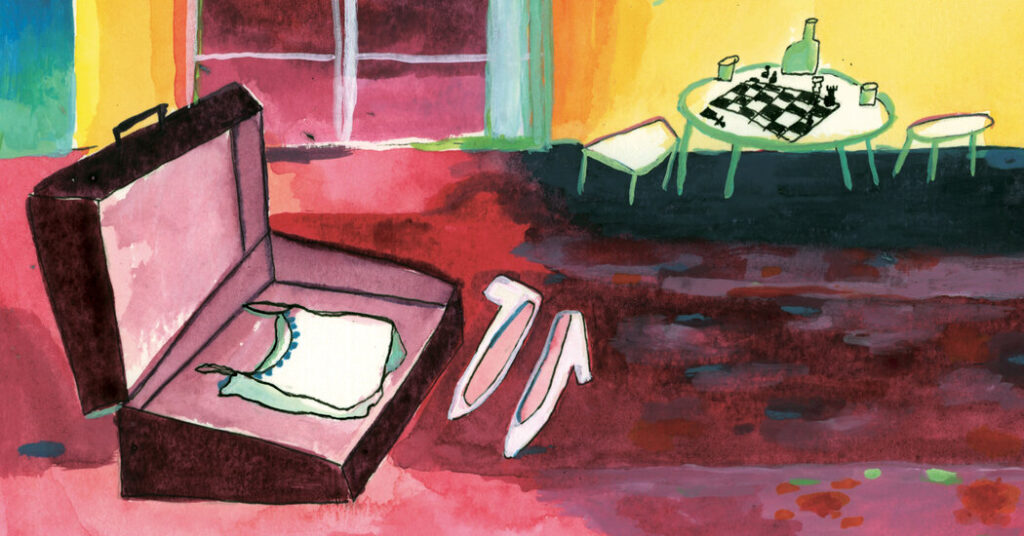
TANGERINN, by Emanuela Anechoum; translated by Lucy Rand
For Mina, the anchor of Emanuela Anechoum’s melancholic debut novel, “Tangerinn,” her reasons for moving to London from Southern Italy in her early 20s remain mysterious, even to her. No matter her motivation, she has stalled out in England, nearly as friendless and financially precarious as when she arrived.
This is not an immigration trajectory you commonly hear, and she knows it; normally the West beckons people with “promises of self-realization, selling them a narrative of success at all costs,” she thinks, with a typical sardonic edge.
When Mina came to London, six years before the book opens, she had no ties and patchy language skills, but she did know how she wanted her existence to look. She’d live on a street of “predictable architecture,” in a flat full of atmospheric lighting and well-chosen art. Her roommate/landlord, Liz, is an orthorexic, wealthy Brit who considers herself a “digital activist” (meaning: She writes long Instagram captions with wispy moral imperatives). Mina worships and resents her in equal measure; she takes to peeing in Liz’s conditioner, and absolving herself of any guilt.
“What kind of person are you?” Liz asks during their first conversation. Mina has no answer. When Liz learns that her new roommate’s father is Moroccan, she finds a dubious point of connection: “I want to have mixed-race children, she declared, I’ve already decided. I want to fall in love with a North African chef who lives in Paris.” (Lucy Rand’s translation perfectly captures the inane register of such egregiously P.C. characters.)
That dreamy archetype is far from Mina’s flesh-and-blood father, Omar. His sudden death returns her to her childhood home on the Calabrian coast, and forces her to confront the agonizing realities she’s dodged for close to a decade.
Mina is one of the more surprising and maddening characters I’ve met in fiction recently, and as she wades into charged emotional experiences (grieving a parent, finding her perch in a world where she resembles no one), her observations are either freakishly poignant or altogether self-serious.
Mina’s older sister, Aisha, stayed behind and looks after their oddly childish Italian mother and the bar their father ran; in her spare time she volunteers at the local migrant reception center, a “little nerve center of passing souls” in an area residents have begun calling “the new Lampedusa.” Her hijab rankles Mina to the point that even a discussion about laundry turns into a religious and feminist referendum: It’s just a scarf, Aisha tells her sister, expletive included.
Aisha shines in Mina’s most exasperating moments. Armed with a sense of humor and a moral compass, she is just as capable of dealing with the local mafiosi as, in her words, “submitting to Allah.”
Their father’s bar, the Tangerinn, is a haven for immigrants in town. As a child Mina would stop by each day before school, greeting the customers who treated her like their own daughter. “He said he was proud of you for going away and making a life for yourself, like he did, like we have done,” one such patron tells Mina after Omar’s death.
How fitting that a man who left his country, family and language behind knew best how to make outsiders feel welcome. Growing up, he was a loving and charismatic boy devoted to his widowed mother, siblings and friends, despite their all-encompassing poverty. His athletic talent even caught the eye of a German agent. “One is never running away from something,” he tells Omar and his brother over lunch, after dangling the possibility of a scholarship. “One only runs toward something.”
“You can tell you’ve never been hungry,” Omar’s brother responds. He pickpockets the man on his way out.
The lion’s share of the novel is written in the second person, addressed to Omar, and recounts his life before arriving in Italy. It’s a curious narrative choice, a daughter unspooling her father’s history ostensibly to him. For readers, these passages have the effect of trying to place us in dusty Moroccan streets or at chessboards as our stomachs growl with hunger, a quick and forced dilation of our sympathies. Occasionally the novel strains under the onus of telling rather than living.
Mina comes to see her British existence as “a tangle of arrogance and solitude.” In the process of making a new self there, she reflects, “I had ended up being nothing but the reproduction of an idea, something that I had only imagined.”
We feel that void keenly in a literary companion. I learned more about Mina through her solution to arm hair (singeing it on the stove until she smells like a rotisserie chicken) than anything else; it certainly revealed more than her self-righteous conversations with Aisha and with a love interest who refers to himself as a white savior. Liz, if she were there, might be proud of Mina’s stated politics in those discussions, but we cringe.
The most intriguing, and meaningful, aspects of “Tangerinn” are the parallels between Mina’s and Omar’s respective flights. Anechoum captures the self-annihilation that accompanies such a radical uprooting, though Mina takes some belated comfort in finally feeling close to her father through her loneliness. The novel is a welcome rejoinder to prevailing ideas about migration: that it is a linear narrative, that leaving home (and, tacitly, drifting westward) automatically corresponds to an improvement in circumstances.
I’ve always been leery of the concept of “immigrant fiction,” as if the experience of changing locations is enough to require a separate genre. I’d still like to see the idea retired, if only to avoid a pernicious, immigrants-versus-everyone-else distinction. But “Tangerinn” is the kind of story I hope to encounter more often. In a novel where almost every character is a migrant, changing countries is practically a fact of life. It sounds like being human.
TANGERINN | By Emanuela Anechoum | Translated by Lucy Rand | Europa Editions | 254 pp. | Paperback, $19
Joumana Khatib is an editor at The Times Book Review.
The post Leaving Home Can Be Both Thrilling and Lonely. That’s the Point. appeared first on New York Times.