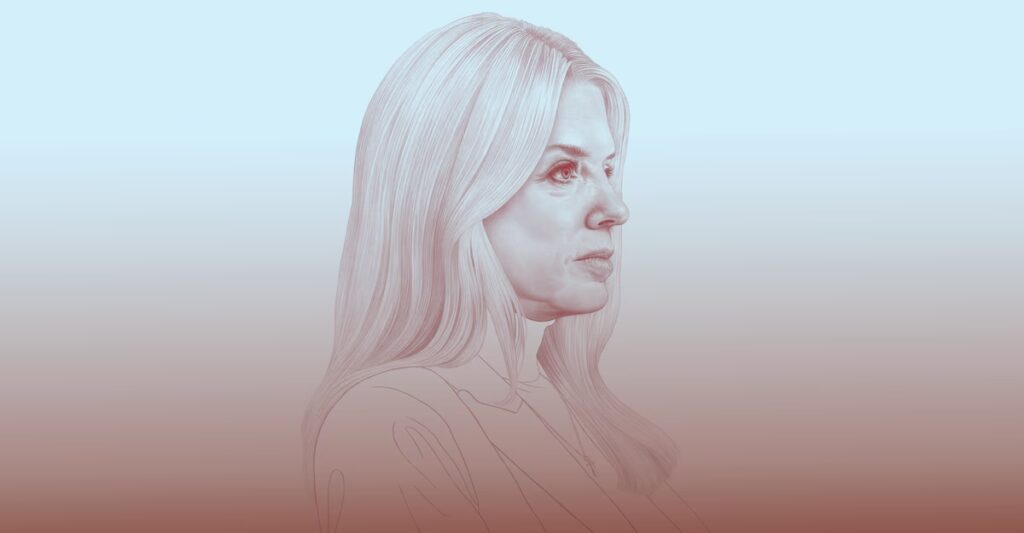
By the time she faced her first oversight hearing before the Senate Judiciary Committee, Pam Bondi had become a person she never really wanted to be. She had told a reporter once that in college she’d wanted to be a pediatrician, but she ended up becoming a lawyer. She’d said that she wasn’t sure she wanted to actually practice law, but she became a prosecutor. She’d told reporters that she “never dreamed” of running for political office, but she did that too, twice winning campaigns for Florida attorney general. She’d said that when Donald Trump eventually asked her to be U.S. attorney general, she “made it really clear” that she did not want the job. During his first term, she had confided to a friend that she wanted to be ambassador to Italy.
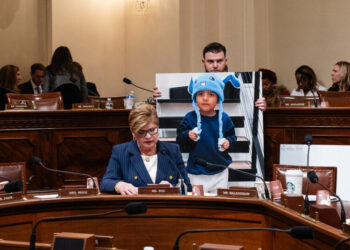
But here she was in a Senate hearing room in October, a person who had once seemed so mild, so warm, so kindhearted that she’d earned the nickname “Pambi,” opening up a folder full of slap-downs, each tailored to a Democratic committee member, with notes on how to deliver them.
“I wish you loved Chicago as much as you hate President Trump,” she told Senator Dick Durbin, who’d asked about the rationale for sending federal troops to his state.
“I cannot believe that you would accuse me of impropriety when you lied about your military service,” she said to Senator Richard Blumenthal, referring to a matter for which he had apologized 15 years earlier, while dodging his question about why the Justice Department had dropped an antitrust case after lobbying by Bondi’s former firm.
“You took money, I believe, did you, from Reid Hoffman, one of Epstein’s closest confidants,” she said to Senator Sheldon Whitehouse, who’d asked whether the FBI was investigating suspicious financial activities related to the convicted sex offender Jeffrey Epstein, and who later said that Bondi had “made up nonsense.”
“If you worked for me, you would have been fired,” Bondi told Senator Adam Schiff.
And on it went for hours, a calculated performance that amounted to a giant middle finger to basic notions of decorum and accountability, leaving all sorts of questions unanswered, including a fundamental one that some of Bondi’s old friends and colleagues back home in Florida had been asking. As one of them put it to me: “I keep asking myself, What the fuck happened to Pam? ”
At this point, there is little mystery about who Pam Bondi has become. She is an attorney general who does not tell Trump no. During the first year of her tenure, Bondi has carried out the most stunning transformation of the Justice Department in modern American history, turning an autonomous agency charged with upholding the U.S. Constitution into one where the rule of law is secondary to the wishes of the president.
What this has meant so far includes firing more than 230 career attorneys and other employees and accepting the resignations of at least 6,000 more, gutting the Civil Rights Division and units that investigate public corruption, and challenging core American principles such as birthright citizenship and due process. It has meant turning the might of the department against Trump’s political enemies, a growing list that includes former FBI Director James Comey, former CIA Director John Brennan, New York Attorney General Letitia James, Federal Reserve Chair Jerome Powell, Senator Schiff, a man who threw a sandwich at a federal agent, an Office Depot clerk who refused to print flyers for a Charlie Kirk vigil, and reportedly Minnesota Governor Tim Walz, Minneapolis Mayor Jacob Frey, and the partner of Renee Nicole Good, who was shot and killed by a federal immigration officer on January 7. It has meant providing a legal justification for the extrajudicial killings of at least 123 people suspected of smuggling drugs, and for the operation to capture the Venezuelan president, an action that opens the door to a world in which the only law is power. And it has meant becoming the face of the Epstein-files scandal, a position that could ultimately be Bondi’s undoing.
Trump’s previous attorneys general were loyalists who pursued a vision of robust executive-branch authority, but they had red lines: Jeff Sessions recused himself from the Russia investigation, citing ethics concerns; Bill Barr refused to say that the 2020 election had been stolen. Bondi’s willingness to do what Trump wants appears to be boundless, and yet that still might not be enough for him. Trump has reportedly been complaining in recent weeks that Bondi has not been moving as fast as he’d like in pursuing cases against his political opponents.
His frustration extends to her handling of the Epstein files, a political disaster for him that could mean legal jeopardy for her. Bondi has so far failed to comply with a federal law that required the release of all the unclassified Epstein files by December 19—millions of investigative documents known to contain not only references to Trump but potentially compromising information about some of the most powerful men in the world. After promising “maximum transparency,” Bondi has released only 12,285 out of more than 2 million documents—a delay she has blamed on the volume of the files—leading even some of Trump’s supporters to abandon him and leaving Bondi under enormous pressure. Arguably, nothing less than the future of the MAGA movement and the sanctity of the U.S. Constitution depend on what the attorney general is willing to do next.
All of which raises a question: not so much what happened to Pam Bondi, but why.
Any answer would have to come from sources other than Bondi herself. A Justice Department spokesperson rejected my requests to interview Bondi. Even as the attorney general has gone on Fox News and posted selfies with MAGA-friendly media personalities, she has not given any extended interviews with mainstream news outlets since she arrived at the Justice Department, where one of her first acts was to move from the traditional corner office of the attorney general to a far larger conference room. The space is some 100 feet long, with floor-to-ceiling windows, ornate wood paneling, and murals called The Triumph of Justice and The Defeat of Justice, the latter depicting Lady Justice as a blond woman collapsed on the ground. At this point, Bondi, who is 60, has sequestered herself within the MAGA-verse.
I went looking for the person who existed before all of that, which meant going to Tampa, where Pamela Jo Bondi grew up in a middle-class suburb between Busch Gardens and I-75, now a landscape of smoke shops, chiropractors, and strip malls moldering in the sun. Temple Terrace, a golf-course development of ranch houses and mossy oaks, was not the best or the worst neighborhood in Tampa. Bondi came from blank-slate America.
She was the oldest of three children. Her mother, Patsy, was a teacher, and her father, Joe, was also a teacher, as well as an education professor and the mayor of Temple Terrace. His grandfather had emigrated from Sicily and was a cigar maker in Ybor City, home to Tampa’s large community of Italians, Cubans, and Spaniards. Joe Bondi was an FDR Democrat, and by all accounts a generous person and the patriarch of the family. In an article in La Gaceta, a local trilingual paper, he spoke of himself as “an underdog” who had “lived the American dream,” and said that growing up in Ybor City, he’d developed “a strong sense of togetherness—this is something I’m happy to say I’ve successfully instilled in my children.” Pam was extremely close with her father and, when he died in 2013, referred to him as “my beautiful Daddy.”
She went to the local public high school down the road, also not the best or the worst. The future attorney general had Farrah Fawcett hair, served as secretary of the student council, and lost her bid for homecoming queen. She went for three years to a college that was also down the road, the University of South Florida, where her father worked, before graduating from the University of Florida, in Gainesville, with a 3.4 GPA and a degree in criminal justice. She often said she loved children, that she wanted to have a big family.
Bondi went to law school at Stetson University, two hours north of Tampa, later telling Florida’s Business Observer, “I wasn’t certain I wanted to practice law.” Her father urged her to try the state attorney’s office in Hillsborough County, where he had connections. She said yes, joining dozens of young prosecutors who worked in the courthouse in downtown Tampa, many of whom were women. The state attorney at the time was known to have a preference for blondes, among other eccentricities; one lawyer described the environment as the “Blond Ambition Tour.” Bondi adapted to a courthouse buzzing in the ’90s with local corruption scandals and often surreal cases involving drugged-out teenagers, fallen baseball stars, the murder of a circus performer called Lobster Boy, and flamboyant defense attorneys with names like Boom-Boom Benito.
Although most prosecutors stayed for five or so years before moving into more lucrative private practice, Bondi stayed for nearly 20, rising from misdemeanors to the felony section, where she handled high-profile murder cases, among others. Her evaluations from that time describe an earnest and hardworking prosecutor who sometimes lacked confidence. On a five-point scale, she got fives on diligence and threes, fours, and a few fives on legal acumen. “While Pam is very capable with good potential, she unnecessarily becomes too intimidated by difficult, long, or important cases. She sometimes becomes intimidated by some attorneys as well,” read one evaluation. Others said “team player” and “my right hand” and “Through some demanding times, she has learned the meaning of the word ‘sacrifice.’ ”
Colleagues and others who knew Bondi then remember her as a competent, at times excellent prosecutor who was good with juries, won many convictions, and was able to convey the moral certitude necessary to seek the death penalty. A former boyfriend, Billy Howard, called her “The Paminator.” At the same time, he told me, “Pam was very well liked—that is something she worked at. She liked to be liked.” Howard said that during their time together, he was at a high point in his career and also a “big partier.” He said that Pam called his boss, saying she was worried about Howard, a moment he now credits with possibly saving his life. “A part of her was genuine and caring and concerned, and it helped me,” he said.
Many others recalled how kind she could be, how accommodating, how Pambi. One courthouse colleague remembered how a relative of a crime victim mistook Bondi for a secretary and asked her to copy some papers, which Bondi did without hesitating or correcting the woman. “She had humility,” said this person, who, like some others interviewed for this story, requested anonymity because they feared retribution. Patrick Manteiga, the publisher of La Gaceta, remembered seeing Bondi at an annual event called the Governor’s Luncheon, part of the kickoff for the state fair. She was standing next to the state attorney at the time, Mark Ober, who became one of Bondi’s most important mentors. Ober was shaking hands, while Bondi supplied him with hand sanitizer.
Besides her willing persona, what began to distinguish Bondi from the courthouse crowd were her appearances on local television. She became the spokesperson for the state attorney’s office, facing cameras during big trials, becoming friendly with reporters. Bondi was good at it, and by 2000, she was making her first appearance on the Today show, talking about a high-profile murder case she had prosecuted. She began getting booked as a talking head on CNN, MSNBC, and Fox News.
Florida politics was trending Republican with Jeb Bush’s election as governor. Though no one I spoke with could recall Bondi expressing strong ideological views—if anything, she seemed fairly liberal—it was around this time that she switched her party registration from Democratic to Republican. She became friendly with Sean Hannity. Soon, Fox News was sending black cars to drive her to the studio to talk about sensational cases such as that of Terri Schiavo, the comatose Florida woman who became the center of a national political drama over whether to end life support. Producers would give Bondi a tape of her appearances afterward, or she’d tell friends to record her segments, and they would gather in a living room and rewatch them. “She’d be like, ‘Did I sound stupid the way I said that?’ ” a close friend from that time told me.
As Bondi’s local fame grew, this side of her personality grew as well, people who knew her said. She could be hyper-defensive and hyper-sensitive to criticism. “The overwhelming thing you have to understand about Pam is her debilitating insecurity—she was always assuming someone was talking about her,” the close friend told me. “Then she’d overcompensate.” At the same time, Bondi was socially ambitious, excelling at the cocktail-party art of remembering details about people—asking about kids, a sick mother—while looking past them at the more powerful person she wanted to meet. People who experienced this spoke of being “Bondied.” She could be thoughtful and kind, yet she would exile friends at the first hint of disloyalty. She needed constant reassurance, and sometimes this came from dogs.
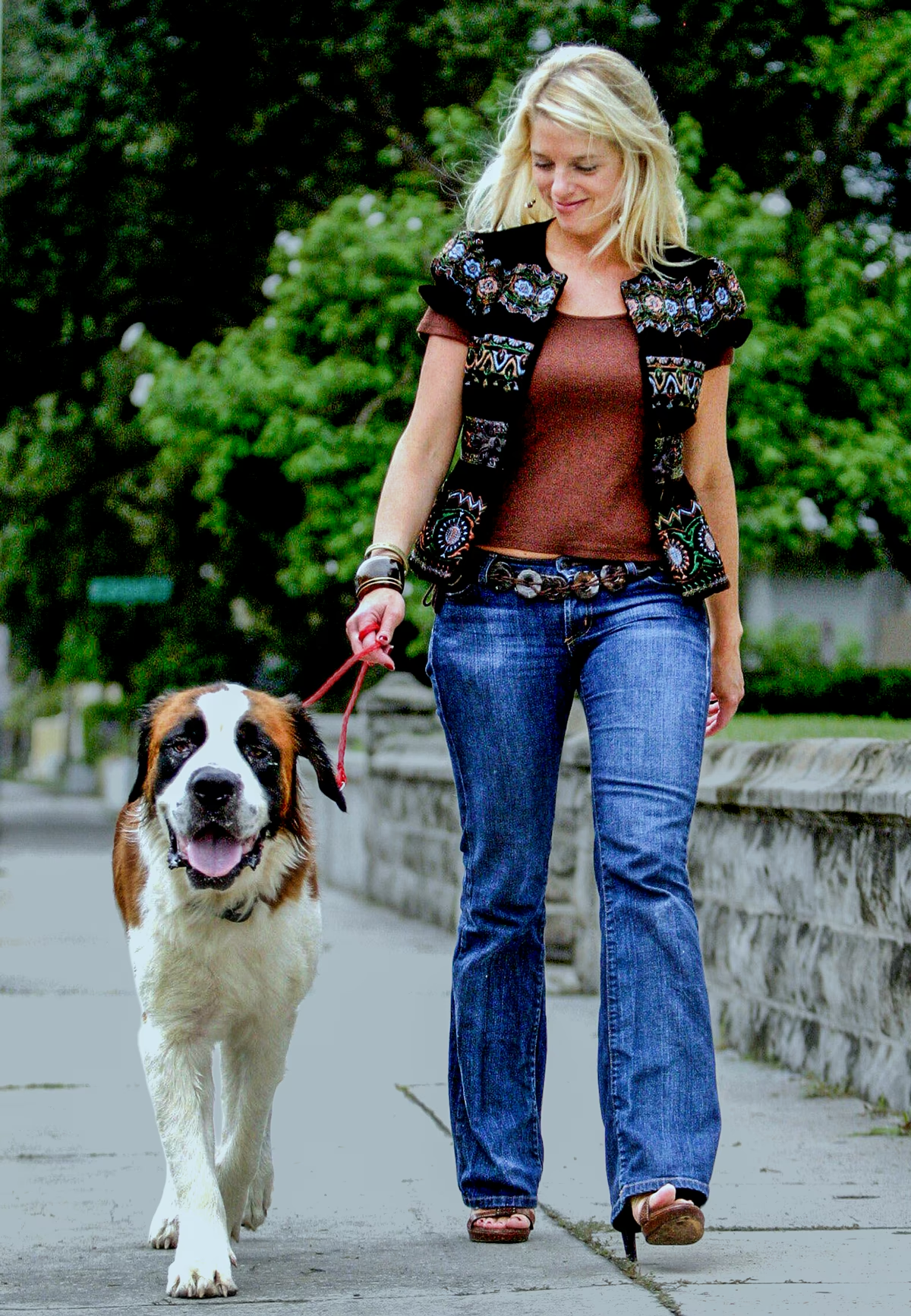
Pam Bondi loves dogs. Always had them, one after another. She got involved with dog shelters and dog rescue, and once pulled off to the side of a busy road and got out of her car to chase down a stray. Another dog she helped was a Saint Bernard named Master Tank. She adopted him from a shelter after he was lost during Hurricane Katrina in 2005, not long after her own Saint Bernard had died. The story has been told but bears repeating. Master Tank belonged to Steve and Dorreen Couture and their grandson, who was 4, recovering from the murder-suicide of his parents and losing his dog during the storm. Bondi said the dog was a “walking skeleton” and “dying from heartworms” when she adopted him. The Coutures eventually tracked down Master Tank, but instead of giving him back, Bondi hired a lawyer, who accused the Coutures of abusing the dog, which Bondi had renamed Noah. “She lied,” Dorreen told a Palm Beach Post columnist years later. “My little grandson begged her to take the dog home, and she refused. She thought she would just wear us down. That we were unstable people and would just quit.” The case was settled out of court, with Bondi securing visitation rights, but she never did visit. She got another dog.
Meanwhile, Bondi was attracting more attention, including, in 2006, that of Donald Trump, who was at the peak of his TV celebrity with The Apprentice. Bondi had been defending him on TV during his dispute with the town of Palm Beach over an enormous American flag he was flying at Mar-a-Lago. As Bondi would later tell the story, Trump called her after one such appearance. “He wanted to thank me,” she recalled in an interview with Lara Trump. “All he cared about was America.”
By 2009, Bondi had also befriended a Florida political operative named Adam Goodman. They had met on a film set where Goodman, a Republican whose specialty was television, was directing an ad for Bondi’s boss, Mark Ober. She was behind the scenes, and Goodman remembers that she kept correcting him whenever he used the word jail. “Prison,” she would say. Goodman had seen Bondi on air, and when the party needed a candidate for Florida attorney general, he thought of her. “I look at things politically, through the lens of performance,” he told me. “Both of us were into the power of performance to compel things to happen.” It helped that Bondi was familiar to voters in the largest media market in the state. If she carried Hillsborough County, she would win.
When Goodman pressed Bondi to run, she told him she had never considered it and needed time to think. He thought she might say no, but then she said yes. Goodman, who remains a Bondi ally, recalled how she “knocked it out of the park” when they filmed one of her first three-minute ads. “She loves the camera, and the camera loves her,” he said, then corrected himself. “She loves the camera because she knows the camera loves her.”
As time went on, reporters began noticing another quality Bondi had developed. Manteiga remembered calling her before he printed a critical story during the campaign. “And she gets on the phone with me, and she’s crying—‘Don’t print this article,’ ” Manteiga told me. “Crying, crying.” He hung up the phone and called a friend who worked for the St. Petersburg Times. “I said she was crying, and he said, ‘Yeah, she does that to us too.’ I called another reporter, and he said, ‘Yeah, she’s done that to me.’ ”
People who knew Bondi during her eight years as Florida’s attorney general tend to make two observations about her. On the one hand, she seemed to have no burning political passions, other than saving dogs. No one I spoke with could point to some dramatic shift in her outlook, or to any newly blossoming conservative values. Privately, she did not express any. She did not seem to hate Barack Obama, subscribe to birtherism, or rail against the Affordable Care Act. She was not worried about the legalization of gay marriage, or gay adoption, or other issues animating the GOP base at the time.
“We talked for an hour about our bunions,” one GOP political operative recalled. “She was not ideological.”
On the other hand, Bondi was willing to make herself useful to the party. She became the public face of a multistate challenge to the ACA. She began wearing a necklace with little elephants. She defended Florida’s bans on gay adoption and gay marriage, arguing in a brief that the latter would cause “significant public harm,” even though she had many gay friends back in Tampa.
This was when some of Bondi’s friends began to wonder what was happening with her. When Bondi was home and ran into people who questioned her position, she would respond with some version of “I had to do it for the party,” or an exhausted “You have no idea how politics works,” or “I was elected to enforce the laws.” When one friend pressed her further, arguing that other attorneys general were refusing to enforce laws denying gay people rights, and telling her how some of her closest friends felt personally betrayed by what she was doing, Bondi said, “You know me. I love gay people. You know my heart.” Sometimes there were tears.
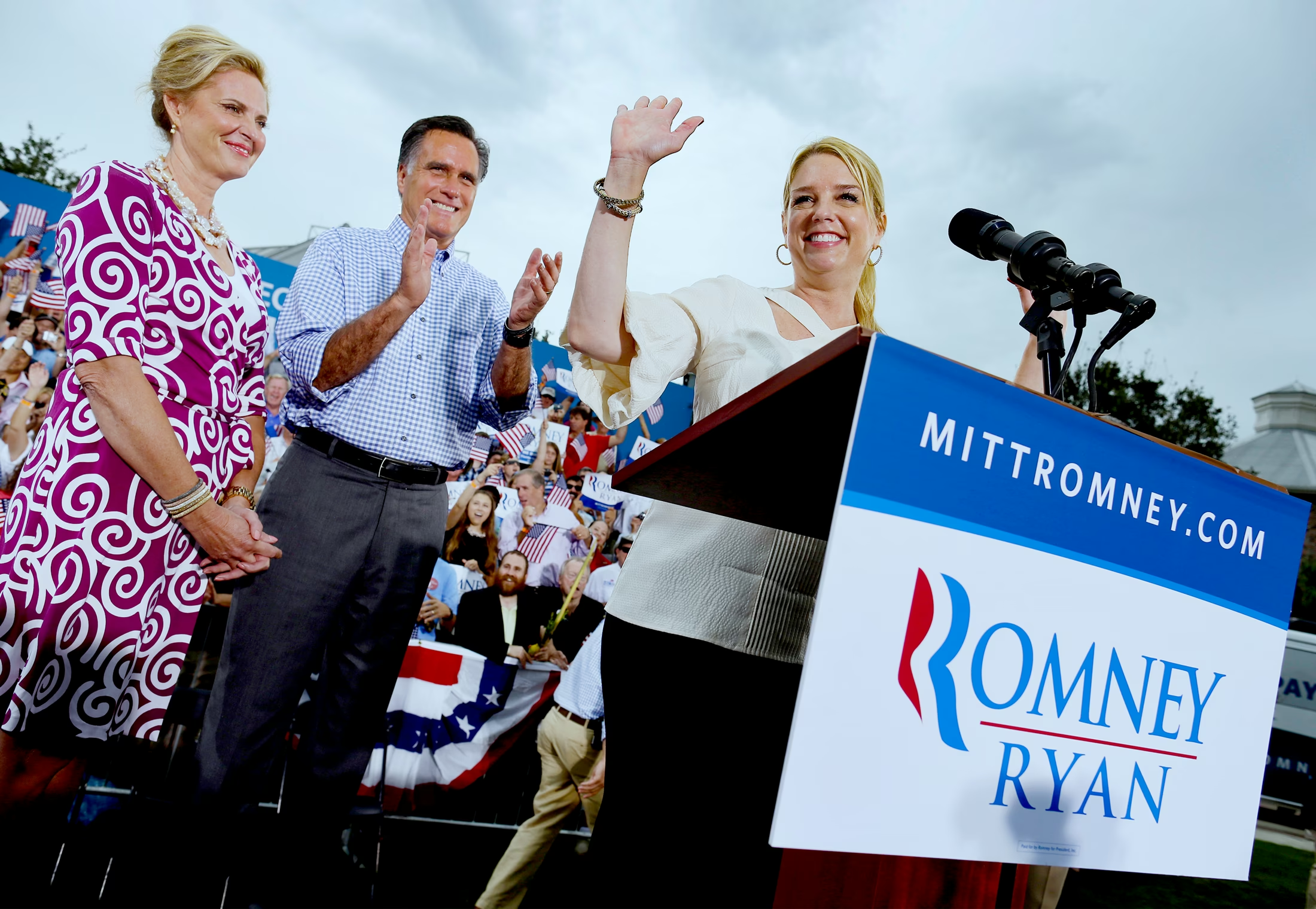
As state attorney general, Bondi was widely praised for her crackdown on opioid pill mills and for her work combatting human trafficking. But more and more, her success hinged on her willingness to be a spokesperson for the party, especially on Fox News. She appeared regularly as a legal commentator on Hannity, Fox & Friends, America Reports, and The Five, where she had a three-day stint as a guest host. “She was an accomplished, well-spoken carrier of the message,” the GOP operative, who worked on Mitt Romney’s 2012 campaign, told me, recalling Bondi’s role as a Romney surrogate. “Pam was somebody you could put out for almost anything,” this person said. “She was somebody you could put on a Sunday show.”
Bondi’s time in office coincided with a dramatic rise in lobbying of state attorneys general. Historically, the office had been a kind of political backwater. But in the years following the 1998 multistate settlement against tobacco companies, corporations aiming to head off similar litigation began donating to attorney-general campaigns and sponsoring lavish conferences for them at resorts in California or Hawaii. Bondi attended many of them. And many of her actions tracked closely with the wishes of corporate lobbyists and campaign donors.
The most well known of these was a decision by her office to drop a formal investigation into fraud and deceptive practices at Trump University, which came after Bondi had solicited a $25,000 donation from Trump’s foundation. (A state ethics commission later stated that the timing of the decision “may raise suspicions” but found no evidence that Bondi had been “involved with the investigation or decisions regarding Trump University.”)
Soon after taking office, Bondi also pushed out two attorneys who had been among the first in the nation to expose fraudulent practices at so-called foreclosure mills; their investigation found that law firms and lending companies were using false documents to monetize foreclosures at the height of the subprime-mortgage crisis. (A Florida inspector general found “no evidence of wrongdoing” by Bondi or her department.)
Documents obtained by The New York Times showed that after being lobbied by the firm Dickstein Shapiro, Bondi declined to prosecute a hospital-bill-collection company accused of abusive practices, an online school accused of “unconscionable sales practices,” and online travel-reservation companies accused by Bondi’s own predecessor of improperly withholding taxes. Bondi has said that she was not unduly influenced, stating at the time that “absolutely no access to me or my staff is going to have any bearing on my efforts to protect Floridians.”
Along with the flood of corporate money to attorneys general came a sharp rise in partisanship, a trend that Bondi helped accelerate. This first became obvious at an annual conference of the National Association of Attorneys General, an event where members would elect a new president. Typically, the elections were a low-stakes formality, the title rotating regionally and, for the most part, alternating between Democrats and Republicans. But one year, Bondi threw herself into contention, mounting a mini-campaign against Jim Hood of Mississippi, a Democrat, calling GOP conferees as they sat around tables. “Are you with me?” she would ask. “It was bizarre,” a Republican attorney general from that time told me. “It was a popularity contest, like in high school. She wanted the recognition.”
Bondi lost, but the move left bitter feelings, and helped diminish the sense of trust at the national association. Bondi was eventually elected to head the Republican Attorneys General Association, where she helped lead an effort to do away with another long-standing norm, that the two parties would not fund campaigns against their incumbent colleagues. The idea was that incumbents often cooperated in a bipartisan way on complex, multistate litigation, and getting rid of them would only hinder those efforts. Bondi was part of a group that seemed to simply want more GOP wins.
“I think she did more to increase partisanship among AGs than any single AG during my tenure,” Chris Toth, an independent who led the national association, told me. “And I just don’t understand why she did that.”
Bondi’s personal life during this time was difficult. Her engagement to a wealthy ophthalmologist ended. Her father died. Some friendships became strained. In an interview during her first term, Bondi described spending 13 hours a day at the office and heading home to a rented condo in Tallahassee. She was becoming a person who said of her life, “It’s been lonely, very lonely,” and who said of her dog Luke, another Saint Bernard, “He’s my company.” Bondi would bring Luke to work. She bought him a therapeutic mattress for car trips back to Tampa.
She began bringing rescue dogs to cabinet meetings, trying to get them adopted, and posting about them on Instagram—a puppy named Baker, a shepherd mix named Zeke. “I was thrilled to introduce Rosie, the gorgeous rescue Boxer mix, at the cabinet meeting yesterday,” she posted. “Rosie is looking for a forever home.”
During this time, Bondi was becoming more entrenched in Republican circles, which for her would come to mean Trump’s circles. When she ran for reelection in 2014, Trump threw her a fundraiser at Mar-a-Lago. When the 2016 presidential primary arrived, Goodman, the operative who had first gotten her into politics, encouraged her to endorse Trump even though establishment Republicans were still keeping their distance. If Trump won, he told her, the endorsement could give her status in his administration.
“She calls me out of the blue, 9 a.m. one morning,” Goodman told me. “She said, ‘I’m going to pick you up in five minutes.’ ” Trump was holding a rally in Tampa that day in March. “She said, ‘We’re going to the convention center, and I’m going to endorse Trump, and I need your help on talking points.’ I’m scribbling as we go to the convention center. It was one of those high-intensity moments and, turned out, historic moments.” In her speech, Bondi spoke of her yearslong friendship with Trump; Trump spoke of their “great relationship.”
And that was how Bondi became a person standing on the stage of the Republican National Convention in Ohio. Before a cheering prime-time audience, she declared that she loved “Donald.” She pointed to someone holding a sign calling for Hillary Clinton to go to prison. Clinton had criticized Bondi over her handling of the Trump University complaints.
“ ‘Lock her up,’ ” Bondi said. “I love that.”
“Oh, Pam, why did you say that?” Chris Toth remembered saying to the television at that very moment. He was certain that she knew better.
It was around this time that Bondi’s old friends began speaking of her as someone they could no longer recognize.
“She was loved around here, just so sweet,” the courthouse colleague said. “People who knew the old Pam, we just can’t resolve it.”
“I thought, Do I really know this person? ” the close friend remembered thinking after Bondi endorsed Trump.
The person they thought they knew was venturing ever deeper into Trump’s world. Though Bondi did not get a position in his first administration, in a way, she got something better. When she finished her second term as Florida attorney general, she joined a lobbying firm called Ballard Partners, which was co-led at the time by Trump’s 2016 Florida campaign manager, Susie Wiles, who would go on to run his 2024 campaign and is now his chief of staff.
Soon Bondi was making more money than she ever had in her life. She lobbied for Qatar. She lobbied for Amazon. She lobbied for Uber. And eventually she lobbied for Trump, joining his defense team during his first impeachment trial. She helped launch a group called Women for Trump during the 2020 campaign, greeting supporters at a mall in Pennsylvania. When Trump contested the 2020 election results, Bondi was one of the first high-profile figures to amplify the lie that the race had been stolen, rushing to Philadelphia with the Trump-campaign adviser Corey Lewandowski the day after the election, where she declared before a small crowd that Trump had “won Pennsylvania” even as votes were still being counted. Bondi went on Fox News, claiming that there was “evidence of cheating” and “fake ballots,” though she never signed her name to lawsuits with those allegations, which could have gotten her disbarred.
After rioters stormed the U.S. Capitol on January 6, 2021, Bondi remained a willing Trump operative. In testimony before the House select committee investigating the insurrection the next year, Cassidy Hutchinson, who had been an aide to then–White House Chief of Staff Mark Meadows, said that Bondi was among the Trump surrogates who had called her prior to her appearances before the committee to shore up her loyalty to Trump, or, as they often put it, “the family.” Hutchinson said the message was that she would be “taken care of” if she protected Trump, and that they could “ruin her life” if she did not. Bondi, whom Hutchinson knew from their encounters at the White House, assumed a kind of caretaker role, calling and texting her with job opportunities in Trump world.
[From the February 2026 issue: Jamie Thompson on January 6, five years later]
“This is Susie Wiles,” Bondi messaged her on Signal at one point, providing Wiles’s email address. “She’s my best friend. She’s super sweet. She’s going to love you.”
“Susie, Matt Schlapp and I had dinner with POTUS at Mar-a-Lago tonight,” read another Signal message, referring to Wiles and a GOP operative, Hutchinson recalled. “Call Matt next week. He has a job for you that we all think you’d be great in. You are the best. Keep up the good work. Love and miss you.” (Through the Justice Department spokesperson, Bondi declined to comment on Hutchinson’s testimony. At the time, she appeared on Fox News, calling the hearings “show trials.”)
Under pressure, Hutchinson wrestled with her conscience and ultimately broke away from Trump. Bondi appeared not to wrestle. She remained inside Trump world, which meant making at least $1 million at Ballard and nearly $3 million from shares in the Trump Media & Technology Group for consulting on the merger that created the company, according to financial disclosures covering the two years prior to her nomination as attorney general.
She would make another $520,000 in consulting fees from the Trump-aligned America First Policy Institute, the disclosures show, where her work in the run-up to the 2024 election forecast the kind of attorney general she was willing to be. Bondi signed on to a brief supporting absolute presidential immunity from criminal prosecution for Trump when he was being investigated for 2020-election interference. In public letters and press releases, she backed a Georgia election-board official who’d claimed authority to unilaterally delay or deny the certification of election results. In April 2024, she warned election officials to do more to ensure that noncitizens could not vote, embracing a long-debunked idea that has been used to make voting more difficult and to contest election results.
Then came the day that Trump won reelection. And the day not long after that when his first nominee for attorney general, Matt Gaetz, withdrew amid concerns that allegations of sexual misconduct and drug use would sink his confirmation. And the day not long after that, the one that Bondi said she never expected would come, when Trump called and asked her to be his attorney general.
At first, she said no. She said she wanted to “go back to my great life in Florida.”
Then, as she often had, Pam Bondi said yes.
As she would later tell Lara Trump, the president, “in his way, talked me into doing this.” Bondi said that she was so devoted to Trump that if he asked her to answer the phones, “I would become the best switchboard operator ever.”
In Tampa, where she had built a wall around her home in one of the city’s best neighborhoods, black SUVs began to let the neighbors know when she was in town. In Washington, D.C., Bondi was easily confirmed, despite concerns among Democrats that she’d declined to acknowledge Trump had lost the 2020 election, and that her first loyalty would be to the president instead of the law. “I need to know that you would tell the president no if you’re asked to do something that is wrong, illegal, or unconstitutional,” Dick Durbin said during her confirmation hearing. Bondi responded that she would “enforce the law fairly and evenhandedly.” She said that the department “must be independent and must act independently” and that “politics will not play a part.”
After Bondi was sworn in, she moved her office into the large, ornate conference room, where Joseph Tirrell, the director of the department’s ethics office, soon met her and her then–chief of staff for their first ethics briefing. Tirrell had worked in the ethics office since 2018, and had briefed the previous AG in the traditional corner office. “I had been prepared, but it was still a bit shocking,” he told me.
Tirrell said that Bondi was courteous as he went over various regulations. She had no concerns until he began explaining restrictions around accepting gifts, specifically challenge coins, the metal medallions that are given out by the military, police departments, the FBI, and other components within the Justice Department, to signify camaraderie. Trump has displayed his own collection in the Oval Office. According to Tirrell, Bondi and her chief of staff had questions about the restrictions, and a 10-minute conversation ensued. She wanted the coins.
“They were like, ‘We still need to dig deeper on this,’ ” Tirrell told me. “That was the only real back-and-forth we had.” (Through her spokesperson, Bondi said, “No ethics advice was ever overruled.”)
Tirrell said that in the weeks that followed the meeting, Bondi pressed to keep other gifts even after he told her she couldn’t. A box of cigars. A FIFA World Cup soccer ball. Tirrell was going back and forth with Bondi’s office about the ball when he was fired, a moment he had been half-expecting; he had recently approved pro bono legal services for then–Special Counsel Jack Smith, who investigated Trump’s role in January 6 and now is on Trump’s enemies list. Tirrell is among many employees suing the department over their dismissals, believing that they were motivated by Trump’s need for retribution rather than any wrongdoing. Bondi has said the opposite—that she is “ending the weaponization” of the department. (The Justice Department is attempting to get Tirrell’s case dismissed.)
[From the February 2026 issue: Franklin Foer on Donald Trump’s destruction of the civil service]
Standing in the Great Hall when Trump visited the Justice Department in March 2025, she proclaimed that “we are going to fight to keep America safe again,” and called Trump the “greatest president in the history of our country.”
“We are so proud to work at the directive of Donald Trump,” she said.
By the end of her first year, Bondi had taken a litany of actions pleasing to the White House. She said yes to dropping the corruption case against New York City Mayor Eric Adams, allegedly in exchange for his cooperation with Trump’s deportation plans, over objections from senior prosecutors who resigned rather than cooperate; she said yes to the firing of career prosecutors even tangentially involved with investigations concerning Trump; and she said yes to an ongoing raft of pardons, including for at least 1,500 January 6 rioters, as well as dozens of MAGA loyalists, white-collar criminals, drug dealers, and business and political allies of Trump’s. Bondi defended the deployment of National Guard troops to Los Angeles, Chicago, Memphis, and New Orleans. And she publicly stood by her then–acting deputy, Emil Bove, even after he allegedly said that colleagues might have to tell a federal court, “Fuck you,” a moment described in a whistleblower complaint. (The Justice Department declined to comment on the incident, due to ongoing litigation.) Bove is now a federal judge.
“That would be the Honorable Judge Emil J. Bove III to you,” Bondi said to Sheldon Whitehouse during the Senate oversight hearing in October.
Bondi kept saying yes, with one possible exception.
According to reporting by multiple outlets, Bondi had quietly raised concerns about the case against Comey, the former FBI director, after federal prosecutors in Virginia concluded that there was insufficient evidence to bring charges.
For a moment, it seemed that Bondi might say no.
But Trump was relentless. He forced the resignation of the U.S. attorney for the Eastern District of Virginia. He sent a Truth Social message to “Pam,” which he accidentally posted publicly. “What about Comey, Adam ‘Shifty’ Schiff, Leticia???” he wrote, referring to Senator Schiff and New York Attorney General Letitia James, and calling them all “guilty as hell.” “JUSTICE MUST BE SERVED, NOW!!!”
Ultimately, Bondi said yes.
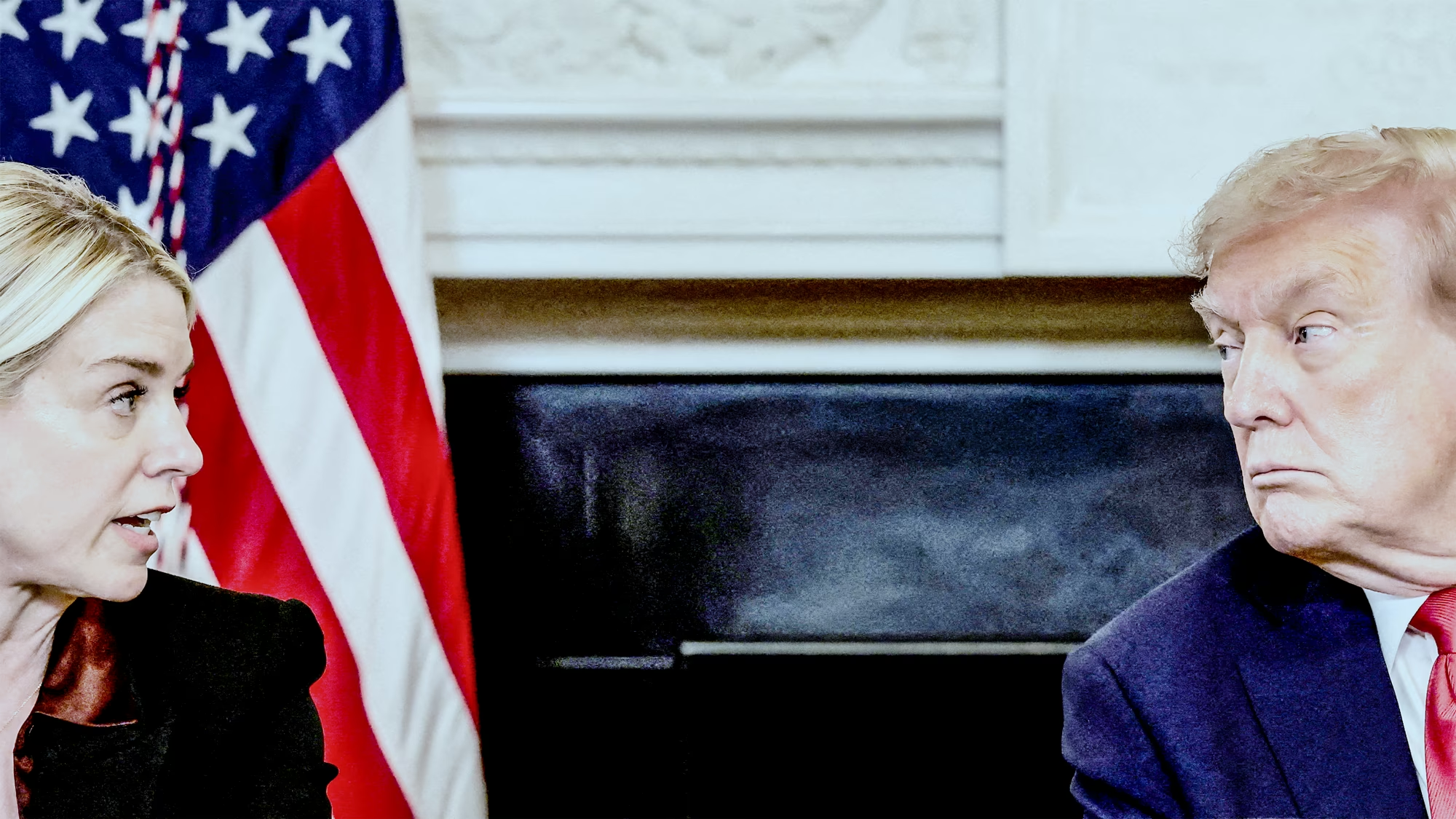
She called reports of her hesitation over Comey a “flat out lie.” Trump appointed a new, inexperienced prosecutor, Lindsey Halligan, who moved forward with the indictment. A judge dismissed the case on the grounds that Halligan had been unlawfully appointed, but the Justice Department appealed the decision.
What the loyalty of Pam Bondi might require her to do next remains an open question, especially after her clumsy handling of the Epstein files. After Trump had suggested during his campaign that he would release the files, Bondi went on Fox News in February 2025 and said that a supposed Epstein client list was “on my desk,” implying that documents were about to be released. Then she invited pro-Trump social-media influencers to the White House and handed out thick binders branded “The Epstein Files: Phase 1,” a moment that immediately backfired because the binders contained no client list and little new information. Many of the influencers criticized the move as a publicity stunt that made a mockery of Epstein’s victims, and some called for Bondi to be fired. Then Bondi backtracked, issuing a joint statement with the FBI saying that in fact there was no client list, which only further enraged a MAGA faction that has been marinating for years in the Epstein scandal and conspiracy theories about global child-trafficking rings. And then came the bipartisan legislation that required Bondi to release the files.
Now she faces an exquisite dilemma: how to comply with the law while also somehow satisfying Trump, who has given conflicting statements about the files. He has called the whole matter a “Democrat hoax,” but eventually supported the legislation requiring the release, saying that “we have nothing to hide.” He has more recently lamented that documents released so far are destroying the reputations of people who “innocently met” Epstein. Trump is exasperated that the issue won’t go away and, according to The Wall Street Journal, has blamed Bondi for making the situation worse. Even Bondi’s friend Susie Wiles, Trump’s chief of staff, has said that the attorney general “whiffed” on the matter. When I asked the White House if I could speak with Wiles, or any allies of Bondi’s, I got no response for weeks. A spokesperson eventually emailed statements praising Bondi from Trump, Wiles, Vice President J. D. Vance, and Secretary of State Marco Rubio, all of which had already appeared in the Journal.
Will Bondi continue to delay the full release of the documents, risking contempt charges? Will she resign and take the blame for the fiasco? Is it possible that Bondi’s red line is not the prosecution of the president’s political enemies, or the killing of 123 people who may or may not have been drug smugglers, or the ransacking of the Justice Department, or the undermining of the Constitution, but the prospect of her own ruin? How far is Bondi willing to go for Trump?
With midterms coming, would she say yes to deploying federal monitors to interfere at polling stations? Yes to challenging election results?
Can Pam Bondi say no?
She has new friends now, a support group of women who have also said yes to Trump, including Lara Trump and Tulsi Gabbard. “We text a lot,” Bondi told Katie Miller, a former Trump-administration aide and the wife of White House adviser Stephen Miller, on her podcast last year. “We all support each other, and have each other’s backs.”
In Tampa, Bondi’s old friends are still trying to figure out what happened to the person they remember, but one of them, the close friend, told me that she has finally stopped trying. At this point, she knows. She has been friends with Bondi since their days at the courthouse in Tampa, and on through Bondi’s time as Florida attorney general, her decision to endorse Trump, and several years after that. She said that she loved Pam, that she had tried to understand Pam, to support her, to care about her, and maybe also to excuse her. She said that she is distressed by what she believes Bondi is doing to the rule of law in America, and distressed to have concluded why.
“She went cheap for power,” the friend decided, and now she has only one question left. “Was it worth it?”
This article appears in the March 2026 print edition with the headline “Never Say No.”
The post The Attorney General Who Won’t Say No appeared first on The Atlantic.