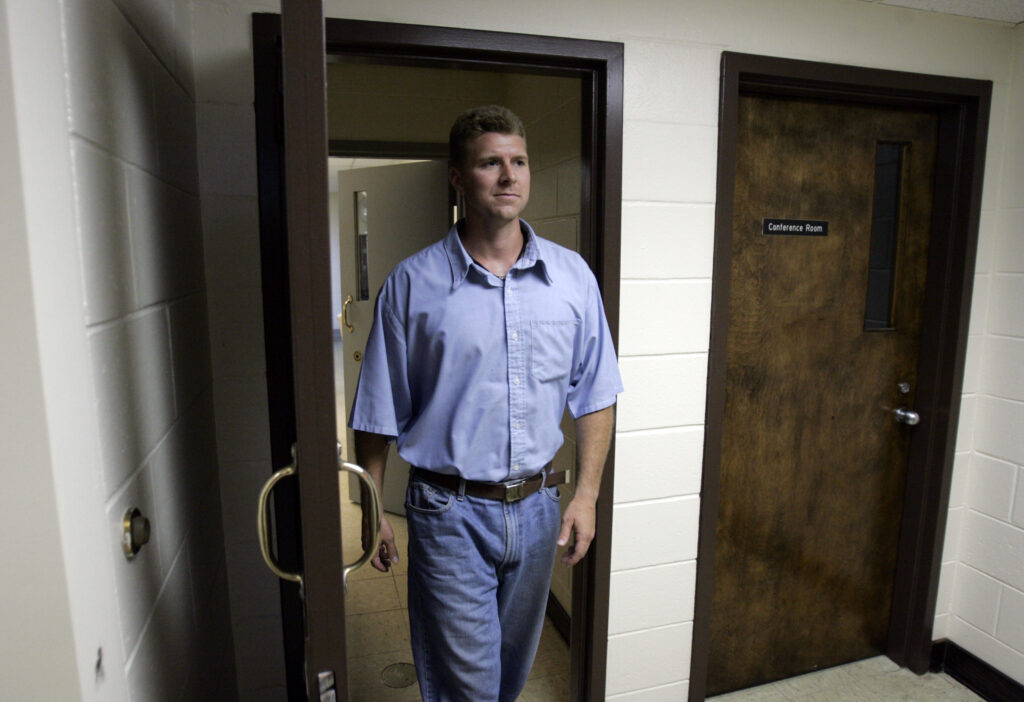
The two men were best friends, and they thought their bond, forged through months of grueling Navy SEAL training, was unbreakable. They were “swim buddies,” in the lingo of the SEALs, and the organization’s ethos — no man left behind — was ingrained in them.
Then a 21-year-old woman was strangled, and the friends — Dustin Turner and Billy Joe Brown — were charged with murder. The case riveted public attention in Virginia’s Tidewater area in the mid-1990s, as Turner blamed the killing on Brown and Brown blamed it on Turner. Both were sentenced to decades in prison in separate trials in 1996. Eventually the crime faded from communal memory.
Now, with Brown still locked up, Turner, 50, is about go free. After long insisting that his only offense was helping Brown dispose of the woman’s body, the former Boy Scout and high school athlete was granted release this month from his 82-year sentence by the Virginia Parole Board. His lawyer said he is due to leave prison within weeks.
Relatives of the slain woman, Jennifer Evans, could not be reached for comment.
Evans, a vacationing Emory University premed student, met Brown and Turner in a Virginia Beach nightclub on June 18, 1995. She disappeared that evening.
Days later, as a police investigation intensified, Turner told detectives that Brown strangled Evans in Turner’s car in the club’s parking lot while Turner tried to stop him. When authorities confronted Brown, he said that when he got to the car after closing time, Turner already had killed Evans in the vehicle.
Both said they drove to a wooded area in Newport News, Virginia, and dumped her body — because that’s what buddies do, they said: They look out for each other.
Brown was sentenced to 72 years. In 2002, early in his prison term, he changed his story, admitting that he strangled Evans. He said that he had falsely accused his friend because he was angry that Turner, in blaming him, had betrayed their bond. Brown told detectives that he had become a Christian behind bars and wanted to clear his conscience.
Even though his confession was deemed credible by a judge, it wasn’t legally sufficient to negate Turner’s conviction.
Prosecutors say that the two were accomplices in the killing.
“Mr. Turner gained … Jennifer Evans’ trust before luring her out to his car … where he and his co-defendant strangled her to death,” Commonwealth’s Attorney Colin D. Stolle of Virginia Beach said in a letter to the parole board, urging it to reject Turner’s application for release. “To grant Mr. Turner parole would be a grave injustice to our community and to Ms. Evans’ family, who suffered a horrific ordeal and loss.”
Turner’s lawyer, Stephen A. Northup, applauded the board’s 3-to-2 decision. “Despite Dusty’s attempts to stop [Brown] and free Jennifer, he could not save her,” Northup said in a statement. “Bound by misplaced loyalty to the SEAL code to never abandon your ‘swim buddy,’ Dusty helped cover up the crime for several days before reporting the truth to his commanding officer and the authorities.”
A series of judicial proceedings in Turner’s case showed the difficulty of fighting a conviction — even when seemingly exonerating evidence emerges. The case also highlights a quirk in the state’s parole system. Typically in Virginia, an inmate must serve 85 percent of a sentence before being eligible for release. But a narrow exception applied in Turner’s case.
Turner, who was 20 at the time of the killing and had no criminal record, grew up in Indiana. Brown, who was 23, is from Ohio.
According to news accounts after their arrests, Brown had been charged with a violent assault when he was 17, but the Navy was unaware of his sealed juvenile record when he was allowed to become a SEAL candidate. In months of arduous training in California and Georgia, Turner and Brown had survived the SEALs’s high attrition rate for aspiring commandos and were close to finishing the last phase of their training, in Little Creek, Virginia.
Court records recount the versions of what happened on the night Evans was killed.
She was a Georgia native staying with two friends in a cottage in the Virginia Beach area. At a nightclub called the Bayou, she and Turner seemed instantly attracted to each other, witnesses told police. While the two chatted in the crowded bar, witnesses said, Brown drank heavily, almost to the point of passing out.
Days afterward, when Turner admitted to being involved in her disappearance, he told detectives that he and Evans left the club. He said they were talking in the front seat of his car when Brown showed up and got in the back seat directly behind Evans. Then, for no apparent reason, Brown became enraged and began strangling her, Turner said. He said he wrestled with Brown, trying to free Evans from his grasp, but he couldn’t.
Turner led investigators to her body, hidden near a park in Newport News. As for why he had helped conceal the crime, he told a judge, “I had a distorted sense of loyalty to my swim buddy.”
Brown, in initially denying that he killed Evans, said in a police interrogation that as he approached the car, Turner jumped out and blurted, “I think I f—ing killed her.” Brown said he saw Evans unconscious on the back seat floor with torn clothes and a bloody nose. He said Turner then told him to climb in, that they needed to get rid of her body.
After Brown’s 2002 confession and a series of legal proceedings, a Circuit Court judge convened a hearing in 2008 to determine whether his confession was credible. On the witness stand, Brown said that after he got in the back seat, “I started talking to them and started playing with her hair,” according to news accounts. “One minute, I was normal, and the next minute I snapped and started choking her. … There was no reason, no rhyme, no nothing.”
He told the judge, “I’m here to glorify Jesus Christ by telling the truth.”
The judge ruled that Brown’s account was credible. Based on that finding, a divided three-judge panel of the Virginia Court of Appeals granted Turner a “writ of actual innocence.”
But the state attorney general’s office sought a hearing before the full Court of Appeals, which ruled against Turner in 2009. The court said that even with Brown’s confession, a jury could reasonably agree with prosecutors that Turner and Brown acted in concert, killing Evans because she refused to have sex with them. The Virginia Supreme Court affirmed that decision, leaving Turner to serve his 82-year sentence.
Under Virginia’s truth-in-sentencing law, passed in 1995, in most cases, an inmate has to complete 85 percent of their prison term. That means that someone who gets an 82-year sentence typically would have to serve about 70 years before being eligible for parole.
At the time of Turner’s trial, juries recommended sentences in Virginia. From 1995 to 2000, jurors weren’t told about the parole rule. As a result, defense attorneys said, juries were calling for unreasonably long sentences because they assumed most defendants would be released early.
The state Supreme Court agreed in 2000, ruling that a jury must be informed of the 85 percent rule before recommending a sentence. As for defendants who had been sent to prison before the Supreme Court ruling, the General Assembly barred the state from applying the 85 percent rule to them — including Turner and Brown.
Turner’s lawyer, Northup, said that in a confidential report prepared by a parole board examiner, “There was no opposition from any family members” of Evans, and just “a sprinkling” of objections from others.
In an interview, Northup said Turner, who was denied parole in 2023 and 2024, is completing a reentry program in prison and looks forward to getting out this winter. Officials are arranging parole supervision for him in Indiana, where he plans to live on rural property owned by his mother.
Northup said Turner has a job lined up with a nonprofit group that supports veterans who are incarcerated.
“He’s feeling good right now,” the lawyer said.
The post Ex-Navy SEAL paroled after 30 years in prison for murder appeared first on Washington Post.