The northern lights dazzled overnight during one of the largest solar radiation storms in decades, streaking the skies of North America and Northern Europe with bursts of red, green and orange.
If you were inspired, you’re not alone.
The aurora borealis has intrigued humans for millenniums. Scholars have identified portrayals in prehistoric cave paintings, in the Bible and other ancient historical texts, and in a number of myths and legends.
The Inuits believed that the lights were torches ignited by the spirits of the dead to guide new spirits to a higher realm, wrote Harald Falck-Ytter in “Aurora: The Northern Lights in Mythology, History, and Science” (1999).
Some cultures, including an Indigenous Siberian tribe, viewed the phenomenon as a sign of imminent childbirth. In ancient China, a written record from 2,600 B.C. said that an emperor’s mother had become pregnant after seeing “a big lightening circulating around” a star in the northern sky, “with the light shining all over the field.”
The northern lights also captivated the ancient Greeks and Romans. The Greek philosopher and biographer Plutarch described “a flaming cloud that did not rest in one place but moved along with intricate and regular movements.”
In the first century A.D., the Roman philosopher Seneca marveled at the variation in the aurora’s colors: “Some are a very intense red; some have a weak, pale flame; some have a bright light; some pulsate; some are a uniform yellow with no discharges or rays emerging.”
The aurora borealis got its scientific name from Galileo in the early 17th century, at a time when Renaissance scholars were studying the phenomenon intensely. He named it after Aurora, the Roman goddess of dawn.
The astronomer Edmond Halley, the namesake for Halley’s comet, linked the northern lights to the Earth’s magnetic field, setting off research into the science behind them. He expected to die without seeing them but finally got a chance in 1716, at the age of 59.
Other scientists would later confirm Halley’s hypothesis. The northern lights happen when charged particles from the sun, carried by the solar wind, collide with gases in Earth’s upper atmosphere, guided toward the planet’s poles by its magnetic field.
The lights have inspired plenty of artists, too.
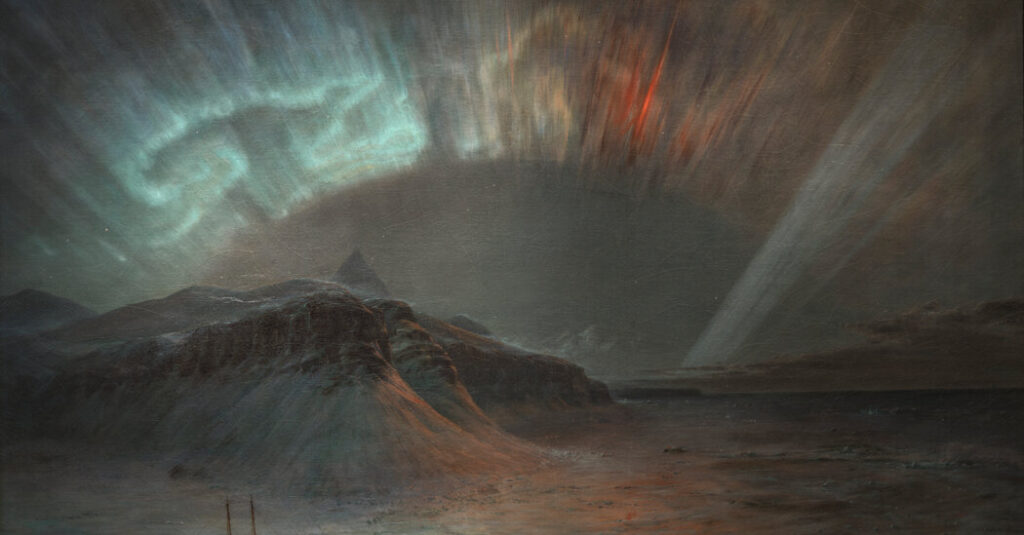
“Aurora Borealis,” an 1865 painting by the American landscape painter Frederic Edwin Church, shows a ship trapped in Arctic ice under turquoise and red streaks in the night sky. He based the painting not on direct observation but on sketches and descriptions from Isaac Hayes, a polar explorer who had seen the northern lights during an 1861 voyage.
The same year the painting was made, the northern lights inspired Herman Melville to write the poem “Aurora Borealis.” It commemorated the end of the American Civil War, during which the northern lights reached as far south as Virginia.
The poem’s irregular cadence echoes the glimmering lights it describes: the “Retreatings and advancings,” the “Transitions and enhancings” and the “million blades that glowed.”
In recent decades, the northern lights have animated songs by the rock bands Death Cab for Cutie and Renaissance, among others.
The lyrics of the 1976 song “Aurora Borealis,” by the country singer known as C.W. McCall, are particularly evocative. It tells a story of stargazing in Colorado, glimpsing the Milky Way over Wyoming and seeing the northern lights from Montana.
“They’re like flames from some prehistoric campfire, leaping and dancing in the sky and changing colors,” he sings. “It’s like the equinox, the changing of the seasons: summer to fall, young to old, then to now.”
In Norway, the northern lights were celebrated in a modern architectural marvel.
The Northern Lights Cathedral, completed in 2013, features a winding titanium facade and sloping concrete walls designed to mimic the coiling shapes of an aurora. Its spire stretches 154 feet into the sky.
John Yoon is a Times reporter based in Seoul who covers breaking and trending news.
The post If You Were Inspired by the Northern Lights, You’re Not Alone appeared first on New York Times.