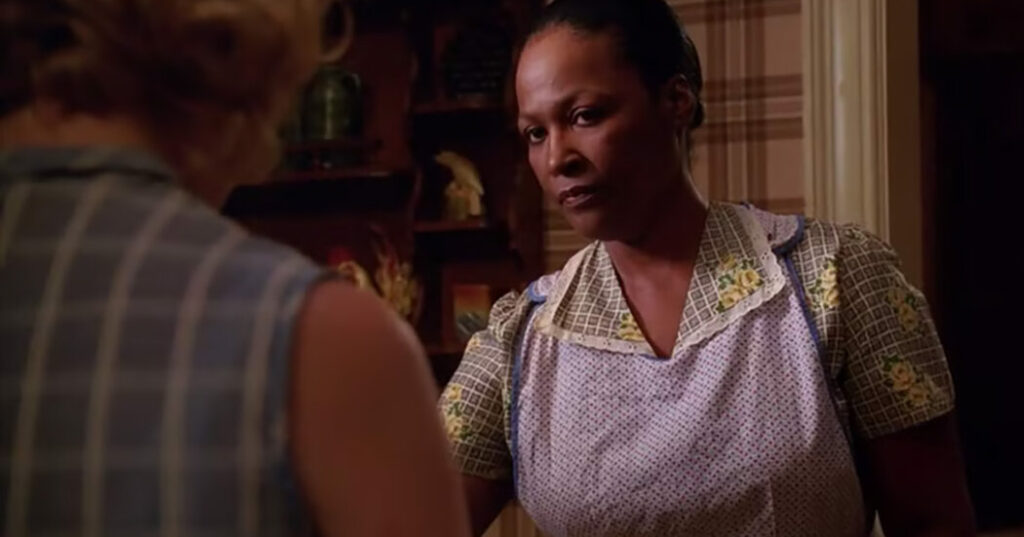
Now that it’s streaming on HBO Max, I recently, like a lot of people, rewatched “Mad Men.” I was prepared for Carla, the Draper family’s housekeeper and the main recurring Black character in the show’s early seasons, to get sacked. Her abrupt exit at the end of Season 4 serves a specific narrative purpose: It’s meant to showcase Betty’s pettiness and precipitate Don’s next relationship.
As sympathetic as this unjustly fired Black housekeeper is in the moment, for me, Carla’s dismissal, like the circumstances of many of the show’s Black characters, breaks the spell of exceptional storytelling that made “Mad Men” the exemplar of a new era of prestige television.
As a Black woman revisiting the series, I already knew that the immersive world-building of a 1960s ad agency — constructed using sharp scripting, artful acting, attentively accurate wardrobe and set design — would only be punctuated by characters who look like me. But the show’s objectification of its Black characters punctures the integrity of otherwise meticulous writing. It left me all too aware of how “Mad Men” — set during the prime of the American civil rights movement and whose run ended as Black Lives Matter was emerging — opts for the easy way out with regard to race.
Carla (portrayed by Deborah Lacey) is the prime example of how “Mad Men” treats its Black characters. In the first four seasons of the series, the show nods toward the ironies of Carla’s position as the actual pillar of the home — watching the kids, buying groceries and cleaning, all while Don gallivants and Betty stresses about social engagements.
Carla seems to exist exclusively as a witness to the Drapers, as a kind of silent judge of their petty dramas. She’s the outside lens, a reminder of life beyond the walls of this wealthy white American dream home. The show doesn’t just use her as a demographic set piece but as a moral one, as well. She’s long-married and goes to church every week, a domestic traditionalist from a lower social class, and so a constant threat to Betty, who becomes increasingly frustrated with her own married life, but is armed with the bourgeoise privilege to divorce and remarry — acts Betty herself considered taboo at the beginning of the series.
It would be one thing if Betty were just projecting her insecurities onto Carla, seeing judgment when there actually is none. But the show’s direction pointedly places Carla in the position of moral judge. In the early episodes Carla is just a figure in the background tending house, but gradually the camera begins to focus on her face during tense family moments. When Betty entertains a male houseguest one afternoon, Carla looks back with a quietly perplexed expression. Betty gets a phone call from a man who isn’t her husband and Carla peers up curiously from her place in the kitchen.
Carla is fired in the Season 4 finale. And though the inciting incident is insignificant — Carla briefly lets in the odd neighbor kid, Glen, to speak to Sally Draper — her sudden dismissal indicates a way in which Betty’s character has changed. Betty’s moving to a new home with her new husband, leaving her life as Don Draper’s wife behind, with all of the shame, strife and temptation that she associated with it.
Carla is dismissed as both the surrogate mother in the household and the model of a traditional loving and dedicated domestic life. Though the audience is meant to sympathize with Carla, four seasons into the show she is still just a domestic foil. There’s no need for her watchful glances anymore.
She isn’t the first or last Black “Mad Men” character to be employed as a mirror for the white characters’ social and interpersonal ethics or to observe their indiscretions. The Madison Avenue main cast mostly only encounters Black characters in literal service jobs and in figurative service to revealing or advancing white characters’ development. It was a directing trope of the show: The camera inevitably pans to the Black elevator hop, janitor, secretary or waitress, whose expression is some subtle mix of judgment or amusement or embarrassment.
The repeated neglect of Black characters is an almost self-congratulatory move on the part of the showrunners; “Mad Men” is purposely situated in this very insular, rich, white setting, but can theoretically have its cake and eat it too if tertiary Black characters call attention, however briefly and superficially, to their outsider status in this world. “That’s just how things were back then,” seems to be reason enough to not dive deeper. These characters don’t need full story lines or back stories; they need only a disapproving stare.
Almost immediately following Carla’s exit, Dawn Chambers is introduced as Don’s new secretary. The circumstances around her hiring are a fluke: When Don places an ad meant to shame a competing agency, it gets interpreted as an equal opportunity job ad, and their reception area is soon packed with Black job seekers. Don and the team decide to hire one of them to save face, and although Don picks Dawn (Teyonah Parris) because she deserves the job, the fact remains that the agency hired her as a prop, and the show itself treats her character as such.
She’s a recurring Black character at the cusp of being written as a fully realized person. In Season 6, Dawn tells a friend, another Black woman, that in the office she just keeps her head down and stays out of the way. It makes sense: She’s the only Black employee, whose race is ongoing joke fodder for her white colleagues. As the outsider, she witnesses — and really understands — how chaotic and destructive that workplace is in a way the white employees, with their midmorning cocktails, torrid affairs and free-flowing stacks of money, never will.
The scene is one of the remarkable few that actually grants a look into a Black character’s life outside the office. It seems to promise that Dawn won’t be another Black person watching, almost like an audience member, from the fringes of the action. But it’s one of the show’s biggest fake-outs; Dawn’s statement helps justify the show’s neglect of her.
Even significant moments in civil rights history, like the marches, riots and the assassination of Martin Luther King Jr., are occasions for the show to reveal more about white characters, who are forced to, momentarily, confront their prejudices.
Inasmuch as the show is meant to primarily reflect Don’s purview, and the terms upon which he is willing to engage, race is an issue that’s mostly out of sight, out of mind, even for a show set during our nation’s most critical push for civil rights. Unlike the other white characters in the show, Don isn’t morally judged so easily by the presence of a Black person — not because he’s undiscriminating or ethically “good,” but because he represents the capitalist ideal, basically apolitical in the interest of making the most money possible.
I can imagine a version of “Mad Men” in which Don interacts with a fully drawn Black character, whether that were a more realized Carla or Dawn or someone else. In rewatching the series I couldn’t help but fill in the blanks myself: the maid chatting with her husband at home, the secretary working the office and socializing at a party with friends, just like Harry Crane, Ken Cosgrove and Paul Kinsey. There’s so much good in “Mad Men,” as long as you’re looking at the writing and presentation of the white characters. And so much left on the table for the Black characters seen in shadow.
Maya Phillips is an arts and culture critic for The Times.
The post Rewatching ‘Mad Men’ From the Outskirts appeared first on New York Times.