Can a Hawaii gun owner bring a concealed handgun to the grocery store? How about to a beachside restaurant, or when pulling into the parking lot of a coffee shop?
The Supreme Court on Tuesday will consider where exactly Hawaiians can carry weapons, hearing arguments in a key Second Amendment challenge to a state law banning concealed firearms on private property without advance permission.
The dispute over Hawaii’s gun restrictions has set up a clash between two rights championed by many of the court’s conservatives — robust private property protections and an expansive view of the Second Amendment.
The case, Wolford v. Lopez, could also provide the justices with a chance to clarify a new standard they set in a 2022 Second Amendment case, New York State Rifle & Pistol Association v. Bruen. In its ruling, the court laid out a new test that required gun laws to be consistent with the country’s “history and tradition.”
That test has created chaos in lower courts, as judges have sorted through new challenges to gun laws — some on the books for years — to determine if historical records have provided analogies to modern-day gun regulations.
In the 2022 case, Justice Clarence Thomas, joined by the court’s other conservative justices, struck down a New York gun regulation and ruled that Americans had wide latitude to carry guns for self-defense outside their homes, in keeping with U.S. tradition.
The Bruen case was the first time in more than a decade that the court had considered a major Second Amendment challenge, and was the first such case accepted by the conservative supermajority that took the bench in 2020. It immediately set off a scramble among states, including Hawaii and California, prompting a flurry of legislation. Some Democratic-led states moved to pass local gun restrictions in light of the new standard.
The Hawaii case is one of at least two Second Amendment cases the justices will hear this term that wrestle with how to apply the 2022 test. In March, the justices will consider another case, U.S. v. Hemani, that focuses on a challenge to a federal law that bans gun possession by people who use or are addicted to illegal drugs.
Hawaii lawmakers in 2023 revisited the state’s gun laws and swiftly passed restrictions on concealed carrying of handguns. The law banned concealed weapons in so-called sensitive places — schools, parks, playgrounds, beaches and restaurants that serve alcohol. It also imposed criminal penalties for carrying a concealed weapon onto private property without permission. Violators face potential criminal misdemeanor charges.
The law required property owners to give explicit consent to carrying weapons, either by “unambiguous written or verbal authorization” or by the “posting of clear and conspicuous signage.”
Anne E. Lopez, Hawaii’s attorney general, wrote in a brief to the court that the law was an effort “to vindicate both the right to bear arms and property owners’ undisputed right to choose whether to permit armed entry onto their property.”
Hawaii has long had some of the country’s most restrictive gun laws, and is known for rarely granting concealed-carry permits. In court filings, officials traced their gun laws to the state’s unique history: its former traditions as a kingdom. They pointed to an 1833 law in place during the reign of King Kamehameha III that prohibited “any person or persons” from possessing deadly weapons.
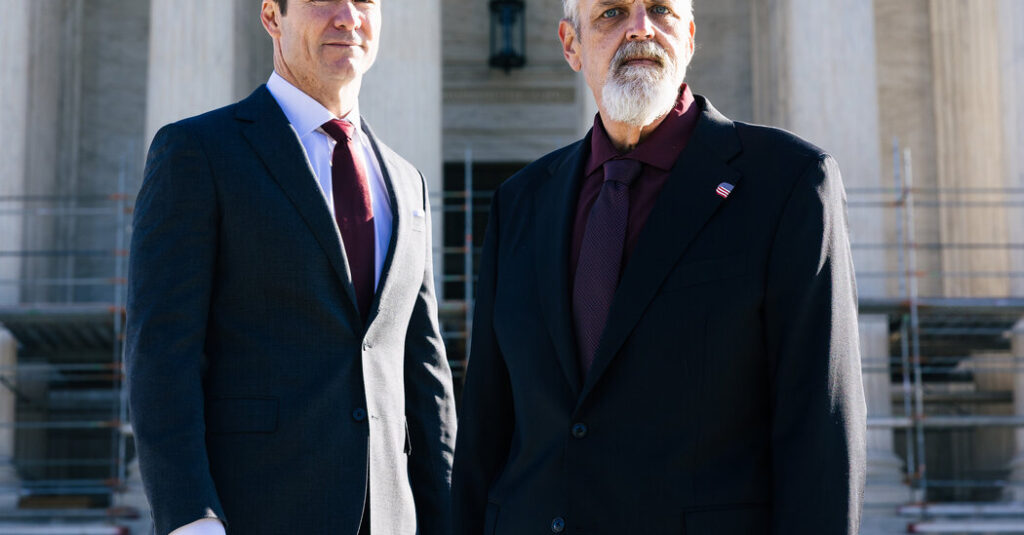
A coalition of Hawaii gun owners challenged the law. The group included a Maui realtor, Jason Wolford, and his wife, Alison, a nurse; Atom Kasprzycki, an architect; and the Hawaii Firearms Coalition, a gun rights group. They claimed that they had a “credible fear of arrest and prosecution” if they took their guns to places in Maui that they frequented, such as local restaurants, parks and beaches.
Through their lawyer, Alan Alexander Beck, the plaintiffs declined to comment. In an interview, Mr. Beck said that “this law right now effectively eviscerates the ability to carry a firearm for self-defense.”
“If you’re taking a walk by yourself on an isolated beach, you may want to be able to defend yourself,” he said.
A federal trial court temporarily paused most of the new law’s provisions as the case moved through the courts, including the part requiring permission to carry weapons on private property.
But a panel of judges on the U.S. Court of Appeals for the Ninth Circuit overturned portions of the lower court’s ruling, clearing the way for Hawaii’s law to go into effect.
The judges drew parallels to the time of the country’s founding, and to Reconstruction following the Civil War — periods around when the Second and Fourteenth Amendments were ratified. They found that there were rules in those times that banned guns in establishments that sold alcohol and at some social gatherings.
The challengers then asked the Supreme Court to weigh in. They were soon joined by the Trump administration, which argued that Hawaii’s law violated the Second Amendment.
In a brief in support of the challengers, Trump administration lawyers argued that “because most property owners do not post signs either allowing or forbidding guns,” the state law “functions as a near-complete ban on public carry.”
The lawyers also claimed that the law meant that anyone carrying a handgun for self-defense in ordinary places — a mall, gas station, convenience store, supermarket, restaurant, coffee shop or parking lot — “commits a crime.”
The case has prompted a raft of impassioned amicus briefs on both sides of the issue. Gun rights advocacy groups have asserted that Hawaii has been trying to get around the court’s Second Amendment rulings. Supporters of Hawaii’s law have argued that striking it down would clear the way for more gun violence.
Abbie VanSickle covers the United States Supreme Court for The Times. She is a lawyer and has an extensive background in investigative reporting.
The post Supreme Court to Hear Case Testing Limits of Hawaii Gun Law appeared first on New York Times.