It’s been suggested that the World Economic Forum’s annual meeting in Davos, Switzerland, the embodiment of the global establishment, is dead. But reports of its demise are greatly exaggerated, or at least premature.
Much like the rest of the international system, Davos is entering a moment of transition that will determine whether it can adapt and retain its relevance. This year’s annual meeting, which began on Monday, will be a harbinger of just how much both Davos and the global system have learned to work with a United States that has fundamentally altered its view of what it means to cooperate.
Davos has evolved significantly since its founding as the European Management Forum, a relatively low-key retreat focused on the project of European integration. Its current metamorphosis, driven largely by President Trump, is more swift and pronounced than any prior period. Gone is the yearslong emphasis on the United Nations Sustainable Development Goals, the implementation of the Paris accords and how governments should rely on local organizations to carry out their development programs. Stakeholder capitalism and the environmental, social and governance objectives are likely to take a back seat, too.
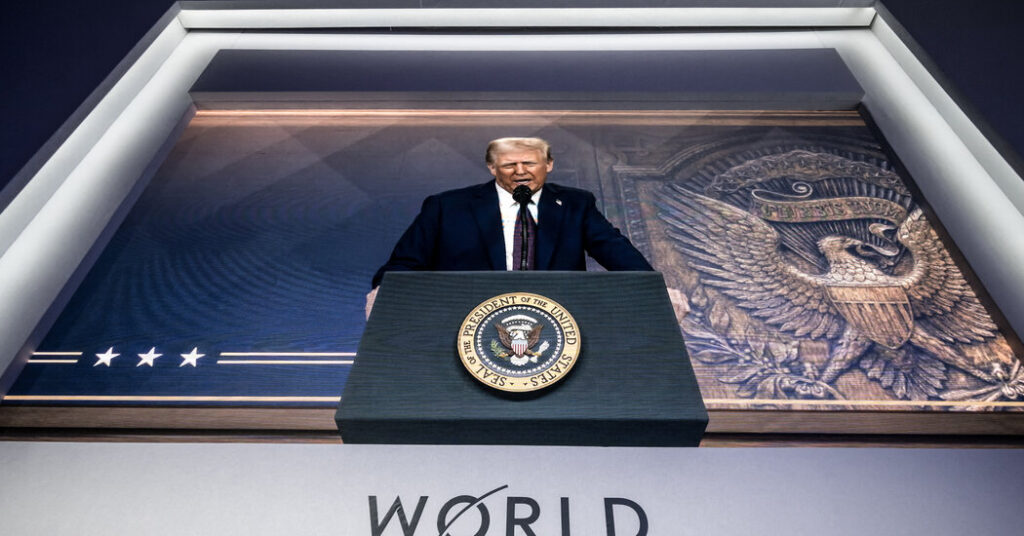
The old Davos is dead, and the new Davos is still coming into view. Mr. Trump is making a bid to shape its future. The president is expected to lead the largest U.S. delegation of cabinet secretaries and senior advisers ever to attend the annual meeting this year. Other American presidents skipped Davos, at least in part to distance themselves from the optics of rubbing elbows with the global elite instead of focusing on kitchen table issues back at home. This is Mr. Trump’s third visit to Davos, and he’s only the second sitting president to make the trek to Switzerland. The first was President Bill Clinton in 2000. While Mr. Clinton attended at a time of peak enthusiasm for globalization, Mr. Trump will attend when it is arguably at a nadir — one he helped bring about and has celebrated.
Mr. Trump has indicated that he’ll use the opportunity to talk about housing and affordability. He might use the forum to make fresh demands that nations work with the United States on trade and migration. But the president’s goal this year transcends policy. It’s about setting the tone. He is not traveling to Switzerland to go on a listening tour. He is traveling to Switzerland with the expectation that everyone will listen to him — and fall in line.
This year’s confab will therefore be a test for the rest of the world’s ability to adjust to globalism with Trumpian characteristics. For the past five decades, the basic premise of Davos has been that mutually beneficial cooperation — among countries and across sectors — was critical to addressing global challenges such as pandemics and climate change. While cooperation is still very much on the Davos agenda, it has taken on a different tone. Instead of seeking cooperation with the rest of the world, Trump will be demanding it.
Davos exists within the broader context of the international system; it does not define it. That makes adaptation an existential imperative for the forum. Davos could play a useful role in exploring how the rules-based trading system should evolve in a world in which the two largest economies, the United States and China, are playing by their own rules. It could serve as a forum for addressing the adoption of artificial intelligence, for reforming development assistance and for reconciling attitudes toward global migration. Davos will survive and thrive if it proves nimble enough to shape and lead the most critical debates.
Why should we value Davos? Whatever its official agenda, Davos is valuable as a place where global leaders from the public, private and civil society sectors feel the need to be present, meet with one another, forge partnerships and cut deals. Greece and Turkey signed the Davos Declaration in 1988. Davos’s role as a center of gravity for decision makers should not be discounted, even as the meeting’s notional themes evolve.
Now that Mr. Trump and many of his senior lieutenants are descending upon Davos, I suspect that attendance from other government, business and civil society leaders will increase, as those figures will be eager to have a 30-second pull-aside meeting with the president.
Historically, one could get a feel of the Davos ethos by walking up and down the town’s icy main street. Some years it was dominated by one country or another seeking to market itself: Russia, China, India. It has shared the spotlight with the leading technology preoccupation of the moment — cryptocurrency, the metaverse and, more recently, an A.I. company or initiative. This year a lavish USA House, sponsored by leading American companies, will occupy a church, and for the first time officially be recognized by the State Department as the United States’ headquarters for the event.
In planting his flag at Davos, Mr. Trump is indicating he is not an isolationist but rather is ready to engage with the rest of the world and reshape the international system, one piece after another. Davos is not immune from his gaze. Indeed, regardless of whether he receives the Nobel Peace Prize, Mr. Trump can rightfully argue that he has achieved a moniker of almost equal acclaim. Mr. Trump is Davos Man, but Davos might never be the same.
Michael B.G. Froman, the president of the Council on Foreign Relations, served in the Obama administration as U.S. trade representative and deputy national security adviser for international economic affairs.
The Times is committed to publishing a diversity of letters to the editor. We’d like to hear what you think about this or any of our articles. Here are some tips. And here’s our email: [email protected].
Follow the New York Times Opinion section on Facebook, Instagram, TikTok, Bluesky, WhatsApp and Threads.
The post Trump Is the Ultimate Davos Man appeared first on New York Times.