Deadly gang violence over the weekend in Guatemala has raised concerns about the stability of the country and President Bernardo Arévalo’s ability to deliver on his promise to root out corruption and organized crime.
He declared a state of emergency on Sunday to crack down on gangs after inmates took dozens of guards hostage at three prisons across the country and several officers were killed in episodes connected to the violence. The government said the riots and reprisal killings had been a coordinated response by leaders of criminal organizations after the authorities took away their prison privileges, including restaurant meals and air conditioning demanded by one crime boss.
A day after Mr. Arévalo announced that the state of emergency would last for 30 days and empower the national police and military to act against gangs, the police death toll had risen to nine. The new powers allowed the authorities to set up checkpoints and claim broader authority to make arrests.
He said he had announced the state of emergency because the violence had been “aimed at terrorizing the population.”
By Sunday, the police had regained control of the prisons, and the guards had been freed, Mr. Arévalo said.
Experts said that the unrest came at a critical time for Guatemala, a Central America country of 18 million people where gangs exert influence even on politics.
Among the major decisions facing Mr. Arévalo this year is choosing a new attorney general. He said on Sunday that the violence came just as the country was trying to free itself of corruption. He called those behind the violence “criminal political mafias that resist and seek to instill terror because they know that this year Guatemala will recover its justice system.”
Some inmates with access to cellphones and the internet have called for the removal of Mr. Arévalo from power. In response to questions about threats against the president, Henry Saenz, Guatemala’s minister of defense, said on the radio on Monday that “the army supports the president” and that Mr. Arévalo would serve out his term.
“It’s extremely worrying,” Ana María Méndez Dardón, the Central America director at the Washington Office on Latin America, a rights group, said of the state of affairs in Guatemala.
“It’s a warning that this year being so decisive for Guatemala and especially for the justice of Guatemala,” she continued, “that these parallel groups of power are seeking to break the constitutional order, to destabilize and generate this chaos to harm President Bernardo Arévalo in order to be able to continue perpetuating the impunity to which they have been accustomed to.”
Mr. Arévalo, an anticorruption crusader and a moderate, was elected in 2023 in a surprise victory that left the country’s conservative establishment reeling, particularly the attorney general’s office, which has been a primary force in blocking his agenda.
In October, 20 inmates accused of being gang members escaped from a maximum-security prison outside the capital, Guatemala City. The inmates were described by officials as high-ranking operatives of the Barrio 18 gang, which has long been linked to organized crime and violence around Central America and which the Trump administration designated as a foreign terrorist organization in September.
A political crisis ensued, and Mr. Arévalo replaced several senior officials, called for an overhaul of the country’s prison system — where gangs are believed to operate unchecked amid rampant bribery and corruption — and said the country would have help from the U.S. authorities, including the F.B.I.
But over the weekend, the tension between the Guatemalan authorities and the gangs reached a breaking point. Officials said they would not negotiate with inmates over the privileges they were demanding. Riots broke out in the prisons, and the authorities raided them to reestablish control.
Later, police officers on patrol in the Guatemala City area were slain in what Marco Antonio Villeda, Guatemala’s interior minister, called retaliatory killings by gangs.
He also said at a news conference on Sunday that Aldo Dupie Ochoa, known as “El Lobo” (The Wolf), a leader of the Barrio 18 gang, had been the main instigator of the riots at one prison. He said Mr. Ochoa was demanding a transfer to another prison and benefits like special food delivery and a king bed.
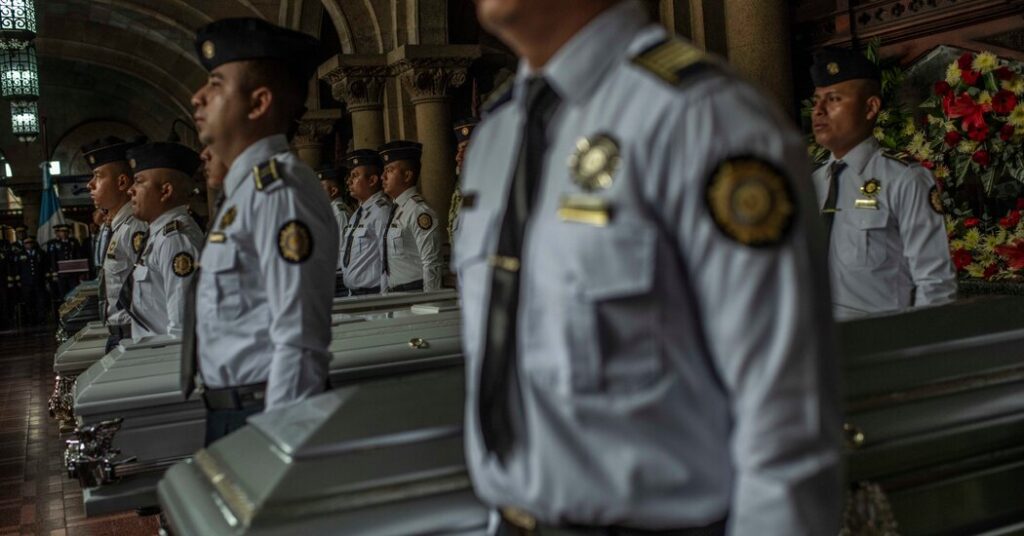
Funeral services for eight officers were held on Monday. A ninth police officer died as a result of the prison operations, the Guatemalan national police said on Monday. Seven other officers were hospitalized with gunshot wounds, said Edwin Monroy, a police spokesman.
And as of midday Monday, he said that 10 members of the Barrio 18 gang had been arrested in connection with the attacks.
Although some civil rights are suspended during a state of emergency, Mr. Arévalo said that it would not affect citizens. The measure calls for deploying all active police officers — approximately 45,000 — and members of the army to make patrols.
On Monday, in Guatemala City, there were few vehicles or pedestrians. A large number of security personnel were on the streets, stopping and checking cars and motorcycles. Public and private schools were closed, but officials said they would resume classes on Tuesday.
James Wagner covers news and culture in Latin America for The Times. He is based in Mexico City.
The post Death Toll Rises in Guatemalan Gang Riots appeared first on New York Times.