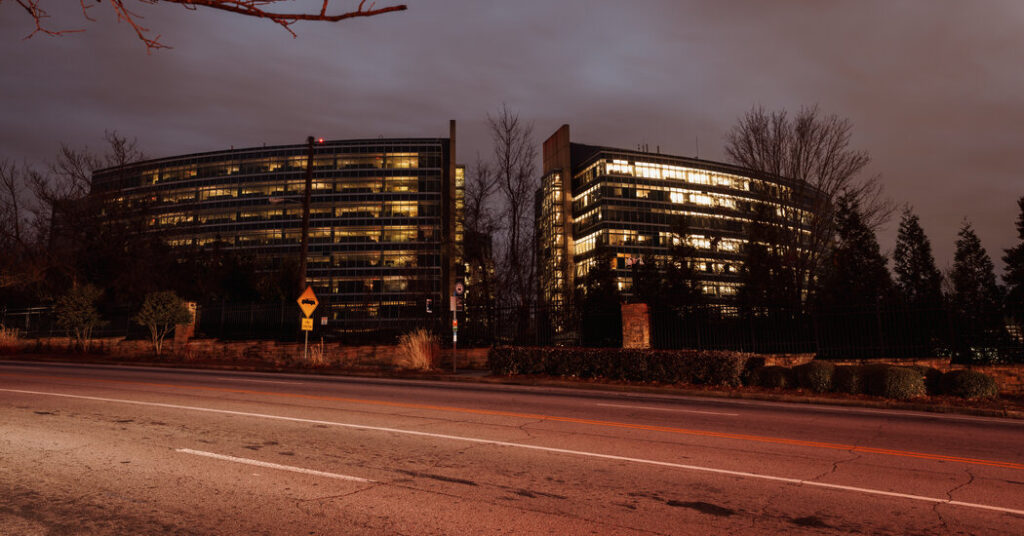
Today, Atlanta is a city full of public servants who no longer serve.
Thousands of them had held jobs at the Centers for Disease Control and Prevention. But last year, the Trump administration slashed the agency in waves of firings. Public health programs were shrunk or shuttered. Top medical experts have resigned.
Seasoned epidemiologists and other staff members are working in yoga studios, walking neighbors’ dogs and job hunting — although cuts to other government agencies and cutbacks at health-related nonprofits have made the job hunt difficult for many.
Dr. Jennifer McQuiston, 54, thought she had a few more years of working at the C.D.C., fighting some of the world’s most dangerous health threats at the National Center for Emerging and Zoonotic Infectious Diseases. But she took early retirement, concerned that the agency had strayed too far from its commitment to science.
These days Dr. McQuiston, who has a veterinary degree, is working at an animal shelter and spending time riding her horse.
“It was my calling,” she said. “I don’t mourn the loss at this moment, because I don’t believe the agency is the same agency I worked in.”
In some ways, the C.D.C. is still trundling along. Government employees still come and go from the agency’s main campus near Emory University. And to the C.D.C.’s detractors, the Trump administration is simply forcing much-needed change to an agency that lost trust during the Covid pandemic.
“The C.D.C. was broken for a long time,” Andrew Nixon, a spokesman with the Department of Health and Human Services, said in a statement. Reform was needed, he said, to combat a “culture of groupthink and mission creep” at the agency that had undermined public confidence.
But civic leaders, scientists and public health advocates are increasingly worried about stories like Dr. McQuiston’s — and their effect not only on the C.D.C., but also on Atlanta.
Over the decades, the disease-fighting work of the C.D.C. has helped define the Southern city’s sense of moral purpose, alongside its rich civil rights legacy. It has helped Atlanta realize its ambitions to be a city with global impact, alongside its famously busy international airport. The C.D.C. is also at the center of a regional life sciences sector that employs nearly 200,000 people and generates billions of dollars in economic activity yearly.
Some fear that the C.D.C. is on “life support,” as three former agency leaders declared in November, no longer trusted by the broader medical community and no longer able to attract some of the brightest minds in the life sciences to Atlanta. An Axios/Ipsos poll in October found that 62 percent of Americans trust health information from the C.D.C., down from 88 percent in March 2020.
“You’ve had a lot of different kinds of institutions benefit from the focus on public heath,” said Doug Shipman, the former president of the Atlanta City Council. “Does that now stall? To me, that’s the fundamental question.”
Trump Administration: Live Updates
Updated
- Trump administration to appeal limits on interactions with Minnesota protesters.
- What to know about Trump’s ‘Board of Peace’ for Gaza: $1 billion seats, Russia and Belarus invited.
- Powell will attend the Supreme Court arguments on Trump’s effort to remove a Fed governor.
Founded in Atlanta in 1946 as the Communicable Disease Center, the agency grew out of the fight to keep U.S. troops at Southern military bases safe from malaria. It would eventually expand its remit to fight all communicable diseases, as well as other health risks like smoking, gun violence prevention and bioterror.
Atlanta would soon become home to other major institutions with a health focus — the Carter Center, the Task Force for Global Health, the American Cancer Society and CARE, the global nonprofit that seeks to eradicate poverty and expand health services in some of the poorest parts of the world.
Over the years, the earnest C.D.C. employee became a kind of Atlanta archetype, alongside aspiring rappers and C-suite strivers. The disease fighters have lent their own flavors — civic-mindedness, scientific rigor — to the metropolis.
But the agency was buffeted by the Covid-19 pandemic and public distrust over its handling of the crisis. After an external review pointed out that its response had been sluggish and muddled, even its leadership acknowledged that it needed to be reformed.
Since Mr. Trump’s second inauguration, the changes to the agency have been chaotic. Agency officials did not respond to a request for details about the extent of the staff reductions. But an article in November in the medical journal The Lancet by Debra Houry, Daniel Jernigan and Demetre Daskalakis — former C.D.C. leaders who resigned in protest over Health Secretary Robert F. Kennedy Jr.’s vision for the agency — states that the number of staff members had been reduced to fewer than 10,000 employees in October from roughly 13,500 employees at the beginning of 2025.
The writers argued that the cuts had left the nation unprepared to handle viruses like Zika and mpox, unable to properly keep track of diseases like Creutzfeldt-Jakob and chronic wasting disease, and understaffed in sectors that keep tabs on basic national health data. The authors said the C.D.C.’s malaria staff in Africa had been eliminated, “undermining decades of progress.” Other cuts, they wrote, threatened to “reverse decades of progress in ending the H.I.V. epidemic.”
Dr. Elizabeth Soda, a Stanford-trained physician and epidemiologist, left the C.D.C. in September after working there for a decade. Among other things, Dr. Soda, an infectious disease specialist, helped to develop health screening for immigrants and refugees entering the United States.
She knew little about Atlanta when she arrived, but she and her husband settled in and started their family. She thought she had found her dream job.
She watched the Trump administration with concern.
She had tried to give the new secretary of Health and Human Services, Mr. Kennedy, a chance, but was sorely disappointed. “He lacks expertise, he believes damaging theories about well-proven science — and this guy’s in charge of our health?” she said.
She had also begun to feel unsafe. In August, a gunman fired dozens of rounds at the C.D.C. headquarters. Dr. Soda had left the campus a half-hour earlier, but her office was four doors down from one of the holes a bullet left in a window.
After her husband, also a scientist, won an appointment in Italy, they moved.
The feeling that she abandoned the agency gnaws at her.
“We go through massive, real guilt moments,” Dr. Soda, 47, said in a telephone interview late last year. “That’s one of the hardest things being here, to be honest, is knowing what we’ve left behind, who we’ve left behind — family, friends, our country.”
There is a modicum of hope that Atlanta will help steer the C.D.C. — or whatever government entity follows in its wake — back on a more trustworthy path. Some of that optimism is rooted in the belief that public health officials know how to solve problems in the midst of chaos. Some of it is rooted in the vast public health expertise that still resides in Atlanta’s nonprofits and educational institutions, including Emory, Georgia Tech, Georgia State and the Morehouse School of Medicine.
These institutions allow Atlanta’s Chamber of Commerce to plausibly boast that the city is the “public health capital of the world.” Many of those groups have been absorbing as many former C.D.C. workers as they can. The hope is that they will continue to incubate the values of the old C.D.C. and lead a comeback in the public health sphere when and if Mr. Kennedy’s influence wanes. said Terry Pechacek, a former C.D.C. scientist and emeritus professor of public health at Georgia State University.
“The future rebound, which may be a generation away, will come out of that core,” Dr. Pechacek said. “The core is not dead.”
Richard Fausset, a Times reporter based in Atlanta, writes about the American South, focusing on politics, culture, race, poverty and criminal justice.
The post When Trump Took a Whack at the C.D.C., Atlanta Lost Something, Too appeared first on New York Times.