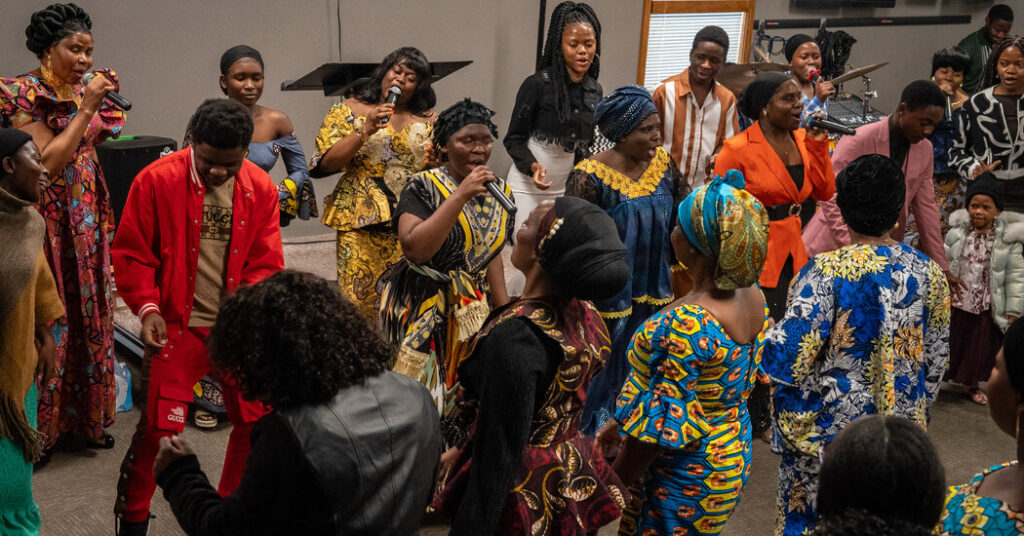
For decades, refugees have been part of the rhythm of Twin Falls, a small city in southern Idaho. Displaced from the world’s most troubled corners — places like Bosnia, the Democratic Republic of Congo and Myanmar — these new residents have worked to rebuild their lives, finding jobs in factories, singing in church choirs and loading up their carts in supermarkets.
It’s a story that is as old as the nation itself: A town prospers with the support of newcomers, who are grateful to be there. There have been some ugly tensions in the past, but refugees in Twin Falls have helped turn the area into a dairy industry juggernaut. They have rehabbed homes and filled classrooms. The town’s children play together in parks, schoolyards and sports fields.
“No matter where you come from, there is opportunity to achieve the American dream in Twin Falls, clichéd as that may sound,” said Shawn Barigar, the city’s director of economic development. “The refugee population, tiny as it may be, is a component that is important to our prosperity.”
But refugee resettlement is now getting an overhaul, as part of the Trump administration’s upending of the immigration system. President Trump, who was elected in part because of his anti-immigration views, has said that refugees pose security risks, strain public coffers and undermine American values.
On his first day in the White House, Mr. Trump suspended the U.S. refugee program. A few weeks later, his administration announced it would make an exception and admit just one group: Afrikaners, or white South Africans.
In October, the administration established new targets for the refugee program, and said it would allow only 7,500 refugees for the coming year — the lowest number in the program’s history. (Former President Joseph R. Biden Jr. set the ceiling at 125,000 for 2024.)
And an overwhelming majority of them, the administration said, would be Afrikaners.
That means Twin Falls, which had typically received 200 to 350 refugees a year, would be in for an adjustment. As it is, since May, a total of 37 refugees, all Afrikaners, have resettled in Twin Falls.
What does this mean for the city’s future?
Idaho has for decades been a leader in resettling refugees, with a robust brigade of volunteers and employers in Boise and Twin Falls to welcome and integrate them.
Under the resettlement program, refugees face extensive vetting before being cleared to enter the United States, often waiting years abroad. On arrival, they are assisted by nonprofit contractors, such as the U.S. Committee for Refugees and Immigrants in Twin Falls, which secure temporary housing, enroll children in school and provide cash for initial expenses.
It’s not just benevolence. Refugees are vital to businesses here in Idaho’s Magic Valley, which has emerged as an agribusiness powerhouse.
The economy around Twin Falls is anchored by the world’s biggest yogurt factory, Chobani. But there are also major companies like Clif Bar and outposts of global companies like Glanbia Nutritionals, a milk processor.
And down the line is a vast network of dairy farms, cheese and whey producers, potato and beef plants and food-science labs, which Hamdi Ulukaya, Chobani’s founder, has called “the Silicon Valley of food innovation.”
The labor market is tight, with unemployment hovering around 3.5 percent. “We have a desperate shortage of people at all levels in this area,” said Daragh Maccabee, the chief executive of Idaho Milk Products, which, like many companies in the area, is in the midst of major expansion.
“The refugee program has been a source of motivated, qualified talent,” Mr. Maccabee said. “I fear the impact of losing that valuable source for the economy and the community.”
On a recent morning, Nijaz Heric, a safety supervisor at Idaho Milk, patrolled the high-tech dairy processing plant with a practiced eye.
In the 1990s, Mr. Heric and his family were among the first Muslim Bosnians resettled in Twin Falls, fleeing war and ethnic cleansing. He had no money, no English, only the hope of starting over. His first job was making cheese.
“I tried to explain with my hands that I wanted a job,” he recalled.
In the 2000s, persecuted minority groups from Myanmar and Bhutan arrived, followed by people displaced by wars in Africa and the Middle East, often after languishing for years in refugee camps.
The low cost of living coupled with good wages enabled many refugees to vault into the middle class. Often, their children, raised in the United States, became college students and professionals.
Not everything has gone smoothly. In 2016, during Mr. Trump’s first presidential campaign, Twin Falls found itself besieged. Far-right outlets, including Breitbart, seized and distorted a story about a sex abuse case involving teenagers. The outlets falsely claimed that a little girl had been gang raped at knife point by Syrian refugees.
Police officials tried to debunk the reports, declaring that the crime was not gang rape and that the perpetrators were juveniles who were not Syrian and did not wield a knife.
But outside militia groups descended on the town. Some people threatened city officials and demanded an end to refugee resettlement, asserting that “all refugees must be criminals,” recalled Matthew Hicks, the police chief.
As hostility intensified, city officials formed civic groups to introduce refugees to residents. That helped ease the tension. And so did the passing of the news cycle.
Today, the tensions come from above. In December, Samuel Nzapalaha sat in the living room of his four-bedroom house, his family by his side.
He bought that house for $385,000 two years ago, putting $50,000 down.
It was one marker of his success in Twin Falls after arriving in 2016 with his wife, Josephine Mirindi, and their five children. The family had fled armed conflict in the Democratic Republic of Congo. At first, Mr. Nzapalaha worked two jobs, at a cheese maker and the local refugee agency, while attending a local college. Within a year, the couple could afford their first house.
Mr. Nzapalaha now works as a case manager at an addiction recovery center. His wife works at Chobani labeling yogurt cups, earning $23 an hour. Their children are working or attending college or high school.
Their story, he said, stands in stark contrast to the president’s portrayal of refugees as ruining America.
“We work hard; we buy things; we are contributing,’’ Mr. Nzapalaha said.
As for opening the door to Afrikaners, he described them as “so-called refugees.”
In May, Twin Falls received nine of the first 59 Afrikaners admitted in 2025 to the United States.
They have been quiet, with neighbors shrugging their shoulders and saying they do not really know them.
In a middle-class subdivision, one Afrikaner couple stood in June on the lawn outside their home. The wife praised President Trump before her husband said they did not want to talk.
Whether more Afrikaners, beyond those who have already arrived, are resettling in Twin Falls is unclear. The political climate is tense, and many in Twin Falls were reluctant to talk, including those at nonprofit agencies that assist refugees and companies that depend on them for work.
Even Chobani, which has been a vocal champion of refugees, did not reply to requests for comment.
But a handful of South Africans cannot meet the labor demands of these companies. A $500 million expansion of the Chobani plant, tied to its acquisition of La Colombe Coffee in 2023, is expected to come online in 2026. Idaho Milk Products plans to open an ice cream factory this year as well.
“If we don’t let refugees in, we’ll stagnate,” said Jim Jones, the former Republican attorney general of Idaho, who has publicly criticized the Trump administration’s refugee policy.
“Refugees are in dairies, maintenance, everywhere,” said Mr. Jones, who was born and raised in the area. “They do hard work that locals think are beneath them.”
Kirsten Noyes contributed research.
Miriam Jordan reports from a grass roots perspective on immigrants and their impact on the demographics, society and economy of the United States.
The post An Idaho City Has New Refugees: White South Afrikans appeared first on New York Times.