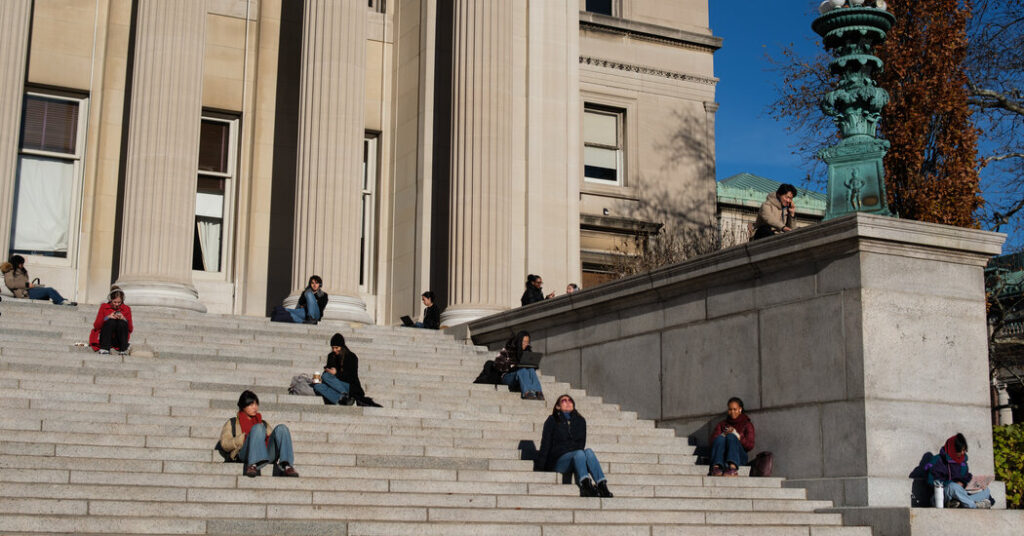
On a frigid evening in December, hundreds of bundled up Columbia students gathered on the university’s main campus — not to shout political slogans, but to mingle at an annual holiday celebration. The campus trees were lit up, the university gave out free hot chocolate, and a cappella groups sang.
But in a sign of the times, the campus’s imposing iron gates, historically open to the public, were closed. The Low Library steps, a frequent site for student protests, were blocked off. Police cars and additional barricades ringed the area outside of the gates, to control any other demonstrations that might happen.
The gates to Columbia’s main campus in Manhattan swung shut more than two years ago to control volatile protests over the war in Gaza. There was a days-long encampment, a building takeover and arrests by police. Now, entry is permitted only to those who hold Columbia identification and their approved guests.
The closure does provide extra security for students and faculty, a benefit underscored after the mass shooting at Brown in December. But its main purpose has been to limit the potential for protests and unrest, including since the Trump administration has used the full force of his office to bend universities to his will.
Columbia was once known as America’s “activist Ivy,” in part because of its hands-off policy for demonstrations, a legacy of 1968 antiwar protests that led to an aggressive police response. The images from that time left an indelible mark not only on Columbia, but on New York’s protest culture more broadly.
Today, the relative quiet at the university — despite its history of uprisings, even within a boisterous anti-Trump New York — is partly a measure of the White House’s success in taming unrest at Columbia and other universities around the country.
“I feel like it’s very disheartening,” said Gabriela Ruiz, a freshman attending the tree lighting with her roommates. “I think protest has become a bad word. The concept of encampment has become a bad word.”
Across the country, President Trump has used executive orders, civil rights investigations and the withdrawal of research funds to try to tamp down protests that he accused of antisemitism, and to reshape universities that he accused of being captured by leftist orthodoxy. Leadership, faculty power, diversity programs and the minutiae of grant proposals are all up for scrutiny.
Columbia was President Trump’s first high-profile university target, followed by Harvard, Brown, Northwestern and others. In July, Columbia settled with the Trump administration, paying $221 million to settle civil rights claims against the university for allegedly failing to protect students from antisemitic harassment. Harvard has not settled.
For some at Columbia, the new, quieter campus culture is a relief, especially for those who found the protests offensive.
Natan Rosenbaum, an Orthodox Jewish senior at Columbia, recalled how in December 2023, the annual lighting celebration was disrupted by a large group of pro-Palestinian protesters who held up signs that said “Joy is Canceled” and chanted slogans like “There’s no room for celebration, end Israeli occupation.” This year, a smaller group of protesters briefly interrupted the event, before moving to rally outside the Columbia gates.
“I’m not saying I was in favor of withholding the funding, but yeah, I think things are entirely more pleasant now,” he said. “The protests were not a kind presence. And their rhetoric was many times very ugly.”
Other students and faculty members say the strained campus peace has cut unacceptably at Columbia’s identity and made the school an example of capitulation to government overreach.
“Political advocacy has just been tamped down to a remarkable degree,” said Michael Thaddeus, a mathematics professor and vice president of Columbia’s American Association of University Professors chapter. In the fall, he navigated the tighter rules on demonstrations while organizing an event for academic freedom.
“You can try to spin it in a positive way by saying, well, the campus has calmed down and people can get back to doing their important work,” he said. “But my view is that protest and dissent are part of the essential work of a university.”
Early in 2025, several pro-Palestinian protests caught the attention of the new Trump administration. In January, a modern Israel history class was disrupted. In early March, there was a Barnard sit-in, with Mahmoud Khalil, then a little-known graduate student and Palestinian activist, acting as a negotiator between demonstrators and administrators.
On March 7, the White House announced it was withholding $400 million in federal grants. The next day, Immigration and Customs Enforcement officers arrested Mr. Khalil in the lobby of his Columbia-owned apartment building and detained him for 104 days.
Columbia administrators did not mention him by name for months. To this day, Mr. Khalil said, Columbia has not reached out directly to him or offered support
“Columbia is no longer an educational institution,” said Mr. Khalil, who is out of detention but still fighting deportation. “It has pretty much become an institution of oppression for the right wing.”
A Columbia spokeswoman said that the university had been “in regular contact with Mr. Khalil through his lawyers since March” and had granted his family’s request to extend their housing lease for months because of their difficult circumstances. Mr. Khalil and seven other students are suing Columbia and the Trump administration over their treatment as pro-Palestinian activists.
As part of its pledges to the Trump administration, Columbia granted arrest powers to some of its public safety officers, a major change at the university. Other new rules include: Demonstrations inside academic buildings are no longer allowed. Columbia’s unwieldy campus Senate, made up of mostly faculty and created in the aftermath of the 1968 protests to encourage democratic decision-making, has had its authority over disciplining student protesters taken away.
Events must go through multiple layers of approval, which on a practical level, reduces their frequency. On some days, no demonstrations are allowed, for security reasons. When there are protests, they often happen outside the campus, where fewer rules apply.
Students have gotten the message that certain kinds of protesting could lead to serious consequences. But that doesn’t mean that they all agree with Columbia’s decisions.
“There’s a lot of simmering contempt, I’d say,” said Stella Dougherty, 21, a junior studying information science. “You get the sense that a lot of people wish they could say things or demonstrate in ways that they feel like they can’t.”
Others see the new rules as an acceptable compromise.
“We were a university in crisis,” said Brian Cohen, the executive director of the campus Hillel chapter. “What we saw was the interruption of admissions tours, storming of academic buildings, assaulting public safety officers, disrupting classes, destroying property. That’s not activism in my book — it’s intimidation.”
The last large pro-Palestinian demonstration happened in May, when dozens of masked protesters stormed into Columbia’s Butler Library to occupy its main reading room. Campus security prevented students from leaving without showing their identification. Eventually, the police were called in. Over 70 students were disciplined, the majority with multiyear suspensions, according to Columbia.
This academic year has been relatively quiet so far. Pro-Palestinian student activists, who say that even cultural celebrations are subject to the new restrictions, are regrouping.
A pilot to reopen the campus was delayed by new security concerns, including worries about federal immigration police having access to campus, Claire Shipman, the acting university president, told students this fall. In one change, people who live nearby can now apply for campus access.
“We understand the desire to return to an open campus, and the university evaluates campus access protocols on an ongoing basis,” said Samantha Slater, a spokeswoman.
Mr. Khalil said he did not expect Columbia to open its gates anytime soon. He was denied permission to go to a November film screening at the university’s journalism school because of what Columbia said were security concerns.
The I.D. checks, he said, are “a sign that we are watching you.”
Sharon Otterman is a Times reporter covering higher education, public health and other issues facing New York City.
The post Columbia University’s Strained Peace: Fewer Protests and Sealed Gates appeared first on New York Times.