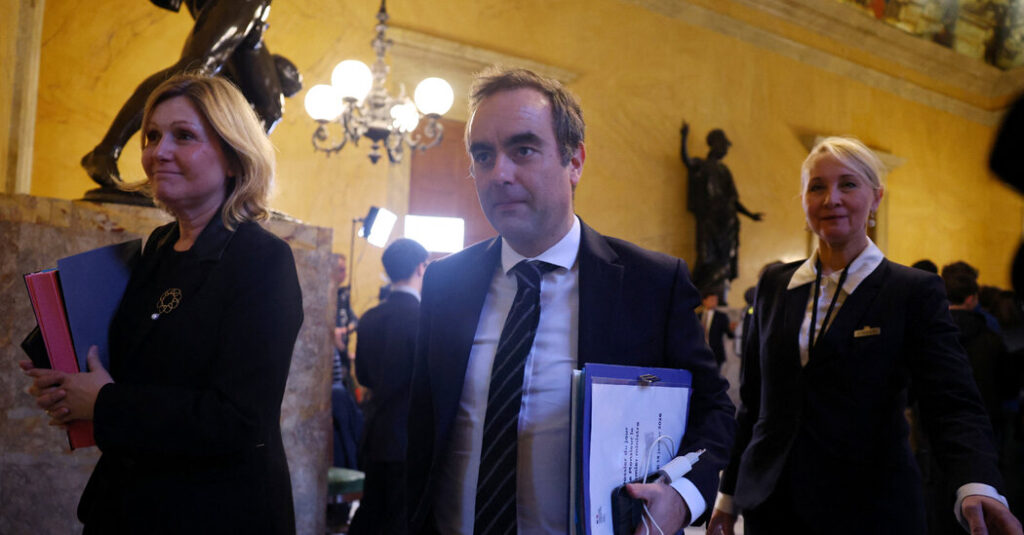
Prime Minister Sébastien Lecornu of France announced on Monday that he would push through the country’s long-awaited budget without a vote in the lower house of Parliament, leading opposition lawmakers to announce plans to topple his minority government with a vote of no confidence.
Mr. Lecornu’s decision followed more than four months of failed negotiations to reach a consensus over the budget in France’s gridlocked Parliament, where the prime minister’s centrist coalition lacks a majority.
To break that deadlock, Mr. Lecornu said that he would use a contentious constitutional tool to force through the budget on Tuesday, a tool that he previously pledged not to use.
Mr. Lecornu said at a news briefing that his government would reluctantly use Article 49.3 of the Constitution, which allows a government to enact laws without a parliamentary vote.
He said the decision had been made “with some regret and slight bitterness” but that it was necessary to quickly adopt a budget addressing the country’s deficit. France has been without an official budget since the beginning of the month. Mr. Lecornu said his goal was “to reject disorder where others thrive on it.”
But using a constitutional shoehorn to force through the budget raises the chances of a different kind of instability, since it opens up the government to a vote of no confidence. If Mr. Lecornu falls, he will be the third prime minister over the past 13 months to be toppled because of the budget.
France has been in a political deadlock since President Emmanuel Macron called snap elections in the summer of 2024, which resulted in a highly fractured Parliament in which no political party holds a majority.
Leaders from both the far left and the far right said on Monday that they would introduce motions of no confidence in the government, moves that would set the stage for a vote later in the week.
Mr. Lecornu’s downfall is unlikely, at least in the short term. The Socialists, who hold the balance of power in Parliament, said that they would not support an effort to topple the government.
Still, Mr. Lecornu’s decision to force the bill through without a vote was a setback. After his two predecessors lost confidence votes over budget legislation, he promised to lead differently, vowing that he would not force bills through Parliament with Article 49.3, deemed by some to be undemocratic. Instead, he would build enough consensus and support to win through parliamentary votes.
At first, Mr. Lecornu seemed to have worked some magic, winning parliamentary approval in December for another budget law funding the country’s generous social security system.
To do so, he made a major concession to the Socialist Party: He agreed to suspend Mr. Macron’s unpopular pension overhaul, which gradually raised the legal age of retirement to 64 from 62 and was forced through Parliament without a full vote in 2023.
Some hoped it was a sign that parliamentary cooperation was slowly replacing the country’s take-no-prisoners political climate that equates compromise with weakness and failure. Those hopes have proved short-lived, with Mr. Lecornu unable to find a similar compromise over the broader national budget, prompting him to act unilaterally.
Mr. Lecornu’s U-turn was condemned across the political spectrum. Mathilde Panot, a senior lawmaker for France Unbowed, a far-left party, called the budget law “miserable” on Monday and said her party would introduce a no-confidence vote. Marine Le Pen, the leader of the far-right National Rally party, said the decision was “irresponsible” and also said her party would try to bring down the government.
Mr. Lecornu has in turn criticized the far left and far right for failing to act in the national interest, saying they were pursuing a “cynical and deliberate strategy.”
His centrist government is likely to survive with the support of the Socialists because the proposed budget will include many concessions to their program. Mr. Lecornu said it would propose such measures as greater bonuses for low-income workers, more public housing and affordable student meals. Big business may have to pay the cost. Mr. Lecornu announced on Sunday that the budget would impose a tax on very large French companies.
If he survives the attempts to topple his government, Mr. Lecornu may win some breathing space, analysts said.
“We may have a period of relative calm,” said Benjamin Morel, a lecturer in public law at Panthéon-Assas University in Paris. “If the budget gets passed, there’s no real reason to raise a no-confidence vote against the government before next fall,” he added.
Though some opposition leaders are still calling for Mr. Macron to resign or to dissolve the lower house of Parliament, most now seem to agreepor “that nothing serious will happen before the 2027 presidential election,” Françoise Fessoz, a political columnist, wrote in the daily Le Monde last month.
Ana Castelain contributed reporting from Paris.
Catherine Porter is an international reporter for The Times, covering France. She is based in Paris.
The post France Moves Once Again to Pass a Budget With No Vote appeared first on New York Times.