Simon Nixon writes the “Wealth of Nations” Substack newsletter, focusing on European political economy.
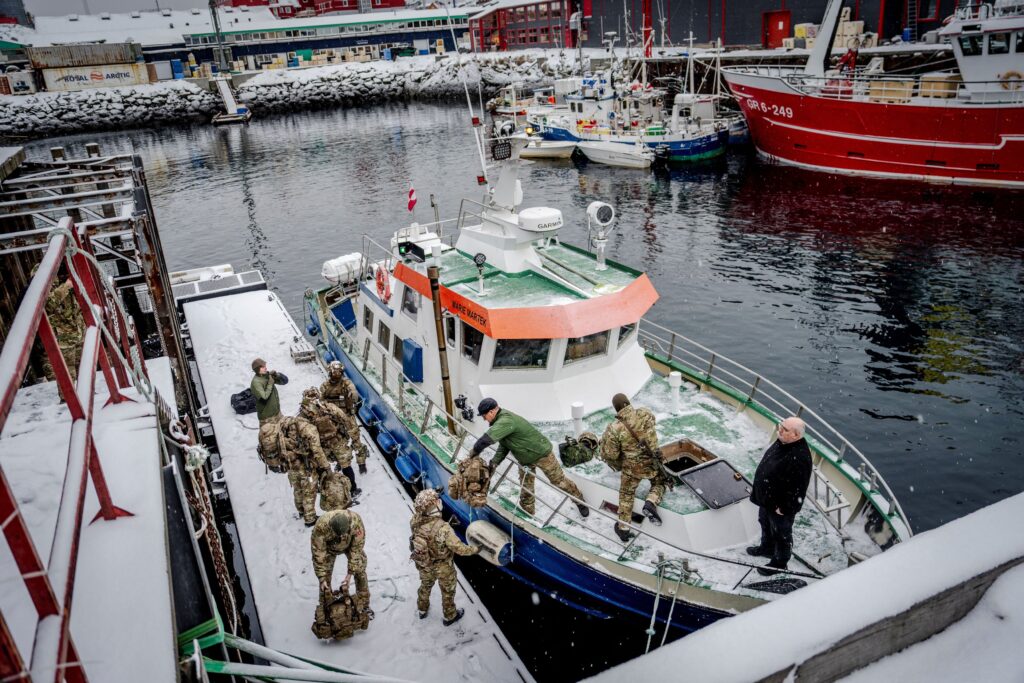
It is hard to overstate the shock in much of Europe in response to President Donald Trump’s threat of tariffs against countries accused of trying to thwart his goal of annexing Greenland. ‘’We will not let ourselves be blackmailed,” said Swedish Prime Minister Ulf Kristersson. British Prime Minister Keir Starmer: “Completely wrong.” French President Emmanuel Macron: “Unacceptable.” Their countries, along with Denmark, Finland, Germany, the Netherlands and Norway, will be hit with 10 percent tariffs, possibly rising to 25 percent, starting Feb. 1. What was their sin? Daring to send a handful of troops to Greenland in a feeble show of European solidarity.
For the past year, Europeans have watched with alarm as Trump has appeared to try to actively tip the scales of the Ukraine war in favor of Russia. They accepted a humiliatingly one-sided trade deal last summer in the hope that doing so might buy leverage with Trump in Ukraine peace talks. They read with alarm a new National Security Strategy that was far more critical of European countries than of Russia and China, and which contained an explicit threat to intervene in domestic politics on behalf of parties that many Europeans consider extremist.
But never in their darkest moments did anyone imagine, despite Trump’s occasional musings about Greenland, that the United States might threaten to seize — perhaps even militarily — the sovereign territory of a European Union and NATO member state. The reaction in Europe has been emotional, even visceral. Not because Greenland is of vital strategic importance to Europe, or because of any atavistic attachment to a barely inhabited, remote island far from the continent, whose approximately 57,000 inhabitants have long signaled their desire to break with Denmark.
The agitated European response is because Trump’s demands represent such a flagrant assault on the most cherished principles of the international rules-based order — in which nowhere is more fully invested than Europe, and which underpins its own internal order.
Yet the depth of the emotional reaction also reflects the extent to which Trump’s aggression has revealed Europe’s own weakness. As the president and his acolytes have ramped up their rhetoric, so too is there excitable talk in European political circles and among analysts and commentators in the media about possible reprisals and retaliation against the U.S.
Some have called for Europe to threaten to close U.S. military bases if Trump tries to seize Greenland by force. Others have called for trade sanctions. The European Parliament leaders say they will pause the ratification of the E.U.-U.S. trade deal agreed last summer. Macron has called for the activation of the E.U.’s anti-coercion instrument, the bloc’s ultimate trade weapon.
Yet, as always in Europe, the challenge will be to forge a united position around any one course of action. Even amid such a fundamental breach of trust, there will be many arguing, at least in private, for the need to reach a deal with Trump that keeps the security relationship with America intact. Countries close to the Ukrainian border, nervous over Russia’s expansionist designs, will ask why their security should be jeopardized for Greenland’s.
Will southern European countries that have played a minimal role in supporting Ukraine be willing to pay a high cost to defend Danish sovereignty over Greenland?
Britain, whose nuclear deterrent is dependent on U.S. maintenance, and whose defense industry — including a new nuclear submarine program — is deeply entwined with America’s, would be unlikely to break even with a rogue U.S.
Similarly, the barrier to coordinated trade reprisals is likely to be high. Much will depend on whether and how Trump’s latest tariff threats are applied. Many details remain unclear, and he has backed off tariff threats before. But while the stalling of the E.U.-U.S. trade deal now seems certain, the E.U. struggled last year to agree on even a modest package of retaliatory measures in response to Trump’s “Liberation Day” tariffs, and may do so again.
Activating the anti-coercion instrument is a lengthy, multilayered process requiring the backing of a qualified majority of E.U. member states. Europeans know that in a trade war, America has escalation dominance.
They also know that their best hope of thwarting Trump lies in the U.S. itself. Their hopes will be pinned on the prospect of a bipartisan alliance in Congress acting to block the threatened use of force against a NATO ally, and perhaps on the U.S. military refusing to obey an order that many argue would be unconstitutional. Yet even here, optimism will be tempered by the knowledge that Congress has so far proved little impediment to Trump’s exercises of executive authority.
Nonetheless, Europeans are right to warn that there will inevitably be a cost to this historic breach of trust. The humiliation will likely reignite latent anti-Americanism never far beneath the surface in parts of Europe — including among some of the far-right parties that the Trump administration sees as its “civilizational” allies. Consumer boycotts of American goods, similar to the mass rejection of Elon Musk’s Tesla cars last year, could harm trade. Investment may be put on hold.
Perhaps the humiliation will also be the spark that ignites a far bigger push toward European integration and strategic autonomy — hardly what the Trump administration is seeking. Or perhaps it will lead to greater fragmentation, weakness and decline, if Europeans blame technocrats in Brussels for this fiasco.
Either way, Trump’s attempts to annex Greenland threaten to be the greatest geopolitical shock that Europe has faced since the Berlin Wall fell in 1989. That was a moment for joyous celebration. The only people celebrating this time will be Russia’s Vladimir Putin and China’s Xi Jinping.
The post Trump’s Greenland threats convey a deeper assault appeared first on Washington Post.