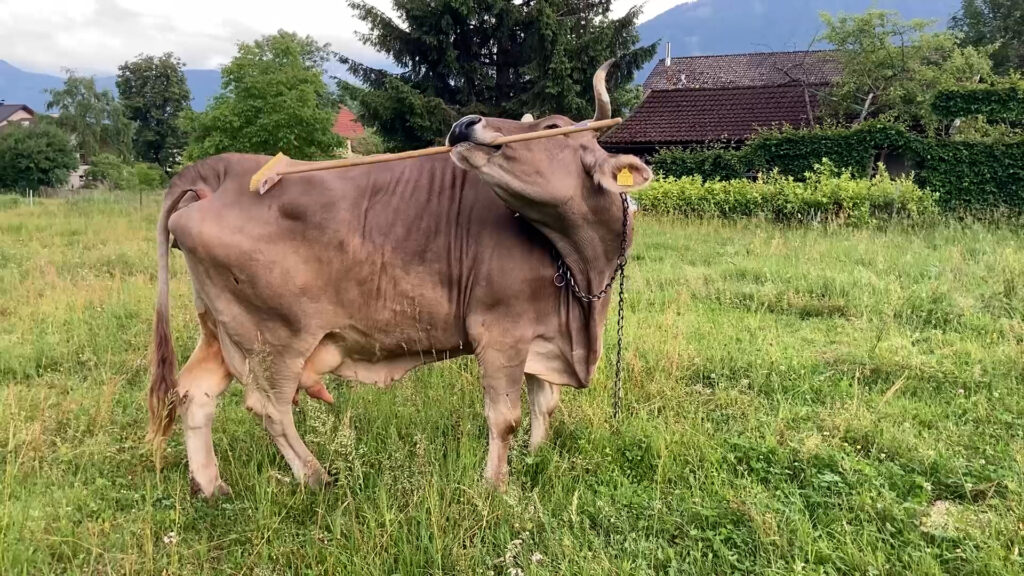
Cows itch, just like us. They rub their rumps against trees and fences. Some farmers even put out bristled posts so cattle can scratch themselves.
But Veronika the cow takes things into her own hands. Or rather: into her mouth.
Plop a long brush in front of her and the 13-year-old cow will curl her tongue around the wooden handle and bring it to her mouth. Holding it horizontally between her teeth, Veronika swings her head to the side to rub the bristled end along her back.
Veronika wasn’t trained to do this. Scientists say it’s the first experimentally verified instance of cattle using a tool. The discovery suggests we’ve been underestimating the potential cognitive ability of cattle, a domesticated animal that humans have lived alongside for millennia for milk and meat.
“We’re constantly in contact with them, but we’re only interested in them in terms of production,” said Alice Auersperg, a cognitive biologist at the Messerli Research Institute at the University of Veterinary Medicine in Vienna. “We’re not really interested in their behavior and their intelligence.”
The findings, published Monday in the journal Current Biology, add to the growing list of animals capable of using tools, an ability once thought to be a hallmark of humanity.
The star of the study lives in Austria. Her owner is Witgar Wiegele, a farmer and baker who keeps her as a pet. When Veronika was about 4 years old, Wiegele noticed she sometimes picked up sticks.
“I was naturally amazed,” Wiegele said, adding that the cow is deeply curious and affectionate. “She enjoys being petted, and conversations. She recognizes my and my mother’s voices from afar and hurries over, calling out to greet us.”
After publishing a book about animal innovation last year, Auersperg was inundated with videos of pets purportedly using tools, including one of Veronika. Seeing what the cow could do, “I got very excited,” she said.
So Auersperg and her colleague, cognitive biologist Antonio J. Osuna-Mascaró, visited Veronika over the summer on Wiegele’s farm. “He gave us a lot of cake from his bakery,” Auersperg said. “It was delicious.”
In a series of trials, the researchers placed a deck brush in front of Veronika in a random orientation. With a camera rolling, the cow picked up the brush to scratch herself 76 times, positioning it with her tongue before securing it in her teeth. Occasionally, she’d readjust her grip by releasing the brush and picking it back up again to get the right orientation.
Unexpectedly, in what the researchers said was another potential sign of higher cognition, Veronika appeared to use different parts of the same tool for different purposes. She largely used the bristled end of the brush to forcefully scratch her upper body, while she used the smooth end to more gently rub the sensitive skin on her udder and belly flap.
Making and using tools was once thought to be uniquely human. Then came a chimpanzee named David Greybeard. In the 1960s, the primatologist Jane Goodall watched David dip a blade of grass into a termite mound to fish for insects to eat.
Since then, orcas, elephants, octopuses, crows, wolves, fish and ants have taken human beings down a peg or two by apparently wielding tools. “The list of animals capable of tool use has been increasing steadily since scientists started to pay attention,” said Alex Kacelnik, an animal cognition scientist at Oxford. The cattle study, he added, “is a very welcome new report.”
But scientists still have lots of competing definitions for what it truly means for an animal to use a tool. Does the animal actually have to make the tool, like crows that fashion sticks to collect grubs? Or does an animal need to hold the tool, unlike wrasse fish, which smash crabs against rocks to remove the shells.
“Tool use is a little bit of a mess in the literature,” Auersperg said. For her, Veronika manipulating the brush in her mouth to scratch an itch — rather than rubbing herself against a stationary object — is enough to constitute tool use.
For Marc Bekoff, a University of Colorado ethologist who was not involved in the study, there is no doubt that Veronika is a tool user. “If she were a chimpanzee or dog, people would agree. Many people wrongfully think that cows are dumb, and they’re not. In fact, they are very intelligent and emotional beings.”
Benjamin Beck, a retired Smithsonian scientist and author of “Animal Tool Behavior,” agreed that “Veronika’s behavior is really tool use, and is an impressive example.” He noted that a related species of water buffalo has been observed dislodging fence rails to scratch themselves, too.
The fact that other bovines appear to use tools suggests the ability is not a by-product of domestication, according to Auersperg and Osuna-Mascaró.
But Beck cautioned against overinterpreting the results as a test of cognitive flexibility, noting many invertebrates that lack complex brains appear to use tools. Ants, for instance, use leaf fragments to carry liquid and small stones to block the nest openings of competitors.
Osuna-Mascaró loved working with Veronika, even though she didn’t always reciprocate. “She behaves like a cat. You can’t force anything on Veronika. You need to adapt to her and gain her trust. But when you gain her trust, then Veronika is a really social animal.”
Still, Osuna-Mascaró doesn’t think Veronika is special. He believes other cows may be capable of learning to perform similar feats if given the long and idyllic life Veronika has enjoyed, which is a rarity among cattle.
“Our conclusion is that Veronika is not special,” Osuna-Mascaró said. “What is special is the conditions that Veronika has.”
The post Cows may be smarter than we thought. This one uses a brush to scratch herself. appeared first on Washington Post.