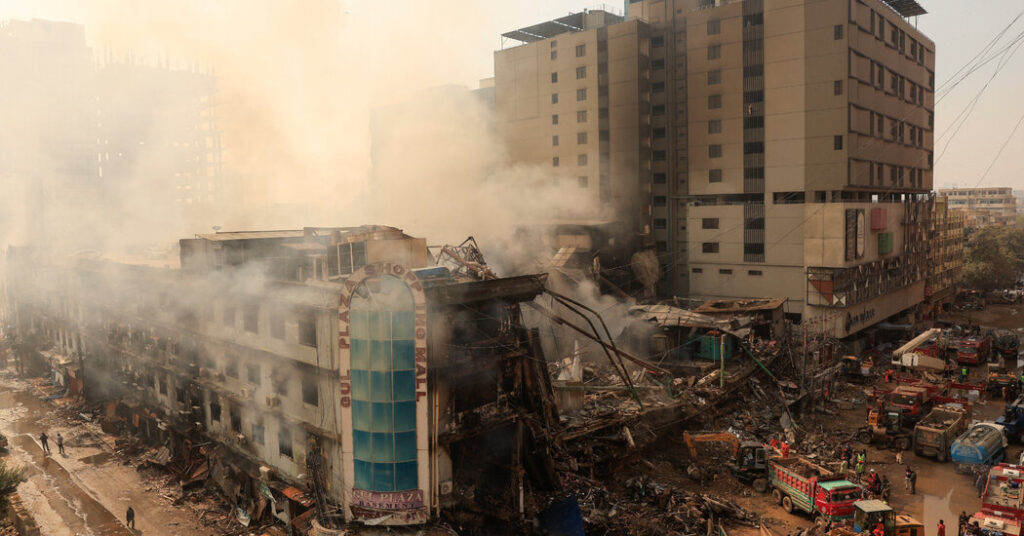
A fire tore through a crowded mall in Karachi this past weekend, leaving at least 23 people dead and dozens missing on Monday in the latest tragedy that urban planners and shopkeepers have blamed on chronic mismanagement in Pakistan’s largest city.
The road outside the mall was crowded on Monday with hundreds of residents who gathered around the blackened shell of a once-thriving market. Shopkeepers stood in silence, staring at ruined livelihoods, while families pressed against police cordons, dialing unanswered phones. Nearby, other market stalls were closed in mourning.
The fire, which burned for nearly 24 hours, began spreading around 10 p.m. on Saturday on the lower floors of Gul Plaza, one of the busiest wholesale marketplaces in downtown Karachi. It housed about 1,200 shops selling luggage, crockery, decorative items, plastic goods, toys, garments and household supplies.
Haji Sabir, a shopkeeper who said he had narrowly escaped, said the area had been bustling: “It was wedding season. The market was crowded.”
Rescue officials said the flames first broke out from the lower-level shops and climbed inside the building, casting an orange glow over the surrounding narrow streets.
By the time firefighters brought the blaze under control at around 10 p.m. on Sunday night, Gul Plaza had been almost completely destroyed, leaving a burned and empty shell behind.
At least 23 people were confirmed dead, according to the state-run emergency services. Dozens more were feared to be trapped in stairwells, shops and under collapsed floors. Rescue workers said the exact toll might take days to establish, as several parts of the structure remained unstable and inaccessible.
Officials initially suspected an electrical short circuit, but said the cause had yet to be confirmed.
On Monday morning, fire engines kept spraying water on the burning building from one side, while demolition workers pulled down badly damaged parts from the other. Rescue teams trudged through dark corridors looking for any sign of survivors.
Inside the building, melted electrical wires hung from the ceilings. Rolling iron shutters on storefronts were still tightly closed, some twisted out of shape. Cellphones belonging to missing merchants rang under the ash and broken concrete, but no one answered.
Outside, grief hardened into anger.
“If the fire engines had arrived on time, with proper ladders, this could have been contained,” said Mujtaba Ali, whose relative was among those believed to be trapped inside. “They were calling us from inside, saying the stairways were locked. What chance did they have?”
Merchants said that some people escaped from the ground floor, but when the fire reached the upper levels, it was too late. Firefighters’ ladders could reach no higher than the fifth floor.
The inferno brought back painful memories in a city long plagued by deadly fires. In 2012, more than 260 workers died in a garment factory after being trapped behind barred windows. In 2023, a fire at a shopping mall killed 10 people and injured 22 others.
“Every time, officials promise change. Every time, the city quietly returns to business as usual,” said Zahid Farooq, joint director of the Urban Resource Center, a Karachi-based nonprofit organization.
“There is a culture of legalizing illegal practices,” he said. “Buildings made for 500 shops are packed with more than 1,200 shops. When buildings are overcrowded, and exits are blocked, tragedy becomes unavoidable.”
In Karachi, Pakistan’s economic hub of more than 20 million people, fire safety laws exist mostly on paper, experts say. Building inspections are rare and punishments for violations are weak. Builders add extra floors without permission. Stairwells are locked to stop theft. Electrical wiring is poorly repaired and heavily overloaded. In crowded markets, illegal extensions clog the narrow streets so much that even small fire engines can hardly pass.
During the weekend rescue operation, fire engines were delayed by roadside encroachments, including those unauthorized expansions, according to officials and rescue personnel.
On social media, a short audio clip spread quickly, showing a man crying, “We’re trapped from all sides. Fire is everywhere. Please forgive me if I did something wrong.” The recording ends abruptly.
Murad Ali Shah, the chief minister for Sindh Province, whose capital is Karachi, ordered an inquiry into the blaze. He directed the authorities to carry out immediate fire safety audits of commercial buildings across the city.
Beyond the human toll, the economic losses are expected to be severe. The Karachi Chamber of Commerce and Industry, the city’s leading mercantile body, said more than 1,000 small and medium shops had been destroyed, wiping out years of savings and cutting off the only source of income for hundreds of families.
Among the crowd outside Gul Plaza was Sharif Khan, 42, who had opened a crockery shop just a year earlier, using a bank loan of about $7,000.
“I put everything I had into that shop,” Mr. Khan said, his eyes fixed on the blackened ruins. “The goods are gone, the shop is gone, but the debt remains. I have no hope that the government will help us.”
The post Slow Emergency Response Blamed in Deadly Fire That Tore Through Pakistani Mall appeared first on New York Times.