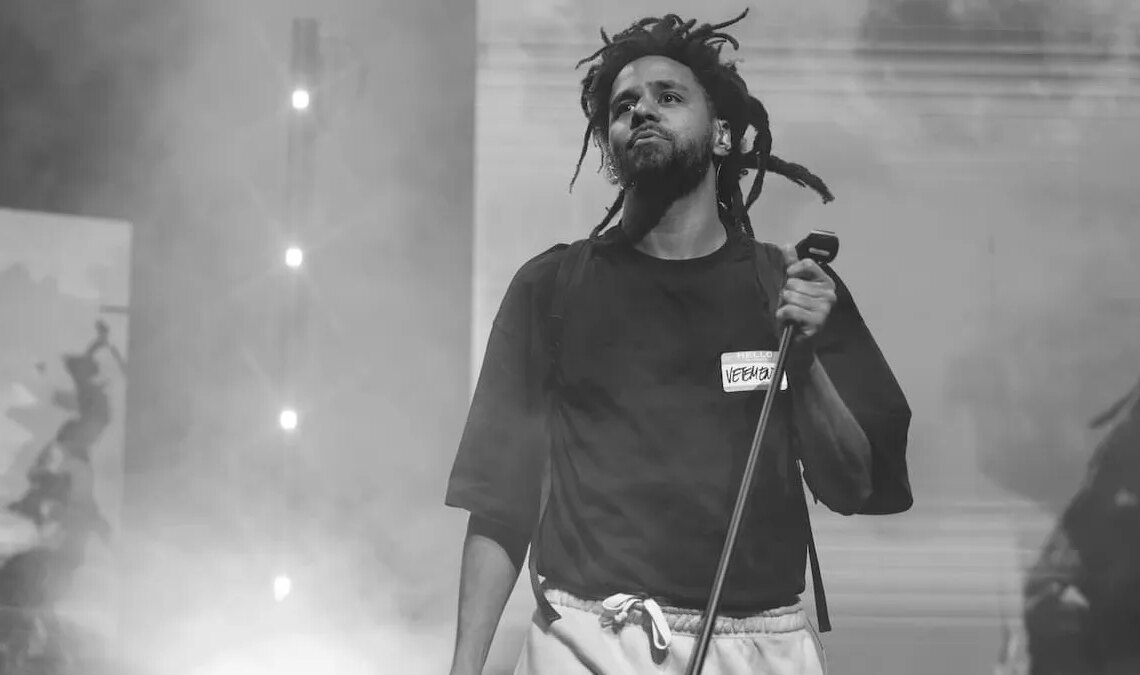
In the ‘big 3’ trifecta, J. Cole has always kept things modest. Where Drake was the ubiquitous hit-maker, and Kendrick was prestigious, Cole was in his own lane with a devout fanbase. Still, he was frequently in the upper echelon of the hierarchy. But now, with his upcoming album The Fall-Off slated to be his last, our understanding of mainstream hip-hop will be radically altered.
Across two decades, J. Cole has amassed an extensive catalog of records. Noisey is cobbling together a Mount Rushmore for the North Carolina rapper (if this is truly going to be his last stand). By picking four of his best songs, the list will highlight his strengths and what made him such an alluring artist to diehard fans back in 2007.
Four of The Best J. Cole Songs of All Time
“Dollar and a Dream II”
J. Cole is the ultimate coming-of-age rapper. A lot of his music, especially early on, centered around working hard to be considered the greatest. He would embark on this seemingly never-ending journey to measure up to his idols. Even when you make it to the top, there’s a new challenge: staying on top. It’s no wonder basketball players are enchanted by his music. The tireless perseverance through the grind is aspirational. One day, it will all pay off.
“Dollar and a Dream II” depicts this relatable, everyman quality seamlessly. The chilly but tender chords and cozy drums are the soundtrack to every long wait at the bus stop. It’s for every struggle meal and every reminder you tell yourself that it won’t be like this forever. It’s the 1,000 free throws until you hug the basketball like J. Cole is on The Warm Up mixtape cover. At this point in his career, the earnestness and coming-of-age suits him. The hunger isn’t contrived or artificial.
“Power Trip”
J. Cole doesn’t typically make songs for the ladies. The “Work Out” slander is a little overblown, and I don’t think that he really let Nas down there. But verses on the raunchy Jeremih’s “Planez” or Miguel’s breezy “Come Through and Chill” do not suit his style in the slightest.
Still, Cole isn’t incapable of channeling his more romantic side. “Power Trip” is a textbook yearner of a song, doubling as a song about him trying to make it in hip-hop. The record is weary and delirious in the love he wants. Miguel’s singing cuts through the wooziness with a sobering question: “Would you believe me if I said I’m in love?” The earnest longing becomes irresistible after a while.
“Neighbors”
Some of J. Cole’s sharpest songwriting, where racism bubbles in classism. His success sees him in a nice suburb, happily enjoying his life. It’s the manifestation of the hard work he’s put in up to this point. Why shouldn’t he enjoy the big ol’ backyard with his friends and pass a blunt around?
But Cole can’t control the prejudice rooted deep inside his neighbors. All of a sudden, the police arrive, and all of the fame and fortune he’s acquired mean nothing. “Just a couple neighbors that assume we slang. Only time they see us, we be on the news, in chains, damn,” J. Cole shrugs. By the end of the song, he makes integration feel like a ruse, a pointless pursuit that can’t possibly work out when such racist perceptions persist.
“4 Your Eyez Only”
The crown jewel in J. Cole’s discography. He masterfully weaves his story with that of his late friend, James McMillian Jr. Everyone has their own dreams, but not everyone can escape the streets in order to fully live. Still, in spite of everything, he persists in the first life. The things he’s doing to survive can’t be everything that life has to offer. “I might be low for the moment, but I will bounce back. Despite the charges, back to the wall, I fight regardless, screamin’ ‘f*** the law,’ my life is lawless,” Cole raps.
By the end of the first verse and into the second, it’s evident that this was made ahead of his death. Cole raps through the perspective of someone who feels like his death is a prophecy, a foregone conclusion. Consequently, he talks to his daughter, to try and contextualize the tragedy why he wasn’t alive to raise her. All he could hope for is that he made the best of his hand in a broken system.
It’s heartbreaking by the end of the song, where Cole finally comes into the frame and tries to paint the rest of the picture for someone who wasn’t around to tell the story themselves. “4 Your Eyez Only” is deeply thoughtful and empathetic, a raw depiction of both the elemental and systemic woes that trap and subdue us. To try to persevere despite it all is courageous.
The post The J. Cole Mount Rushmore: His Top 4 Songs of All Time appeared first on VICE.