Among those who defend the behavior of ICE in the shooting of Renee Nicole Good, one argument goes like this: Activists have been recklessly trying to obstruct these agents as they carry out their work, all for the sake of getting a viral moment that makes the officers look like thugs. These ICE defenders are not wrong, but what they see as annoyance and endangerment seems more like a deliberate strategy with a long history—a successful one.
The unarmed, nonviolent citizens who have been following ICE agents, blowing whistles to alert people to their presence, even heckling and mocking them, are not just trying to impede their work. They are aiming, as well, to illustrate a contrast, evoke a reaction that will reveal a moral truth, and tell a story they can capture on their phone: on one side, an aggressive, violent, extrajudicial (and masked) paramilitary group exercising brute force against anyone who gets in their way, and on the other, people who are simply attempting to be decent neighbors. Good and her fellow “rapid responders” achieved this contrast—at the cost of her life.
Some people might think this is unfair, that ICE agents are just trying to do their job of finding and deporting undocumented people, and that the activists are to blame for provoking the violence. But this is not the way the activists see it, and after Good’s killing, it’s not the way the majority of the country sees it either. A CNN poll conducted after the shooting found that 51 percent of Americans believe that “ICE enforcement actions were making cities less safe rather than safer.” And the number of people who feel that Trump’s immigration-enforcement efforts go too far has grown, increasing from 45 percent last February to 52 percent in the new poll. The change is incremental, but for those who have been opposed to ICE all along, it is steady progress.
What the neighborhood-watch groups and activists are doing in Minneapolis seems to be working, and their tactics are worth recognizing today in particular as Americans reflect on the legacy of Martin Luther King Jr.
The civil-rights movement was built on creating and exploiting (in the best sense) such moments of moral witness, images of contrast. And King was the most prominent promoter of this approach. Sitting in a jail in Birmingham, Alabama, in April 1963, where he was detained for eight days, he composed one of his most famous pieces of writing: a letter to a group of clergymen who were advocating a more moderate approach to activism. (The Atlantic published it in the August 1963 issue under the headline “The Negro Is Your Brother.”) King was in the city as part of a campaign, called Project C (for confrontation), to break segregation in a place where it was as settled as sedimentary rock. The movement organizers had planned a series of rolling marches and sit-ins everywhere from the local Woolworth’s to the public library. The cartoonishly racist commissioner of public safety known as Bull Connor had tried to shut it all down by obtaining an injunction against protesting—which is how King ended up behind bars.
[Read: The unspeakable, enabled]
Persuading the local authorities to come to the table and loosen racial restrictions demanded the “creation of tension,” King wrote in his letter. The movement would have to provoke “a situation so crisis-packed that it will inevitably open the door to negotiation.” He was even prepared to accept the label of “extremist,” he wrote. “The question is not whether we will be extremist, but what kind of extremists we will be. Will we be extremists for hate, or will we be extremists for love? Will we be extremists for the preservation of injustice, or will we be extremists for the cause of justice?”
The confrontations in Birmingham were being staged for an audience, just as the many people who filmed the moment when Good was shot—including the ICE officer, who sought to tell his own story—were recording for an audience. King knew that he couldn’t easily change the minds of white southerners and make them less racist overnight, but he wanted to create a moment that would anger white northerners and increase political pressure everywhere. The point of such tension was to accrue a kind of symbolic capital, which could be used to purchase specific freedoms: the freedom to sit at the Woolworth’s counter, or at the front of a bus, or in a good school.
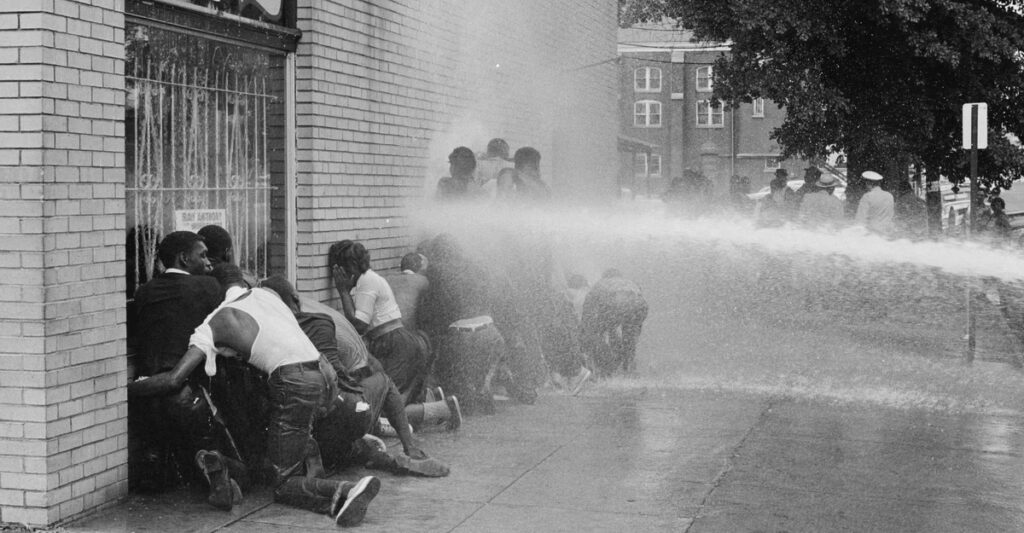
Once out of jail, King, along with his lieutenants, came up with a plan to use children as protesters, including some as young as 6. This was dangerous—at least as dangerous as following an ICE officer in your car. Just how risky it was became clear when Connor responded by having his police turn high-pressure water hoses and then dogs on the young marchers. The water stripped the shirts off the children’s backs, forcing them to fall down and roll on the ground. They held on to telephone poles and chanted “Freedom” over and over. The dogs barked and lunged at them. Three people had to be hospitalized.
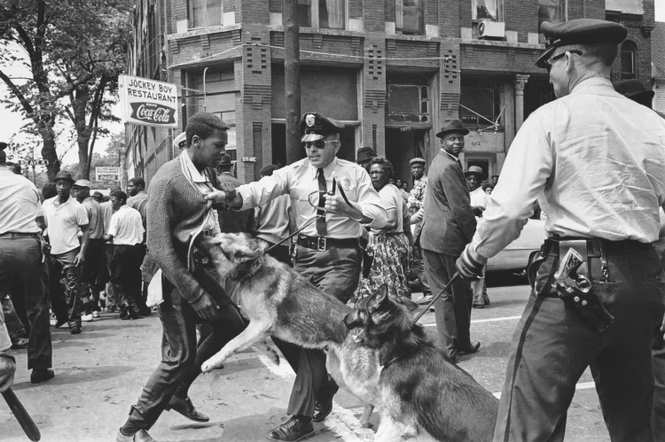
This is familiar to many people because the images that this confrontation produced have become indelible—especially the one of a teenager named Walter Gadsden being attacked by a German shepherd as a police officer pulls him toward the dog. It was on the front page of The New York Times. This was an illustration of contrast.
The plan was also a success in that the pressure it applied forced the city to negotiate, resulting in a deal, days later, to desegregate Birmingham’s downtown shopping district. It also happened without anyone getting killed or seriously hurt. Yet no one had a way of knowing this in advance. Black parents in the city were angry that their children were being used as what seemed to some like cannon fodder. A shockingly wide range of commentators thought that King had gone too far, including Malcolm X (“Real men don’t put their children on the firing line”) and Attorney General Robert F. Kennedy (“Schoolchildren participating in street demonstrations is a dangerous business. An injured, maimed or dead child is a price that none of us can afford to pay”).
[Read: Martin Luther King, Jr.’s “Letter From Birmingham Jail”]
King himself was nervous about the tactic, until he began to see that the tide was turning. Once 2,500 people were crammed into the city jail, most of them elementary- and high-school students, and Connor was struggling against the waves of terrible press, the situation became untenable, and King knew that it was only a matter of time before the city caved. “Don’t worry about your children,” he told parents gathered at the city’s 16th Street Baptist Church. “They’re going to be all right. Don’t hold them back if they want to go to jail, for they are doing their job for not only themselves but for all America and for all mankind.”
I’m remembering this story today because it’s always worth pointing out that King was an activist, in his own words an “extremist,” a man who was willing to take mortal risks and encouraged others to do so—not just the secular saint preserved in granite near the National Mall. But I also think this story is important because King was right about what moves people, and he is more right now than he was in 1963, when attention spans were a little longer. Even President John F. Kennedy, disturbed by the photo in the paper, was caught on a recording saying, “This may be the only way these things come to a head.”
None of this makes the death of Renee Nicole Good any less tragic. But it is worth understanding that the confrontation emerged from a strategy—revealing tension by exposing the moral deficiency of the government’s behavior. And this deficiency has, to many Americans, been exposed. That martyrdom can be the cost of such a revelation, and that change might be possible only through injury or death, is a sad commentary on the human brain and heart. Sometimes we need to be shown what is wrong in the world—shown in the most unambiguous of terms—before we are willing to act. For King, this was the point of nonviolent civil disobedience, “to bring to the surface the hidden tension that is already alive.” As he explained in his letter from jail: “Like a boil that can never be cured so long as it is covered up but must be opened with all its ugliness to the natural medicines of air and light, injustice must be exposed, with all the tension its exposure creates, to the light of human conscience and the air of national opinion before it can be cured.”
The post Minnesota Had Its Birmingham Moment appeared first on The Atlantic.