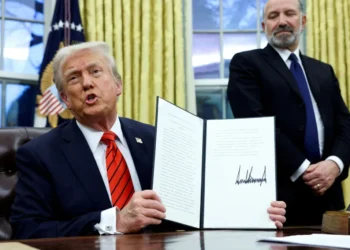
The dispute between the United States and Europe over the future of Greenland, which has escalated with President Trump’s announcement he planned to impose tariffs on eight friendly nations who oppose his plan to seize the Danish territory, isn’t the first time the allies have been at loggerheads.
Deep disagreements have flared up from time to time since World War II, bringing transatlantic diplomatic crises.
Here’s a look at some of them.
Suez Crisis
When France, the United Kingdom and Israel invaded Egypt in 1956, aiming to topple Egyptian President Gamal Abdel Nasser and take back control of the Suez Canal, the U.S. employed heavy diplomatic and economic pressure to stop it.
The U.S. intervention severely strained Washington’s relations with London and Paris, which were key allies during the Cold War, and was a milestone in Europe’s waning postwar influence.
Vietnam War
While European countries except France gave diplomatic backing to the U.S., they refused to provide troops.
Street protests in Europe against the war had a significant political cost for the continent’s governments, which had to reconcile their support for the U.S. with an erosion of their domestic popularity, and were a burden on transatlantic relations.
Euromissile crisis
Beginning in the 1970s, the Soviet deployment of new SS-20 missiles that could quickly hit targets in Western Europe compelled NATO to install U.S. Pershing nuclear-tipped ballistic missiles and cruise missiles in Europe in order to maintain the balance of the nuclear arms threat.
The move ignited an uproar on the continent, where fears of a new arms race deepened. Huge anti-nuclear peace demonstrations, with protesters often aiming their ire at Washington, filled the streets of European capitals in the 1980s.
Invasion of Iraq
The U.S.-led invasion of Iraq in 2003 sparked a major crisis in relations with Europe, especially France and Germany after they refused to support the attack on President Saddam Hussein’s government.
Washington officials rebuked Paris and Berlin, with U.S. Defense Secretary Donald Rumsfeld referring to them as “Old Europe” and praising Eastern European countries as “New Europe.” Public opposition in Europe against the war was widespread.
Extraordinary rendition
As part of its “war on terror” after 9/11, the United States captured and sometimes kidnapped suspects, and then transferred them to locations in countries where they were interrogated and often tortured outside the reach of U.S. law.
While some European governments were complicit in the program, a public outcry forced political leaders to denounce the practice.
War in Ukraine
When President Trump returned to the White House in January 2025, he upended three years of American policy toward Russia’s invasion of Ukraine.
Trump spoke warmly of Russian President Vladimir Putin, as he had in the past, was cold toward Ukrainian President Volodymyr Zelensky, notably scolding him during an Oval Office meeting. Trump then significantly reduced U.S. military aid for Kyiv.
Alarmed European leaders, who see their own security at stake in Ukraine, have pressed Trump to be on Ukraine’s side.
National security strategy
The Trump administration set out a new national security strategy in December that portrayed European allies as weak.
Echoing the remarks of far-right leaders in Europe, the assessment was scathing in its criticism of the allies’ migration and free speech policies, suggested they face the “prospect of civilizational erasure” and cast doubt on their long-term reliability as American partners.
Trade tariffs
With relations between the U.S. and Europe deteriorating, Trump threatened the continent last July with heavy trade tariffs in what was seen as a deeply hostile move.
Trump initially announced tariffs of 30% on the 27-nation European Union, which is the biggest trading partner of the United States. Both sides later agreed to a trade framework setting a 15% tariff on most goods.
The post The U.S. and Europe have been at odds before over the years: A timeline appeared first on Los Angeles Times.