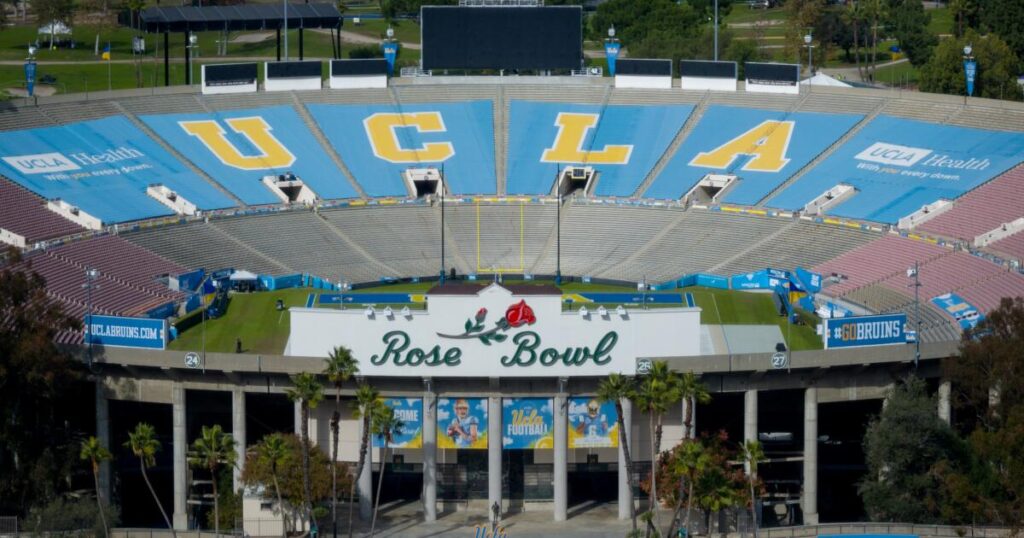
If legal scholars were setting a betting line on Rose Bowl v. UCLA, it might be a pick’em.
It’s possible that a judge or arbitrator in the high-stakes breach-of-contract case awards monetary damages to the Rose Bowl and the City of Pasadena based on a prediction of lost revenue over the length of a lease that runs through June 2044, freeing the Bruins to abandon their longtime football home for SoFi Stadium.
In another scenario, that judge or arbitrator considers the possibility of wild success under new coach Bob Chesney leading to a packed stadium and figures there’s no way to reasonably calculate damages, given that the team’s longstanding attendance woes don’t provide a reliable blueprint for future revenue. In that instance, UCLA most likely would be forced to stay at the Rose Bowl.
“I don’t think that it’s a sure thing either way,” said Russell Korobkin, a UCLA law professor who specializes in contracts and was one of three legal experts who spoke with The Times about the case. “I wouldn’t want to be betting on the outcome.”
What’s at stake goes well beyond where UCLA football fans will be spending their fall Saturdays.
Attorneys for the Rose Bowl and the City of Pasadena contend that UCLA’s relocation attempts represent “a profound betrayal of trust” and that the team’s departure would inflict “irreparable harm” for which money alone could not sufficiently compensate the stadium and surrounding community.
Opposing counsel says UCLA has not violated any agreement and is only considering all options to ensure a path toward financial viability amid a rapidly changing college sports landscape. Publicly the school has maintained that it hasn’t made a decision about its future football home.
In all likelihood the case results in one of two outcomes, according to legal experts. Either UCLA cuts a huge check to the Rose Bowl and City of Pasadena, allowing the Bruins to move to SoFi Stadium, or it is forced to remain at the Rose Bowl.
Given that UCLA has played at its current home since 1982, Korobkin said, it might be possible to reasonably calculate lost revenue over the lease’s final 18 seasons. But those calculations could be complicated by the construction of a $30-million field-level club in the south end zone as part of a revenue-sharing agreement between the Rose Bowl and UCLA.
While UCLA will receive revenue from new wider seats associated with a club that’s expected to be completed before next season, the Rose Bowl will get to sell those seats at a premium for concerts and other events.
“Since those don’t exist right now,” Korobkin said of the seats, “it would be harder to project the amount of revenue the Rose Bowl would be losing by not being able to sell those seats.”
The City of Pasadena has claimed a UCLA departure would result in intangible reputational harms that might be impossible to quantify. There’s also no way of knowing how many more fans might pack a home stadium to see a team contending for an appearance in the College Football Playoff after the Bruins have gone more than a quarter of a century without so much as a conference championship.
“The uncertainty of the future is an argument in favor of specific performance rather than just giving money damages,” Korobkin said, “but the problem exists in many, many breach-of-contract cases that you’re never certain about how much revenue you’re losing as a result of the breach.”
Another factor that could be pivotal is the length of the contract.
Paul Haagen, the co-director of Duke’s Center for Sports Law and Policy who specializes in contracts, the social history of law and law and sports, said that had UCLA’s lease been set to expire a few years from now, a judge or arbitrator most likely would force the school to remain at the Rose Bowl via a legal term known as specific performance.
“The fact that it’s ‘44 is a huge deal,” Haagen said, alluding to the contract’s expiration date.
In favor of whom?
“In favor of [a judge or arbitrator] thinking that, ‘A, we’re not going to enforce specific performance,’” Haagen said, “because it’s now a really long time to enforce your judgment and that is likely to make it more difficult — maybe even moving in the direction of implausible — that UCLA can operate in that environment” given recent athletic department deficits that required a university bailout.
“I think the complexity here is, it’s entirely possible that the nature of this contract would essentially so hamstring UCLA that they couldn’t perform and so that’s at least a conceivable thing.”
But couldn’t the Rose Bowl attorneys argue that while they understand times are changing, a contract is a contract and needs to be honored?
“Can they say that?” Haagen said. “Absolutely they can say that.”
As far as the Rose Bowl’s contention that representatives of Kroenke Sports and Entertainment and SoFi Stadium meddled in the matter by encouraging UCLA to change stadiums, leading to a claim of tortious interference, legal scholars are divided.
Korobkin said there’s nothing that legally forbids SoFi Stadium from engaging UCLA in discussions about a potential move.
“It’s not tortious interference to be a competitor and to offer a potential client a particularly good deal should they decide to enlist your services,” Korobkin said. “There would usually have to be some kind of pressure being put on the parties by the third party — by Kroenke, in this case — on UCLA to break its contract with the Rose Bowl. … There’s not a plausible story about how Kroenke could be putting undue pressure on UCLA to break its lease with the Rose Bowl, so I think it’s a bit of a red herring.”
Emails between UCLA and SoFi Stadium officials disclosed as part of the discovery process revealed that the sides have been in discussions going back as far as August 2024. Given that UCLA’s contract with the Rose Bowl is a matter of public record, this potentially could be problematic for Kroenke and SoFi executives, according to Greg Keating, a professor of law and philosophy in the USC Gould School of Law who teaches torts and professional responsibility, among other topics.
“If, as alleged, they were aware of the existing Rose Bowl contract terms and nonetheless actively encouraged UCLA to discuss moving its home games to SoFi Stadium in clear breach of that contract,” Keating said, “then we have tortious interference in that contract, and resulting intent to create known harms to the Rose Bowl and to the City of Pasadena.”
One aspect of the case that Keating finds curious is the Rose Bowl’s claim of anticipatory breach given that UCLA has not played a home game anywhere else for more than four decades.
“Conceptually, the problem is that there isn’t a breach yet, just an intended one,” Keating said. “Where’s the legal wrong? Why doesn’t the counterparty have to wait for actual nonperformance of the contract? How are they wronged unless and until the contract is breached? Empirically, it’s hard to say when anticipatory breach happens. Is it an anticipatory breach to muse out loud about not performing? To say you never will perform? Will something short of saying you never will perform do? How do we know the anticipatorily breaching party won’t change its mind?”
UCLA filed a motion to move the matter from Los Angeles Superior Court to arbitration, which would keep the proceedings out of public view. Attorneys for the Rose Bowl and Pasadena contend that the case should play out in open court because it involves two public entities and is of great interest to the public.
“The complaint by Pasadena and the Rose Bowl is partially a contract claim and partially addressed to the court of public opinion,” Haagen said. “So one of the things they certainly believe they want is to have this play out in the L.A. Times and to enlist public interest in it.”
Why would that matter? Haagen said it could invite legislative intervention if a public portrayal emerges that is unflattering to UCLA.
“Part of it is explaining to your own voters what you’re doing and that you’re not hapless and stupid and you didn’t agree to all of this work on the Rose Bowl and now you’re not getting anything” in return, Haagen said. “But also if the narrative is ‘greedy UCLA is going back on its word, not meeting its commitments,’ that’s kind of a big impact.”
Maybe everything that happens after Thursday’s court hearing to rule on the motion to compel arbitration will unfold behind closed doors.
Korobkin said he considered the likelihood of a judge granting UCLA’s request for arbitration “high” given the wording in the dispute resolution clause of the parties’ contract. The arbitrator likely would have the power to compel UCLA to remain at the Rose Bowl, Korobkin said, meaning the Rose Bowl would not be put in a disadvantageous position should the case be moved out of court.
But should a judge determine that the arbitrator would not be able to resolve the case quickly enough to prevent irreparable harm — such as UCLA playing games at SoFi Stadium — then the judge could issue a temporary restraining order forcing UCLA to remain at the Rose Bowl until the arbitrator can resolve the case, Korobkin said.
So who ultimately prevails in a case that has divided not only legal scholars but also the UCLA community, one fan wearing a “SoFi Hell No Won’t Go” T-shirt to basketball games at Pauley Pavilion?
While acknowledging the possibility of UCLA writing a big farewell check on its way to SoFi Stadium, Haagen said he wouldn’t rule out a settlement in which the Bruins remain at the Rose Bowl after agreeing to more favorable lease terms. Meanwhile, Keating and Korobkin suggested there’s no way to know with any reliability which way this will go.
“If you forced me to make a prediction,” Korobkin said, “I’m going to bet on money damages rather than specific performance, but I wouldn’t bet a lot of money on that.”
The post Will UCLA be forced to stay at the Rose Bowl? Legal scholars weigh in on the case appeared first on Los Angeles Times.