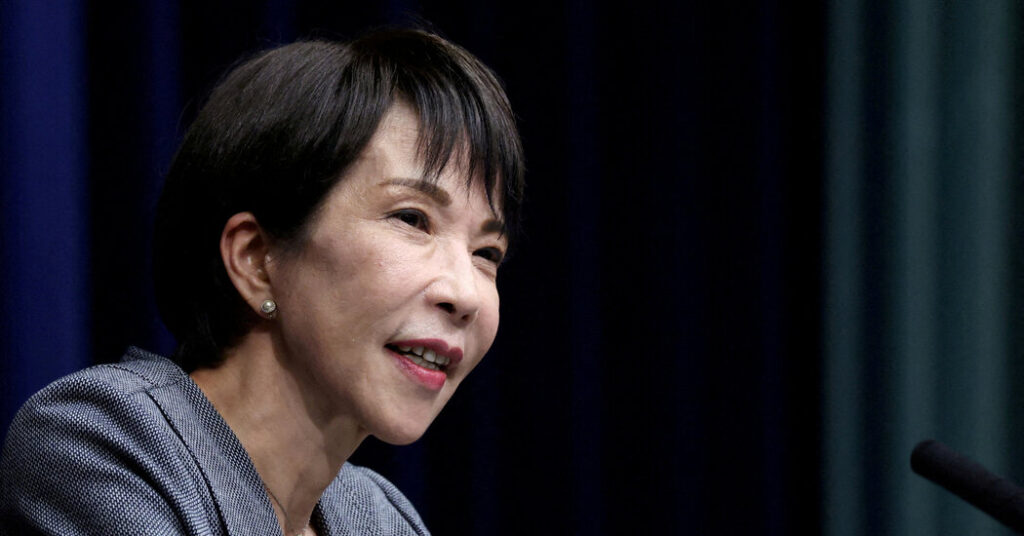
Sanae Takaichi, Japan’s prime minister, said on Monday that she would dissolve Parliament and call a snap election, in a bid to strengthen her power and revive the sagging fortunes of her party.
Ms. Takaichi, the first woman to lead the country, said she would dissolve the House of Representatives when it convenes for its regular session on Friday and schedule an election on Feb. 8 — only about three months into her tenure.
“I believe that the only option is for the people, as sovereign citizens, to decide whether or not Sanae Takaichi should be prime minister,” she said at a news conference in Tokyo.
The decision to call an election is the biggest bet of Ms. Takaichi’s tenure.
She risks losing critical seats, which could hinder her priorities and undermine her attempts to cultivate an image as a transformative, enduring figure. And if the L.D.P. suffered a major defeat, she could lose her job, though analysts said that scenario was unlikely.
But Ms. Takaichi, a hard-line conservative, could also help reinvigorate the Liberal Democratic Party — Japan’s main political group — and gain the seats in Parliament it needs to comfortably push through her economic and security agenda.
“She wants to seize the momentum and strengthen her hand at home and on foreign policy,” said Mireya Solís, director of the Center for Asia Policy Studies at the Brookings Institution in Washington. “The risk is, she cannot move forward with her agenda and emerges a much weaker figure.”
The decision to call a snap election comes as Japan grapples with a host of challenges. China has in recent months imposed a series of economic reprisals on Japan, aiming to punish Ms. Takaichi for her expression of support for Taiwan, a self-governing democracy that Beijing claims as its territory.
Japan is also dealing with uncertainty from the United States under President Trump. Ms. Takaichi has sought to woo Mr. Trump in an effort to get his administration to maintain its military and economic support for Japan.
By calling an election, Ms. Takaichi is betting that she can help revitalize the L.D.P., the broad-tent conservative group that has governed Japan for most of the past 70 years. Her party has suffered bruising defeats in recent elections, leaving it in the unusual position of being a minority in both houses of the parliament, known as the Diet.
After Ms. Takaichi’s election last October, the L.D.P. had a falling out with Komeito, its longtime coalition partner. The L.D.P. has since formed an alliance with the Japan Innovation Party, a conservative group, in an arrangement that has allowed the L.D.P. to continue to govern.
Opposition groups have expressed concerns about Ms. Takaichi’s decision to call a snap election, saying it could delay the approval of a budget and hurt the livelihoods of workers.
The L.D.P. remains unpopular because of recent political finance scandals and inflation. But Ms. Takaichi consistently earns high marks, especially among younger Japanese. Her election last fall, in a party leadership vote, was seen as a milestone in a country where women are vastly underrepresented in politics.
The economy will likely be front and center in the snap election, as voters look for assurances that Ms. Takaichi can deliver relief from rising prices and stagnant wages. Ms. Takaichi on Monday called inflation an “urgent matter” and promised to redouble efforts to ease the burden on families.
Kiuko Notoya contributed reporting from Tokyo.
Javier C. Hernández is the Tokyo bureau chief for The Times, leading coverage of Japan and the region. He has reported from Asia for much of the past decade, previously serving as China correspondent in Beijing.
The post Japan’s Leader Calls for Snap Election in Bid to Expand Power appeared first on New York Times.