Utah pediatrician Ellie Brownstein is used to encountering parents hesitant to get their child vaccinated.
But after the Trump administration in early January pared back the list of vaccines routinely recommended for babies and children, she’s seeing something else: Parents worried they won’t be able to vaccinate their kids.
At Brownstein’s Salt Lake City office, one mother pressed for the measles, mumps and rubella shot for her 2-week-old infant. Brownstein declined because the first dose is intended for children between 12 and 15 months old.
“The pro-vaccine crowd has become outspoken,” Brownstein said. “They want all the vaccines since this announcement.”
Pediatricians and national leaders with the American Academy of Pediatrics interviewed by The Washington Post say they are fielding more questions from families, illustrating the confusion and anxiety sown by the overhaul of the childhood immunization schedule despite the administration’s assurances that anyone who wants a vaccine can still get them free.
The doctors are essentially ignoring the agency’s approach and relying on recommendations made by the AAP, which mirror the Centers for Disease Control and Prevention’s guidance from early 2025. They are spending more time explaining the importance of immunizations — a task that has become more common with the ascent of Health Secretary Robert F. Kennedy Jr., a longtime anti-vaccine activist who has upended the nation’s immunization policies.
Las Vegas pediatrician Terence McAllister said the extra time explaining vaccination “means you have to skip explaining something else,” such as proper sleep practices or nutrition.
Days after the administration announced it was recommending fewer vaccines, McAllister struggled to answer a question from a patient who asked why there are different childhood vaccine schedules.
“There’s not a good scientific explanation for why,” McAllister said. “Our data about these vaccines has not changed. We still know that they are effective.”
President Donald Trump in December instructed health officials to reassess the vaccine schedule, saying children get too many shots, contradicting researchers, medical associations and career scientists at the CDC who say they have been safe and essential in fighting infectious disease. Administration health officials cast the move as bringing the United States in line with peer countries such as Denmark, even though others largely mirror the U.S., including Canada, the United Kingdom and Australia. They asserted that the change will forge trust in the nation’s immunization system after backlash to covid vaccines, encouraging uptake of vaccines for some once-rampant highly contagious viruses.
The CDC’s Jan. 5 announcement preserves broad government recommendations for those core childhood vaccines for diseases such as measles and polio. But the agency is no longer recommending every child be immunized for several other diseases, which medical associations and public health experts have warned could endanger children and reverse the declines in vaccine-preventable illness.
Only a smaller group of babies and children should get meningococcal ACWY and hepatitis vaccines if they are high risk or a doctor recommends it, the agency said. The federal government is recommending flu and rotavirus vaccines under a designation known as “shared clinical decision-making,” where the government no longer endorses them but allows children to get the shots after families consult with their health care providers. The CDC already shifted to this model for coronavirus vaccines in the fall.
Medical associations, public health advocates and state officials in Democrat-led states have blasted revisions to the childhood vaccine schedule, saying comparisons to other countries are misleading because their populations are smaller and less diverse and have access to universal health care.
Crystal Rommen, director of advocacy group Louisiana Families for Vaccines, said she is already practicing how to speak to parents about the change at a health fair this month. “Comparing the U.S. to Denmark is like comparing apples to oranges,” she plans to tell parents who ask.
The Department of Health and Human Services did not respond to a request for comment to the concerns raised by pediatricians and vaccine advocates.
Even before the CDC’s announcement, blue states had begun establishing regional alliances to recommend vaccines, underscoring the splintering of public health policy in protest of Kennedy. At least 19 states have rejected the CDC’s new childhood recommendations in favor of AAP’s schedule.
The tensions came to a head after the Food and Drug Administration narrowed approval of the coronavirus vaccines in the summer and the CDC had not promptly recommended them. Many Americans struggled to get the shots at pharmacies, prompting a flurry of states to change their rules to ease access.
Because of those actions, pharmacists in most states are no longer limited to administering vaccines recommended by the CDC, said Brigid Groves, vice president of professional affairs at the American Pharmacists Association. Pharmacists are already well equipped to discuss vaccines with patients under a shared clinical decision-making model, she said.
“By and large, we are really anticipating that for those families who want vaccines, it’s going to be business as usual,” Groves said.
Infants and toddlers are generally vaccinated at doctor’s offices instead of pharmacies, but the minimum age requirements vary by state.
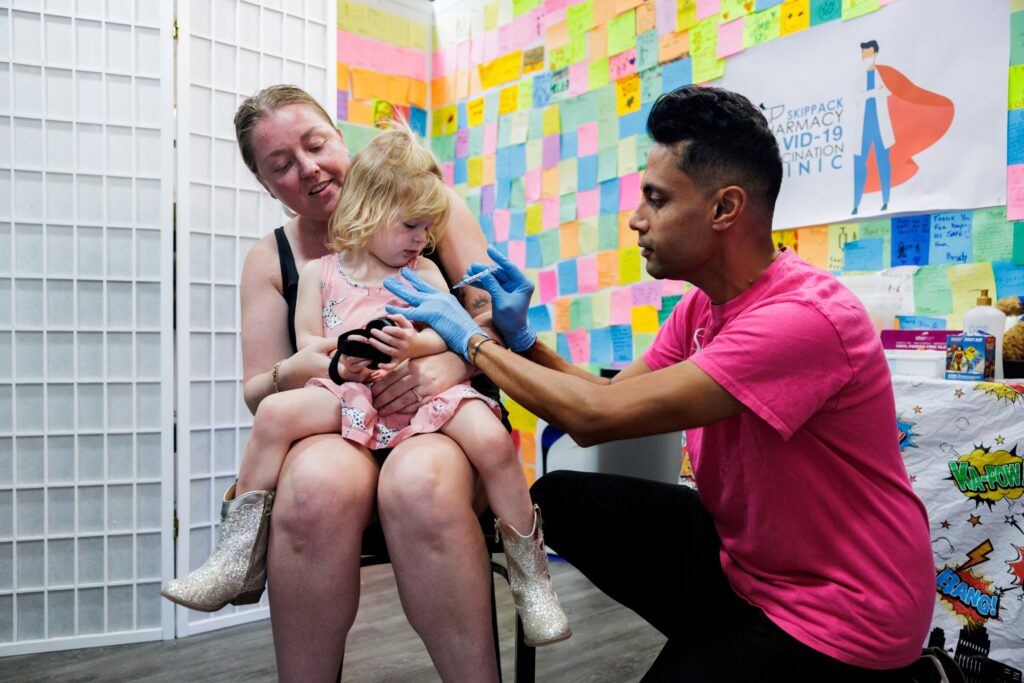
At Skippack Pharmacy, about 32 miles north of Philadelphia, pharmacist Mayank Amin said he has continued administering shots to children, particularly immigrants who need vaccines to attend school. Many of the shots are paid for through a federal program that pays for vaccines, which HHS officials have said will continue.
Among his patients, few have mentioned the CDC’s schedule change, reflecting that many parents take their cues from trusted local health providers, not the federal government, he said.
“The messaging [from the CDC] isn’t so strong anymore,” Amin said.
Some parents say they feel emboldened to ensure their children get their shots.
Sarah Lewis, 42, a nurse practitioner and mother of three in Columbus, Ohio, recalled discussing whether to space out shots with her pediatrician when her first child was vaccinated, because the number of shots felt overwhelming.
Ultimately, Lewis trusted her pediatrician, and her youngest child received vaccines on the CDC’s then-schedule. The CDC’s announcement hardened her conviction that her two youngest children, ages 1 and 3, must get timely vaccinations — she worries parents have forgotten about diseases such as measles that regularly infected kids.
“Everyone who questions vaccines need to take a step back and look at our past,” Lewis said.
Pediatricians have also had to reassure families that — for now — public and private health insurances will pay for the shots, as mandated by the CDC’s new schedule and promised by major insurers. But they also do not know whether that will remain the case months or years from now.
In Utah, Brownstein said she is worried that diseases such rotavirus and hepatitis A will come roaring back — and she’s had experience with both. Decades ago, her own children fell ill with rotavirus, which was the leading cause of infant diarrhea before vaccines. She took both children to the emergency room and one was hospitalized overnight for IV treatment.
In the 1990s, Utah once had one of the highest rates of hepatitis A, a liver disease, fueled by infections passed on to adults by children who contracted the virus in day cares, she recalled.
In Louisiana — where health officials have forbid vaccination promotion events and a member of the overhauled CDC vaccine panel who became prominent as a critic of coronavirus vaccines is now surgeon general — pediatricians and parents are seeing the effects of the vaccine debate, and its limits.
Among Medicaid patients at Nest Health, a company that provides health services at home for low-income families in New Orleans, nurses and doctors have continued administering vaccines for families along AAP recommendations — with few questions asked.
“People on Medicaid have bigger fish to fry than whatever the administration is doing” with vaccine messaging, said Rebekah E. Gee, a former Louisiana health secretary. “We’re just remaining clear and concise and sticking to our guns on what we think is the right thing to do.”
Louisiana’s state health department did not return a request for comment.
Baton Rouge pediatrician Mikki Bouquet this week met with a mother that delayed her infant’s vaccines by two months because she thought it was safer, which made the child to old to start the rotavirus vaccine, she said.
The mother also declined an immunization for respiratory syncytial virus, saying she heard on the news that it was optional and “not necessary.”
Although federal health officials said they were classifying the recommendation for RSV immunization to high-risk groups, they later clarified that otherwise healthy children whose mothers did not receive a maternal vaccine are considered high risk. In short, nothing had changed: doctors were still advised to immunize every newborn against the leading cause of infant hospitalizations, despite the confusion.
Bouquet didn’t push the vaccine issue, instead discussing the baby’s rash. “Hopefully, with some trust, we can bring up these topics again,” she said.
The post What happened after the Trump administration upended childhood vaccine planning appeared first on Washington Post.